Spinoza, Atheist
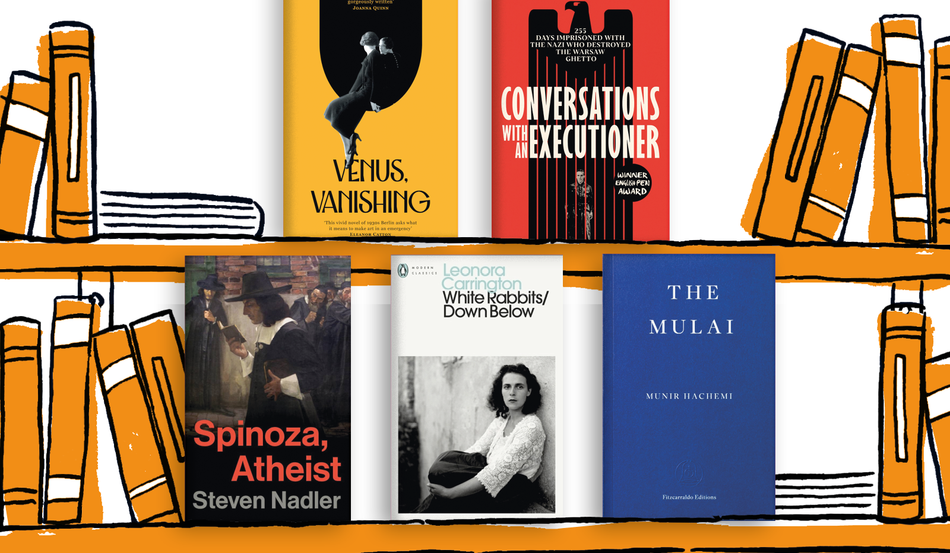
by Steven Nadler (Princeton UP, £25)
In 1656, when he was 23 years old, Baruch Spinoza was issued with a “herem” by the Portuguese Jewish community in Amsterdam. He was, in other words, excommunicated. The text of the herem was unusually harsh and was never rescinded. It condemned “the horrifying heresies which [Spinoza] was practising and teaching”. It did not wish him well. “Cursed be he by day and cursed be he by night; cursed be he when he lies down and cursed be he when he rises up.”
Baruch Spinoza was born into a Jewish family that had fled from Portugal to the relative tolerance of Amsterdam. At the time of the herem, he was a merchant, importing nuts and fruits. Later he became a lens grinder; dust from his work may have caused the lung disease that killed him, aged 44.
In 1670, Spinoza published Theological-Political Treatise. Fully aware of how inflammatory its contents were, the author kept his name off the front page, but his identity was soon leaked. The Treatise is now regarded as a foundational text of liberalism and secularism.
But to this day, Spinoza experts continue to debate the extent of his radicalism. In particular, is it fair to characterise Spinoza as an atheist? That is how he was condemned in his lifetime, though the issue is complicated by the term having a variety of meanings in the 17th century—someone could be accused of atheism for immoral behaviour.
Nonetheless, Steven Nadler, one of the world’s leading Spinoza scholars, makes a compelling case for Spinoza’s atheism as we would understand the concept today.
It wasn’t just that he denied the possibility of miracles, rejected the historical account of the Bible and disparaged rituals, as well as the notion that God rewards good and punishes evil. While he often talked of God, he equated God with nature, governed by laws of necessity.
Properly understood, argues Nadler, Spinoza’s god is empty of all religious meaning. He was indeed, as one of his contemporaries described him, “the greatest atheist who ever lived”.
David Edmonds
Conversations with an Executioner
by Kazimierz Moczarski, tr Sean Gasper Bye (Duckworth Books, £25)
This is a book that seems impossible in many ways. First, it focuses on the discussions, in prison, between a Polish freedom fighter and journalist, Kazimierz Moczarski, and the Nazi official responsible for the destruction of the Warsaw Ghetto, Jürgen Stroop, after Moczarski was imprisoned in the same jail by communist authorities. Second, it covers, often relentlessly, the horrors of Stroop’s crimes—including his wartime responsibility for the murder of more than 50,000 people and the torture of others. Third, the descriptions are meticulous in their detail, despite the difficulty of recording material in prison. Moczarski claims he “jotted down notes shortly after leaving prison and verified some elements of what Stroop said in archives and available historical records”.
Throughout Moczarski’s text—which is being published for the first time in the UK, thanks to Sean Gasper Bye’s translation—Stroop is never less than grandiose, despite the prison setting and the threat of execution. The journalist returns frequently to the “lead” in his subject’s eyes; flashes of which appear whenever Stroop is pressed too heavily on his position in the Nazi machine, though it likely started in his childhood. Stroop discusses his biography with Moczarski, from his early adoration of “physical force… strict internal discipline” to his belief that it is “wrong ever to oppose authority”, as well as his education in racism towards Eastern Europeans, the French and Jews.
After military success in the First World War, Stroop slowly climbs the ranks of German society, before joining with the Nazis in 1932—and personally meeting Hitler, Göring and Himmler. He is positioned in occupied Poland during the Second World War, appointed as SS and police leader of Warsaw—and it is there, during spring 1943, that Stroop orders the ghetto to be liquidated. Six years later, he shows little remorse for his crimes. The book is a bleak depiction of the personality of a war criminal—and the systems that made his appalling behaviour possible.
Juliette Bretan
The Mulai
by Munir Hachemi, tr Julia Sanches (Fitzcarraldo, £12.99)
Munir Hachemi’s second novel, deftly translated from the Spanish by Julia Sanches, is the story of an archaeologist sent to a distant planet to study a group of stranded space travellers, the Mulai. After 400 years of isolation, these former Earthlings have evolved in striking ways. They are untroubled by notions of property, power relations or regular working hours. They have sex when-, where- and with whomever they want. And they speak a strange language that changes by the hour.
Their name, which means “the tree comes”, is one of many Mulai words we encounter. (The planet’s four, randomly occurring seasons, for instance, are “telyu”, “ma”, “sif” and “kalima”.) Often unglossed, these can confuse at first, but then the archaeologist is confused, too. Chapters from the perspective of Mulai past and present also create challenges of comprehension, but the rewards of perseverance are great, with moments of humour and pathos aplenty.
Hachemi’s first novel, Living Things, was about the damage we are doing to the environment; and the harsh climatic conditions of the Mulai’s planet—which they endure by living in a temperature-controlled dome—point to the results of that. Yet The Mulai’s primary concern is language. Beyond the safety of the dome lives a group of violent and, crucially, speechless Mulai called the Brabat—a warning for what happens when language is debased and treated only as a blunt means of communication.
The utopia that has formed within the dome, by contrast, appears to stem from language being cherished, with the Mulai’s own tongue complemented by beautiful dancelike movements and an admirable disregard for economy of expression. At a time when language is being weaponised and creative writing marginalised, Hachemi’s novel is a powerful, necessary statement.
George Cochrane
Venus, Vanishing
by Rebecca Birrell (Picador, £16.99)
“Most paintings depict things that belong to other people,” muses the young narrator of Rebecca Birrell’s fiction debut, Venus, Vanishing. Set in 1930s Berlin—a place, the novel contends, of polyamory, partying and queer romance—Birrell is interested in the possession and legacy of art, especially for a lost generation of Jewish creatives.
Hannah Schmidt, daughter of a seamstress (“lower in her [mother’s] priorities than a stranger’s coat”), is Birrell’s painter protagonist. Hannah is a compound of various real-life female Jewish artists, from Charlotte Salomon to Gela Seksztajn, whom the author hat-tips in a historical note at the end of the text—a “corrective chorus of female creativity”. In some ways, the book follows in the footsteps of Birrell’s first publication, This Dark Country, a brilliant nonfiction work uncovering the lives of early 20th-century female artists.
Yet Birrell’s latest also has a tendency to romanticise the existences of her arty characters. In between sketching burlesque dancers on napkins and balancing two lovers, Schmidt’s “obsession” becomes Elke, an upper-crust housewife whose soldier husband is making inroads into government. The pair become her seductive patrons, meanwhile exhibiting her work under an alias that is a homage to the fascist thinker Dietrich Eckart. As antisemitic sentiment in Germany rises, this setup proves deeply unsustainable.
Birrell makes astute observations on the nature of art, desire and womanhood, while keeping hold of a sweeping, epic narrative. Her characterisations, especially of Elke and her clan of conservative wives, fall short—but the novel excels as a tribute to, as Elke’s husband vehemently calls them, “canvas-smearers without morals”.
Miriam Balanescu
White Rabbits/Down Below
by Leonora Carrington (Penguin Modern Classics, £9.99)
Born in Lancashire in 1917, Leonora Carrington was a debutante who ran away to Paris to live among the surrealists. She was muse to the movement’s founder, André Breton, and the lover of artist Max Ernst. In 1942, she moved to Mexico, which became her home for the rest of her life. Here, she painted and wrote—and, beginning in the 1970s, was taken up by second-wave feminists, leading to the admiration for her work that continues to this day.
White Rabbits/Down Below takes us back to earlier in her life, though. The eight short stories with which the book begins were written between the mid-1930s and the 1950s, while Down Below, although transcribed in 1987—Carrington “told” it to her friend, the writer Marina Warner—is a memoir of the time she spent incarcerated in a mental institution in Spain in 1940.
It’s an extraordinary narrative, one in which reality and dreams converge, her unbalanced psychic landscape mingling with the physical setting of the asylum. To read it as it’s presented here—after the stories—means that the reader is well prepared. Carrington’s fiction is every bit as fantastical as her paintings; populated by talking animals and weird crones with strange appetites. In the opening story, the young female narrator sends a talking hyena (wearing the face of the girl’s murdered maid) to her coming-out ball in her place, so that she can stay at home and read Gulliver’s Travels.
The worlds Carrington conjures up are eerie and full of violence. But then, so was her life. In 1940, Ernst was taken to a French internment camp, which triggered Carrington’s psychotic breakdown. She details her barbaric treatment, at the hands of the creepy Dr Morales, in Down Below.
Lucy Scholes