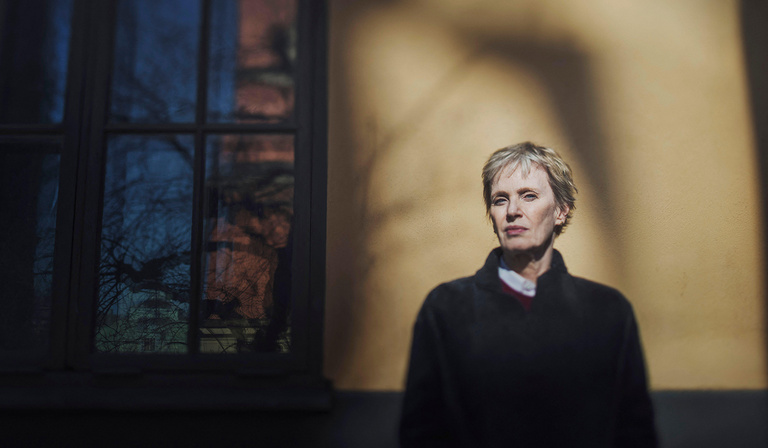
Siri Hustvedt has been described as a 21st-century Virginia Woolf. As well as being the award-winning author of novels such as What I Loved (2003), The Summer Without Men (2011) and The Blazing World (2014), she has written collections of essays and a neurological memoir called The Shaking Woman, or A History of My Nerves (2010) about her own experience of migraines and seizures. She is currently also a lecturer in psychiatry at Weill Cornell Medical College. Her most recent book is a memoir called Ghost Stories, about her long marriage to the writer Paul Auster and his lung cancer and then death in 2024.
She tells me over videocall from her brownstone in Brooklyn that, when it came to writing the book, “I burned to do it”. Although I had been wary of assuming the process was cathartic, she leans forward slightly and says, “I think that the feeling of incoherence and fragmentation that occurred right after his death, which I hadn’t expected to be as dramatic as it was, made it essential for me to seek the coherence and the form and the representation of writing itself. And, yeah, it burned. And I’ve been going back and forth about the idea, you know, of writing as therapy. I actually taught psychiatric patients, and I did come away from that teaching thinking, ‘Yes, writing in itself, has a therapeutic value,’ and this book definitely did for me, too.”
Hustvedt and Auster had met at a poetry reading in 1981, when she was 26 and he was 34. In her memoir, she writes, “I saw a beautiful man in a black leather jacket… My attraction to him felt like a blow to the back of the neck.” He was separated from his first wife, the writer Lydia Davis, with whom he had a three-year-old son, Daniel. Later, he told Hustvedt that he didn’t know what to make of her at first—a tall blonde in a black jumpsuit. She, on the other hand, was already “head over heels” that first evening. After three months of his relationship with Hustvedt, Auster returned to Davis for ten days. Hustvedt includes in her memoir the two letters she wrote to him during what she calls “our hiatus”. The cool-seeming blonde sounded ruffled: “I shall collect my earrings at an unknown future date and seduce the hell out of you. My humor is waning just a bit.” Auster returned to her and they were married in 1982, “days after Paul secured a divorce decree”, as she writes. At their wedding, a friend gave a toast: “To the bride and groom, two people so good-looking I’d like to slice their faces with a razor.” She comments wryly of the friend, “I wasn’t surprised when he disappeared from our lives.” The couple’s only child, Sophie, was born in 1987.
What happened to Auster’s son Daniel nonetheless haunts this book to some extent: he grew up to become a heroin addict and it is widely accepted that Hustvedt wrote a fictionalised version of her relationship with him in her novel What I Loved (2003), although she has never spoken publicly about this. There have been, as she says, some “lurid” accounts of what happened to Daniel in adulthood, so it seems appropriate to allow her to recount it in her own words. She writes: “The truth is I gag on our ‘antecedent trouble’, what Paul called the horrible things. Even putting into words what is a matter of public record and was publicised by countless media outlets in lurid stories around the world continues to feel nearly unspeakable to me. Paul’s 10-month-old granddaughter, my step-granddaughter, Ruby Auster, died on 1 November 2021. Six months later, when the medical examiner determined that the cause of her death was heroin and fentanyl, Paul’s son, my stepson, Daniel, who was alone with Ruby when she died, was arrested and charged with manslaughter, criminally negligent homicide and endangering the welfare of a child. He was sent to Rikers, released on bail, and hours later overdosed on heroin and fentanyl. He died on 26 April 2022. He was 44 years old.”
‘The real life story is much harder than the book’
As tragic as this is, a possibly unexpected aspect of the memoir is how close and loving the relationship between Siri and Daniel was, and she reproduces a handful of the many affectionate notes and letters she wrote to him when he was a child. When he was an adolescent, he nonetheless stole over $13,000 from one of her bank accounts. She writes, “He was still young. I loved him, and I forgave him.”
I ask her how difficult this relationship was for her to write about. She responds: “The reality, of course, is that this is something I’ve had to live with in my life, right? That’s infinitely harder, the real life story is much harder than, you know, than the book, right? And, I mean, I live with this every day of my life, don’t I?”
She also writes in the book that her daughter Sophie will have to live with what happened to Daniel forever. Sophie is a successful singer with a husband, the photographer Spencer Ostrander, and a young son, Miles, of her own, but I’m brought up short when I admit I had not fully considered the lasting impact on her. Hustvedt says, “He was her brother, yeah. I mean, where are the imaginations of people? This is what I want to say. Where the heck are they? I mean, I don’t read things like this in the newspaper and have anything but tremendous feeling for the people who are involved, you know. Is that me? Am I some kind of errant human being? I don’t think so.”
Hustvedt also had a terror of something happening to Miles, her grandson. I ask her if she thinks this is the way trauma works—that because Ruby, her husband’s granddaughter, died at 10 months old, that even though she didn’t understand the reason, she had an inbuilt fear that the same thing would happen to Miles? “Well, you know, I do mention anniversary reactions, which is a very common thing in psychoanalysis, it’s a very well-documented phenomenon and it’s almost always unconscious in the person and it usually then has to be pulled apart for the person to understand what’s happening. But, yes, I think that was an anniversary reaction and there were all these corresponding things; Miles turning 10 months old three years to the day that Ruby died was a pretty explosive coincidence that triggered something in me, and the terror that I projected on to Miles, of what had happened to the other baby… yeah, that doesn't go away.”
She began writing Ghost Stories only two weeks after her husband died and mentions in the book that even whilst grieving she has been able to think clearly. When I ask her if this is really true, she answers expansively: “I am a person who does not make this very old mind-body division. These are just conveniences. We talk about psychology and then we talk about physiology, but we’re these things all completely entwined, right? You can’t have a mind without a brain and, at the same time, you can’t reduce what we think of as mind to the brain, because the mind is also stimulated by all kinds of material outside it. So this kind of primitive reduction is a bad thing.”
There was nonetheless, she notes, a certain “radical disarray” created by Auster’s death. On one occasion, she got into a half-full bathtub with her socks on. She also found herself one morning waking up at the foot of her bed, something that had never happened before. She writes, “I woke up afraid. Where was I? After several seconds of high alarm, I understood that my head was at the foot of the bed and that my legs were pushing against the pillows. […] My husband died recently. The house, the bed, my body are out of whack.”
She says to me of this period, “I didn’t feel that my intellectual faculties were really compromised. But I did have, like, memory things; much lower-to-the-ground kind of memory issues that I called ‘cognitive splintering’.” She goes on: “I did read papers. I didn’t put it in the book, but there can be hippocampal shrinkage in grieving people. The little part of the brain that has been so associated with memory actually shrinks.”
One byproduct of grieving that she is grateful for is that, multiple times since he died, she has had an olfactory hallucination of Auster’s cigar smoke. He had given up smoking nine years before he died and yet Hustvedt smells the smoke, on planes, in her study and outside. It has been a deep comfort to her. When I ask her if it is has ever been disturbing to her, she explains: “No. I’m really quite rational and quite engaged in the scientific literature on this. But it was a tremendous, wonderful comfort. And I hope it doesn’t just vanish altogether, but it is becoming many, many fewer instances of this experience now, after almost two years.”
Multiple times since Auster died, Hustvedt has had an olfactory hallucination of his cigar smoke
On the day of Auster’s small family funeral, Hustvedt rode home in a limousine and then sat with her family in her back garden. It occurred to her that “the widow can do whatever the hell she wants”, so she went upstairs to lie down. As she lay there, she heard nothing but felt with absolute certainty that Paul was taking the last two steps up to the third floor and walking into the room. She writes: “It wasn’t the sick Paul who couldn’t walk but the well Paul from before the fevers, before cancer, before treatment. I didn’t see, hear, or smell him. He didn’t touch me, but he was palpably there in the room. He occupied exactly the same space he would have occupied in life. I knew he had come to make sure I was all right. And as he stood near me in the room, his invisible, adoring, concerned presence flooded me with a dense, plump happiness.”
Hustvedt and I have been talking about her grief for nearly an hour and I am aware I should release her shortly, not least because there is another journalist on the line waiting to interview her. At the start of our interview, I had also been conscious that, although she has chosen to write a book about the subject, our conversation may have felt intrusive, so I had begun by asking her whether she had seen Emerald Fennell’s adaptation of what she considers to be the greatest of all novels, Wuthering Heights. She admitted that she had avoided it. As we finish up, she returns to the subject, saying: “Take good care of yourself! And stick by Wuthering Heights and don’t let anyone else’s imagination get in your way!”
Which, if nothing else, seems a very Hustvedt kind of edict: don’t let anyone else’s imagination get in your way!