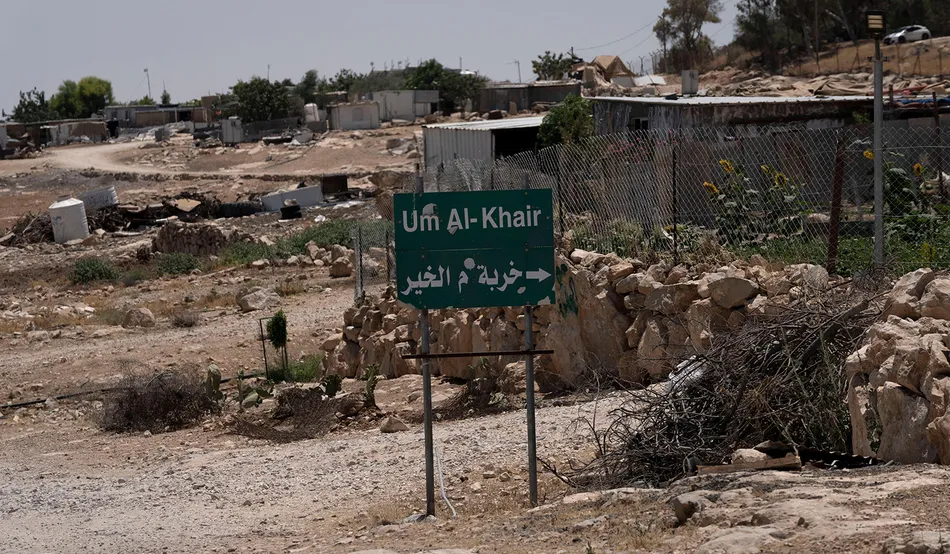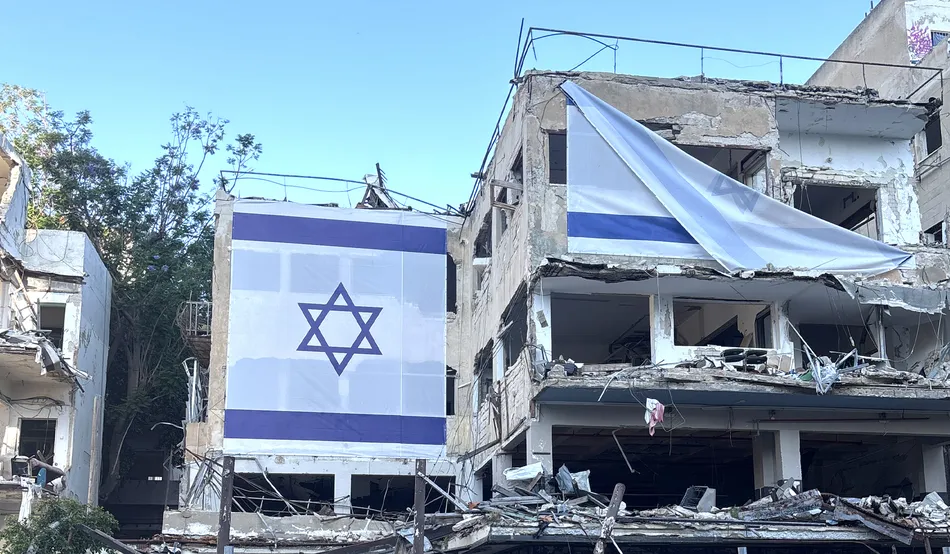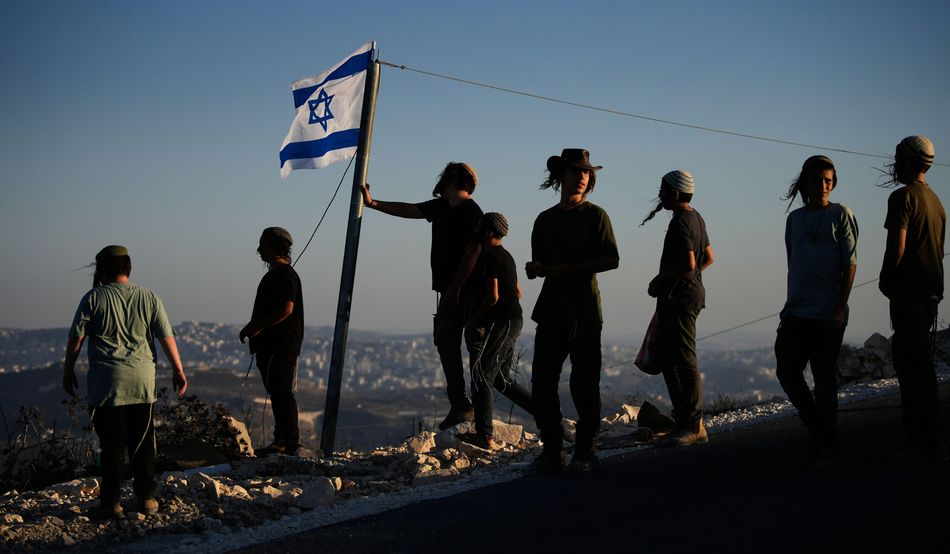
On 9th August, Israeli settlers surrounded three Palestinian homes in Ras al-Ayn, on the edge of the village of Qusra, south of Nablus, and did not leave. Twenty-one days later at least four people were still inside one house, cut off from water, electricity and supplies. Getting food to the villagers was an arduous process that could take at least three to four days. Instead of removing the settlers, the Israeli army erected three new roadblocks nearby. The siege continued.
The official framing from the Israeli state, repeated often in western media, is that this is fringe behaviour. Prime Minister Benjamin Netanyahu condemned the Qusra siege as “criminal acts of violence” by “a handful of rioters who are violating the law”. President Isaac Herzog and the foreign ministry issued similar statements.
It is a framing that the UK has now, in effect, written into policy. On 8th September the foreign secretary, Ed Miliband, launched what he had trailed a week earlier as a “comprehensive reset” of UK policy on Israel. The announcement included a ban on goods from illegal settlements; sanctions on those who build, finance and market them; sanctions on settlers who incite violence; and a refusal of new arms export licences that “materially contribute to the occupation”.
France and Canada announced parallel measures and other western governments pledged to follow. As the most significant shift in British policy in years, the bulk of the change targets the settlements. Settlement goods are estimated to account for less than 1 per cent of UK-Israel trade. Thus the UK’s wider relationship with the Israeli state carries on largely as before. Whether the ban is enough to change what is happening to Palestinians depends on whether the fringe explanation for settler violence is correct.
If it were, then these violent events in the West Bank are a law-enforcement failure, one in which the Israeli state has momentarily lost control of its most radical citizens. But that is not the case. What is, in fact, happening is that the Israeli state is carrying out policy through deniable means. Condemnations by state officials are not evidence of failure, then, but part of the process.
Riots do not require or use bureaucracy. The reality is that these settler campaigns, or pogroms as some have described them, are not usually spontaneous raids, riots or rampages. These are well-planned sieges and ultimately part of a broader state-led policy.
This has been well-documented by Palestinian and Israeli journalists alike. For example, last month Basel Adra, one of the filmmakers behind No Other Land, reported in Jewish Currents on a wave of livestock theft across the South Hebron Hills. Shortly after midnight on 21st August, in Khirbet Deir Sams, roughly 15 masked settlers attacked a family and opened pens holding close to 200 goats and sheep. The Israeli army passed nearby and, in the words of one witness, did nothing. Not a single animal stolen that day has been recovered.
The events Adra describes are not unusual. In July, in another village, settlers took some 227 sheep from their pens while soldiers pushed the owners back. Palestinians in that incident were arrested for merely seeking to prevent the theft of their animals. B'Tselem, an Israeli rights NGO, has counted 17 such incidents in 2026 alone, each flock worth tens of thousands of dollars. These are not mere thefts, as the livestock are not just property. They are a Palestinian herding family's entire productive base. The settlers and the state understand that if the animals are taken then the family will expel itself, having no means of income after that. The expulsion then proceeds quietly, without a bulldozer in sight. In fact, since the start of the Gaza war, a record number of Palestinians have been displaced from their homes in the West Bank.
Palestinians are also being pushed off their land under the guise of security. On 8th July the head of Israel’s Central Command signed an order seizing dozens of dunams of land from Bil'in and three neighbouring villages for a security road connecting the settlement of Modi'in Illit to a settler outpost called Sde Ephraim, as Oren Ziv reported for +972 Magazine.
Bil'in once was the poster child of Palestinian nonviolent action. The village sustained roughly 15 years of weekly protests against the separation wall (or as Palestinians know it, the “apartheid wall”) built by Israel along the Green Line and inside parts of the West Bank ostensibly to stop Palestinian attacks, but which expropriated a significant amount of the village’s land. The Israeli High Court eventually ordered part of the wall removed and the seized land returned, an outcome held up internationally as proof that nonviolence works.
Ironically, the new road connecting the settlement and the outpost runs directly through that returned land. Organiser Mohammed Khatib says the road is not the main objective: the point is the eventual seizure of some 600 dunams. As the Israeli rights lawyer Michael Sfard put it bluntly, the state does not “think twice about co-opting the security argument for purposes that are clearly settlement-oriented”. This claim is reinforced by the road’s route through a low area unsuitable for a true security corridor.
Finally, a third mechanism by which the Israeli state is able to control more land in the West Bank involves organised settler hiking groups. Such groups claim the right to roam wherever they want, including Palestinian villages and herding land. As one hiker put it, “Wherever the hiker’s foot treads, there the border will pass.” These groups do not ask for state permission but merely notify the army of their whereabouts, at times seeking official escort.
One such hike near Hebron ended when an armed “civilian security coordinator” shot and killed 17-year-old Karim Shalalda and wounded another Palestinian. Similarly, a 24th July hike near a village west of Nablus left six dead: two Israelis and four Palestinians.
What these incidents share is a pattern of coordination in which the state keeps declining to intervene against this supposedly fringe element of Israeli society. This is not the same as arguing that the state and the settlers are the same: Israel and its settlers are distinct actors performing complementary functions within one project.
Settlers can do what the state cannot do openly, without diplomatic cost. They can steal property, attack villages and even kill Palestinians in a way that produces displacement without the need for official decisions. And conversely, the state can accomplish the objectives of this shared project in ways the settlers can’t. The state can sign the seizure orders and declare state land, build roads and stand aside as settlers attack Palestinians, or even arrest Palestinians under attack instead of those attacking them.
What the state supplies, above all, is ambiguity. By being present but not intervening, it sends a signal to Palestinians that these crimes are sanctioned. It outsources the violence and repression in a way that is deniable. This will sound familiar to those who study other conflict zones; it’s the way paramilitaries are used in other places. Therefore the Israeli state does not need to coordinate the settlers too directly. It simply has to create the conditions that produce them.
Each incident also produces new realities that are difficult, or impossible, to reverse. Stolen livestock does not come back. Once a road is built it is hard to remove. A hiking route becomes a corridor, then a security zone, then land on which Palestinians can no longer farm. Finally, a siege needs no formal expulsion order, only a family concluding it can no longer raise children under such conditions. This is all annexation without the need for an official declaration.
The distinction between the state and the settlers, and the relationship between them, dictates how we should understand the solution. If this is fringe violence the solution is to target the settlers, as the Biden administration belatedly and ineffectively attempted. The US sanctioned some individuals, but this was not only incomplete, but also immediately reversed when Donald Trump returned to office. The UK’s reset, for all its significance, follows the same logic on a larger scale. It penalises the settlements and those who profit from them while leaving the state that plans, protects and expands them largely untouched.
If the events described here are indeed state policy carried out through deniable proxies, the solution surely becomes imposing a cost on the state itself. Every government with leverage professing concern over what is happening in the West Bank would need to direct policy towards the state of Israel, not just the illegal settlements. But because governments continue to limit their critique and policies to settlers, essentially choosing the “fringe rioters” framing, they are able to condemn the effects of these policies without cost to the state.
This matters well beyond the UK. London’s reset is already being treated as a template. If the UK model becomes the limit of what Israel’s partners are willing to do, it will send a clear signal that relations with the Israeli state can continue as normal so long as the “problematic” settlements are held at arm’s length.