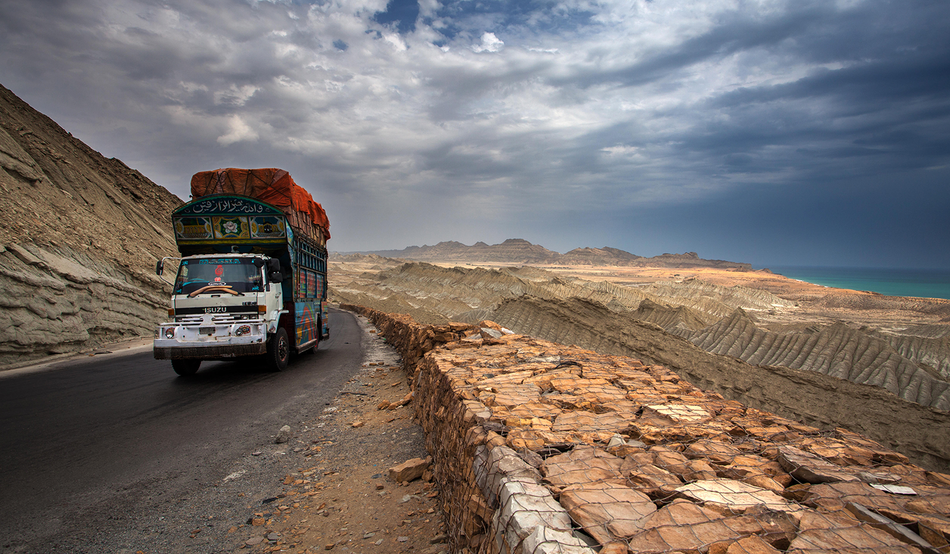
The US-Israel air campaign against Iran earlier this year significantly increased the strategic significance of a large landmass sitting between Pakistan, Iran and Afghanistan. With the Strait of Hormuz effectively paralysed by the conflict, the Makran coast of Balochistan—Pakistan’s largest province—instantly became the only viable maritime bypass for global shipping, as well as a strategic backdoor into eastern Iran. Straddling southeastern Iran and southwestern Pakistan, it is now arguably the most critical geopolitical real estate in South Asia.
For Pakistan, the region houses the Chinese-funded Gwadar port, essential to navigating the current shipping crisis. Meanwhile, Washington-based thinktanks such as the Middle East Media Research Institute have highlighted the resource-rich region as an ideal outpost for containing Tehran. And for the exiled leaders of the Baloch independence movement, the crisis represented the opportunity to court a new patron: the state of Israel.
Baloch separatism has operated within a familiar anti-imperialist framework for decades, drawing explicit parallels between its fight against the Pakistani state and Palestinian resistance under Israeli occupation. But today, the parallels are diverging.
This shift has been coming for over a decade. As early as 2013, prominent Baloch figures including Mir Suleman Dawood Jan, the Cardiff-based Khan of Kalat (the hereditary title for the former monarchs of the historical Baloch state of Kalat) began speaking about the alignment of Israeli and Baloch interests. “The world has interests,” he told the Tower magazine that year, “[The US’s] is that Iran shouldn’t be nuclear, and also that Pakistan be weak. I have my interests—independence.”
But a partnership between separatists and the state of Israel only became a viable political strategy after one of the most unexpected political manoeuvres in recent times: when, on 26th December 2025, Israel became the first UN member state to formally recognise the independence of Somaliland, angering regional neighbours in order to secure a strategic foothold on the Red Sea.
Following Israel’s recognition of Somaliland, prominent figures within the Balochi movement explicitly offered an independent Balochistan as a secular bulwark against so-called peace spoilers such as Pakistan, in exchange for Israeli diplomatic backing.
Hoping to capitalise on Benjamin Netanyahu’s desire to make allies, the following day, the London-based Free Balochistan Movement (FBM)—led by Hyrbyair Marri, the son of nationalist leader Khair Bakhsh Marri—issued a statement celebrating the Somaliland alliance and formally declaring his group’s own recognition of Israeli sovereignty the following day.
On X, Marri explicitly criticised Pakistan’s hosting of Hamas leaders and asserted that a “bilateral friendship between Balochistan and Israel holds immense potential to enhance regional stability,” setting the movement in clear opposition to Pakistan, Iran and Turkey.
In European exile hubs this realpolitik calculation has created intense debate, though the Baloch desperation for international leverage seems to be shifting the dial.
“Baloch are seeking help from anyone around the globe,” says Hassan Kosa, the vice president of the Baloch Advocacy and Studies Centre (BASC), a London-based human rights organisation which aims to expose systemic abuses against the Baloch people in Pakistan by security forces. He has lived in exile in the UK for 27 years after fleeing political persecution.
For Kosa, the movement’s willingness to accept Israeli support is born out of existential necessity rather than ideological alignment. “When you are going through miseries and you are dying, and anybody helps you, I think that it is justified to take that help,” he tells me. He adds that seeking such assistance is also justified under international law.
Kosa attempts a precarious diplomatic balancing act, carefully distinguishing between Israel as a geopolitical reality in the region and the actions of its current administration. “I condemn the atrocities and the things the sitting Netanyahu government is doing right now,” he clarifies. He rejects the notion that seeking Israeli aid equates to abandoning the Palestinians. “This is not a religious conflict between Muslims and Jews—it is a territorial dispute between Israel and Palestine,” he says. “Palestine has the right to exist in the same way as Israel.”
He also points to a broader regional hypocrisy that has left the Baloch deeply disillusioned with traditional Muslim solidarity. Koa argues that Pakistan and the Arab states consistently engage with Israel behind closed doors when it suits western interests, while remaining silent on the systemic abuses occurring in Balochistan. These range from the March 2025 arrest of protest leader Mahrang Baloch to the 2009 enforced disappearance and murder of her activist father, Abdul Ghaffar Lango, the 2010 abduction and fatal torture of pro bono lawyer Zaman Marri, and other “kill and dump” operations by security forces.
In Israeli strategic circles, the prospect of a relationship with Baloch separatists—both militant and non-violent groups—is pragmatic. A recent analysis in the Times of Israel framed Balochistan as a vital “pressure point” against Iran and Pakistan, echoing Israel’s historical strategy of seeking alliances with non-Arab and non-Muslim countries and minorities in the Middle East, sometimes known as its “periphery doctrine”.
But critics warn this alliance is counterintuitive. Writing for Al Jazeera, researcher Abdulla Moaswes argued that Israeli intelligence has historically aimed to co-opt secessionist groups to fracture transnational solidarity. For activists facing state pressure, Israel offers no immediate support. On the contrary, it endangers them by handing the Pakistani military and its Inter-Services Intelligence a pretext for violently suppressing domestic grievances and support for the claim that the Baloch movement has lost legitimacy because it has been infiltrated by “foreign agents”.
While exiled leaders in Europe seek support from Israel, civil resistance groups inside Balochistan—such as the Baloch Yakjehti Committee (BYC)—remain focused on daily survival against Pakistani state violence.
Geographical distance has provided the movement’s exiled leadership with the freedom to court controversial prospective allies, yet this risks endangering the population they represent. The Baloch diaspora is betting its future on the Somaliland blueprint. Whether this massive gamble secures the Makran coast for Israel or leaves the Baloch population used and abandoned will ultimately dictate the fate of South Asia’s longest-running insurgency.