I still remember walking through Cairo’s Tahrir Square on 11th February 2011, some 15 years ago. As I entered the locus of the mass protests to overthrow the government of Hosni Mubarak, a friend called me from the Gulf, asking if I could pick up a copy of the newspaper the next morning. He knew it would be historic and indeed it was. The following day Al-Ahram published a single, massive headline: “The people brought down the regime”.
I can still remember the euphoria, the hope and the optimism. Egyptians had done something that only weeks earlier no one had thought possible. Since then, I’ve spent most of my working life living across and researching the Arab world, watching how confidently outside actors predict what comes next in the region, and how consistently they get it wrong.
The populations of the Middle East are not some kind of abstraction, showing up only in the video game mock-ups of war on the Trump administration’s social media posts. They’re not mere props in someone else’s political argument. And when politicians in Washington and London push for military intervention, such as occurred in Iraq and as we are now seeing in Iran, it’s not people in the Beltway or Westminster who have to endure the aftermath. This helps explain the gap between western policymakers and many of those living in the region when it comes to the idea of regime change.
Whether or not the aim of this war is regime change seems to fluctuate daily, depending on the latest remark from Donald Trump, Pete Hegseth and Benjamin Netanyahu. But the idea that sustained military and diplomatic pressure on Iran could achieve what decades of sanctions could not—the collapse of the Islamic Republic—had indeed been gaining traction across western thinktanks and in government corridors in recent months (although neo-conservative circles in Washington, and certainly Israel’s prime minister, have been calling for this for decades). Given the Iranian regime’s record of brutality against its own people and beyond its borders, it’s understandable that this has been under consideration. Regardless, many in the region who do oppose the government in Tehran, still think this war is a rather bad idea. It’s these people, Iranians, Iraqis, denizens of the Gulf, who have the most at stake, and their perspective can be rather different.
Ask people across the Gulf what threatens their stability and they won't give you one answer. They’ll tell you, emphatically, that Iran is a major problem, and they’ll express genuine anger about what Tehran's allies have done to Iraq, Lebanon and Yemen. But they’ll also name Israel's drive towards entrenching its power in the region, and developing an Israeli paramountcy. This is something Israeli officials are now indicating far more openly, including the Netanyahu himself, who earlier this month spoke of “changing the balance of power in the Middle East”.
Oman’s foreign minister Badr al-Busaidi, speaking to local media last week, made this dual threat framework explicit. He condemned violations of Gulf sovereignty, but simultaneously declared the war on Iran illegitimate, warning that “its continuation keeps the countries that ignited this war in violation of international law.” He also said that the war’s true objective was not to curb Iran’s nuclear programme—negotiations had reached “very advanced stages,” including an Iranian pledge not to accumulate enriched material—but rather to weaken Iran, reshape the region, and “prevent the establishment of a Palestinian state.” Oman, he stated flatly, will not join Trump’s Board of Peace, and will not normalise with Israel.
This comes even as discussion continues in Western and Israeli policy circles about expanding Arab-Israeli normalisation, including the possibility of agreements with Saudi Arabia or even Syria. Yet after the last few years in Gaza, where Israel continues to answer charges of genocide at the International Court of Justice, the persistent bombing of Lebanon (which has now intensified and widened) and a new occupation of Syrian territory, Arab capitals writ large don’t see regional destabilisation simply through the lens of the threat from Tehran, but also with greater vigilance when it comes to Tel Aviv.
That kind of context rarely makes it into western policy discussions. Often, you’ll find western policymakers denying that Israel is even considered a destablising force by others in the region. If they want to understand how regional leaders and populations do see the state of play, however, they can’t ignore the threats they perceive.
Is it even possible to topple a government like Iran’s through a military intervention such as that launched by the US and Israel on 28th February? Removal of a government's leadership is not the same as changing a regime. A regime is also everything else—the military structures, administrative machinery, economic networks and webs of interests that have been aligned, sometimes violently, over decades. Remove the leader and all of that persists, or worse you get a vacuum, and who knows what might fill it.
The invasion of Iraq in 2003 is the perhaps the most obvious example. Saddam Hussein was gone quickly, but whoever decided to disband the Iraqi army and hollow out the state didn’t just remove a dictator; they destroyed the only institutions holding the country together. What filled the gap wasn’t the new Iraq that people in Washington had sketched out. It was militias, insurgents and foreign proxies, many of them backed by Iran. The intervention designed to push Iran back from Iraq’s door opened that door wider than ever. I remember the incredulity with which people across the region watched this happen in real time.
Syria taught another, albeit somewhat opposite lesson, which is just as important. After years of internal revolt and international isolation, Assad survived. For all the territory lost and all the fragmentation, the Assad regime’s security institutions stayed intact, and he had external backers in Iran and Russia. The state cracked in 2012–2013, and Assad lost control of much of the margins to revolutionaries and Kurdish nationalists, but the regime didn’t collapse then, either. It was only after more than a decade of civil war, after the slow hollowing out of the state, and the building up of alternative governing structures in Idlib in northern Syria, that it was possible to transform the country as revolutionary forces overtook the Assad regime.
None of those factors are present in Iran, which makes the notion of regime change there considerably harder. That difficulty is consistently underestimated by those who won’t have to live with the consequences if they are proved wrong.
The Islamic Republic was built, deliberately and carefully, not to fall when its leadership is struck. It is a system of overlapping, redundant institutions, each capable of functioning even when others are under pressure. The Islamic Revolutionary Guards Corps (IRGC) is effectively a state within a state, with its own military capacity, intelligence networks and economic empire operating alongside, but separate to, the formal government. This redundancy was designed to survive precisely the kind of military intervention launched by Trump and Netanyahu last month.
Over the past decade, the Iranian regime has taken massive blows. Qasem Soleimani, architect of the IRGC’s regional reach, was killed by the US in 2020. Iranian-allied forces in Lebanon, Syria, Yemen and Iraq have taken serious, even massive losses during this period. Iran itself has been struck repeatedly by missiles and airstrikes from without, and massive demonstrations from within earlier this year. And yet, the Iranian regime has continued to function and hold on to power. This is not a reflection of its popularity at home (it’s not popular), but of the fact that the regime was built this way. The core assumptions that have held Iran’s government together thus far are still intact: just enough popular support, a complete monopoly on the use of force at home, and enduring institutions that still function keep the regime alive.
All of this was blatant, and yet seemingly ignored by the people who planned this war. I’ve struggled to find serious analysts in the region who believe that this kind of pressure, combined with flying in exiled figures from the west, such as Reza Pahlavi, the exiled son of Iran’s last shah, or Maryam Rajavi, the Paris-based leader of the Mujahadin-e-Khalq opposition group, would produce a clean political transition. Reportedly, significant parts of Israeli officialdom don't believe it either.
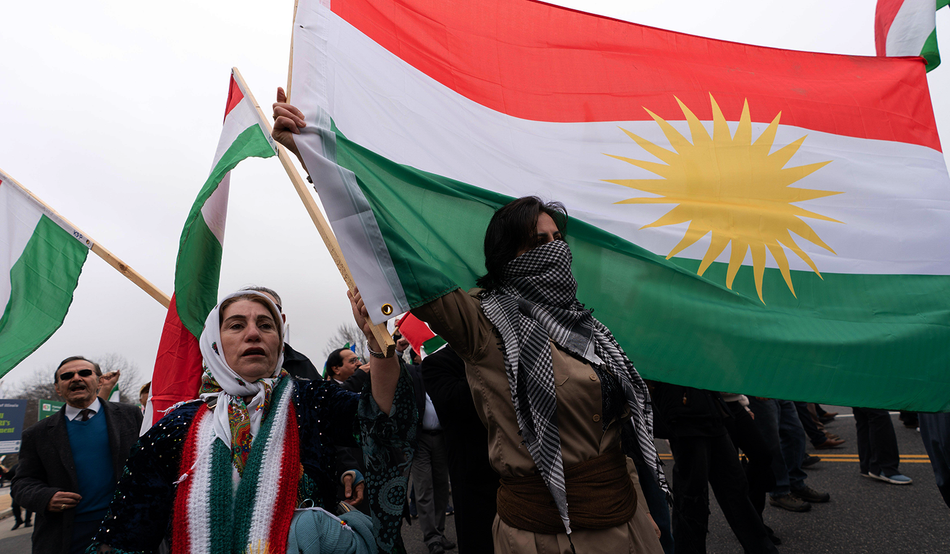
Then there’s the argument about fracturing the regime from the margins—pressing on the Kurdish communities in the northwest; the Baluch in the southeast; the Arab populations in the oil-rich southwest. But a system built for redundancy doesn’t shatter that way, it pulls back and consolidates. The repercussions of such an approach wouldn’t stay inside Iran. They would spill into Iraq, Turkey, Kurdish populations across borders and possibly Azerbaijan. It could eventually work out like Assad’s Syria, where the state is hollowed out after a decade or more of war, and alternative structures are built.
Yet another likely outcome is chaos. A collapsed Iran will likely produce a contest, with regional states and armed factions competing to fill an enormous vacuum. Iranian proxy networks, freed from central direction, could become something more fragmented and harder to track. Israel would be positioned to consolidate exactly the kind of regional paramountcy that Netanyahu has spoken of, and that neighbouring Arab governments are watching with alarm.
Meanwhile the remainder of Iran’s neighbours, Iraq, the Gulf states, and the wider Arab world, would be left managing a disorder they didn’t choose, weren’t consulted about, and can’t easily walk away from. Oman’s al-Busaidi warned explicitly of the global price, including higher oil costs and supply chain disruption. His sharpest observation may have been structural, however. Many countries in the Middle East know they are part of a broader plan, not merely spectators to an Iran policy, “but they are betting that going along with the United States may push them to amend their decisions and directions.” Alignment with the US is meant to deliver influence, but that hasn’t proven to always be the case, particularly when it come to this White House.
One senior Gulf official, Majed al-Ansari of Qatar, said, with a bluntness that I think surprised some of the people in the room, that “…escalation left unchecked in the region would lead to catastrophic results… This is exactly what we have said since day one. This is the biggest ‘I told you so’ in the history of ‘I told you so’s in the world.”
The question was never whether the Iranian regime is dangerous. No serious analyst disputes the instability and violence Iran’s government has wrought. The question is whether military strikes can actually change the regime, or whether it simply reshapes the threat into something the region, not Washington or London, spends the next decade trying to survive. Nobody pushing for the Islamic Republic’s collapse has answered that seriously.
The irony is that someone from Washington already said it plainly at the Saudi-US Investment Forum in Riyadh on 13th May last year: “In the end, the so-called nation builders wrecked far more nations than they built, and the interventionists were intervening in complex societies they did not even understand themselves.”
That someone was none other than Donald Trump.