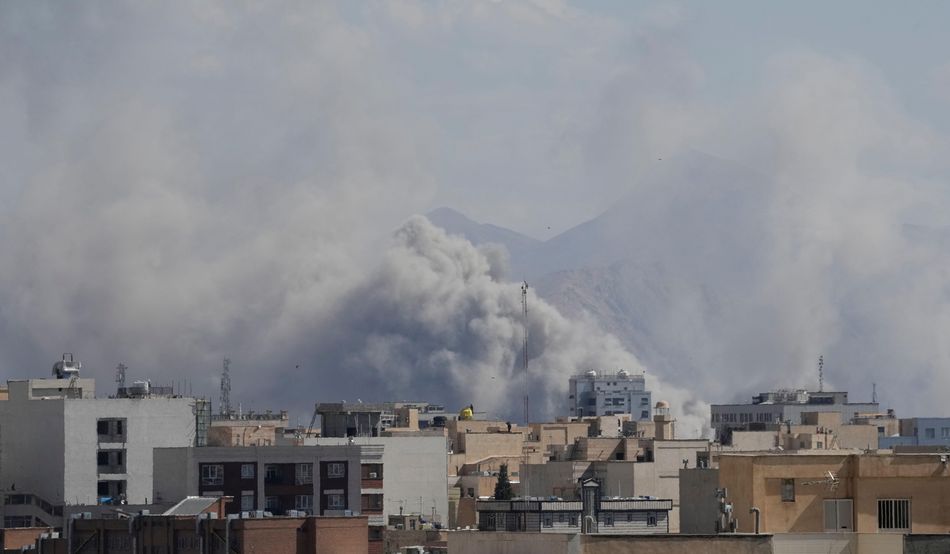
On 7th March Otto English, pen name of the writer Andrew Scott, posted on Bluesky in the social media site’s characteristic tone—that of a weary, slightly superior policy wonk dabbling in irony. “I wonder if a drone has hit Dubai Marina. Or whether it was just debris from a successful interception,” English wrote. “If only loads of Dubai based accounts, including Isabel Oakeshott’s, could tell me.”
Below were screenshots of social media posts responding to reports of an Iranian strike near the marina—a touristy part of town—all with the same wording: “No drone has hit Dubai marina. It was debris from a successful interception.” Freestyling, Oakeshott added: “Everyone is ok. I can see the building from my window and it’s fine and dandy.”
This wasn’t true. The debris that struck the 23 Marina tower also hit a taxi, killing its Pakistani driver (there are more than 1.5m Pakistanis living in the UAE, many of whom work in the transport sector). Iranian drone attacks have continued on the UAE, but in the context of a regional war that has already killed thousands across the Middle East, Dubai is not a particularly dangerous place to be, barring the kind of terrible, force majeure-strength bad luck suffered by that taxi driver.
Despite this, on top of its official responses, the UAE government has instigated a readily detectable PR counteroperation where influencers and other expats push out near-identical posts declaring that Dubai is safe and stable, and its rulers beneficent. Residents and tourists have also been warned by the attorney general not to post video of attacks or their aftermath, on pain of steep fines or even a prison sentence for “cybercrimes”. A 60-year-old British tourist is reportedly among those facing charges. Radha Stirling, founder of Detained in Dubai, told LBC that the authorities have effectively worked to “criminalise reality”.
I was there a few weeks ago, staying near the marina. My partner had secured some cheap flights and said that, if nothing else, I would enjoy some winter sunshine and a trip to the desert. But my first impression, in the taxi ride to our hotel, was of nothing so exotic. That it was as if a town planner had been so dazzled by the North Circular, particularly the brutalist stretch from Staples Corner to the Hanger Lane gyratory, that they decided to build a city to that template: a long stretch of motorway, flanked by swirling concrete overpasses and underpasses, high-rise office blocks, sketchy looking restaurants and retail units, car dealerships in glass boxes, and giant billboards.
At the mall I saw a group of my compatriots, perhaps commission-only estate agents (80 per cent of whom will return home within a year of arriving), buying lunch, all skin fades, Moss Bros and gym bulk. (And, no doubt, aftershave. Dubai reeks of the stuff, being full of jobs where dousing oneself in aftershave is very much the done thing.)
But they might have been influencers too. As Marina Hyde and Richard Osman explained on a recent episode of their podcast The Rest is Entertainment, the bar to being admitted to Dubai as an influencer is not that high and the criteria generously vague, including a proven content career, income from digital activities, and “strong engagement and measurable impact”. Being granted a golden visa—a scheme set up in 2019—is trickier. You will need to be, say, an established creator with an international audience, or a podcaster with measurable cultural impact, and in return you will receive ten years of tax-free residency, potentially renewable.
Dubai’s 50,000 content creators from across the world comprise a substantial chunk of the UAE’s economy. The government hopes they will account for around five per cent of GDP by 2031. Creators HQ, a facility that offers studios, back-office support, mentoring and training, was launched last year to help attract 10,000 more.
All of which is to say that many of these go-getting entrepreneurs receive generous state support. Including many of the British, the reality TV washups from Love Island and The Apprentice, the footballers’ wives, telling us they left the UK to escape the choke on free enterprise imposed by its bang-average levels of taxation, and the terrors of Sadiq Khan’s London (consistently ranked one of the safest major cities in the world).
As well as promoting Dubai as a luxurious safe-haven, migrants from Europe and the Anglosphere show that for a certain kind of westerner material comfort and tax-free income trump human rights, free expression or democracy. Without security, however, the whole deal collapses. “We came to Dubai to feel safe”, as the influencer Petra Ecclestone put it following Iran’s first attacks. Hence the “You live in Dubai. Aren’t You Scared?” campaign, in which posts end with images of Dubai’s crown prince and the phrase “No, because I know who protects us”. The precise terms of what an influencer might be asked or obliged to do, and whether that includes calling the crown prince Daddy, are private matters, but there is no question of who they are working for, and that it isn’t only for themselves.
Then again, knowing that what the influencers are selling isn’t wholly real—that the supercars and private jets they pose in are rented by the minute—doesn’t explode the fantasy, it enhances it: you can indulge an easy dream of an easy life and congratulate yourself for seeing through the fakery and coercion. As in other forms of entertainment we relish continuity errors; we are delighted when the walls of the set wobble. Clever us, for noticing.
One of the reasons we fixate on the wealthy, or those who play the part, is in order to discover that there is nothing to be fascinated by, and much influencer content caters to precisely this tension with a mix of banality and bling. Here, lives of luxury are also lives of dull, worry-free domesticity; “safety” again, but also of not having to fret if your bills go up or your boiler breaks. We are comforted, and enraged, that they are not more deserving than us.
Marina Hyde described influencing as “a loathed profession; a lot of the people following them are doing embittered detective work”. Offering yourself up for exposure and ridicule is a constituent part of the all-important engagement. The festival of schadenfreude aimed at Dubai’s influencers, much of it as bathetic and crass as their own responses to the war, merely accentuated something that was already part of their deal. The violent derision from across the political spectrum is merely a further expression of the establishment class’s habitual loathing of people who dare to incarnate or express something of the material aspirations of ordinary people.
Influencing is a grift, and grifting always takes its toll. If you don’t have other skills and professional avenues to pursue, a lot of the time it must be a shabby, boring, itinerant, insecure existence. For all its apparent solipsism, it is an exercise in permanently managing, or failing to manage, what others think about you. Some practical help, a tax break, and a bit of appreciation from the guys at Creators HQ might make that path less lonely, and less unstable, provided you keep to the rules.
Dubai was not for me, but I thought I could see something of its appeal, especially for young people. There is plenty for the inner or actual teenager to do, from water parks to endless fast food, to ogling supercars, to harvesting Insta shots in front of the Burj al-Arab hotel, to a night out at the Dante-esque TopGolf entertainment experience.
But more important than that, it might seem like a place where self-betterment is still possible. Dubai, unlike the UK, is not scared of the future. Rather, it seems to think the future belongs to Dubai. Why worry about climate change when you’re already living in a desert? Why worry about ecosystem collapse when you are reclaiming land from your overheated sea to build cookie-cutter novelty islands, and you have the brute sovereign wealth to confront whatever comes at you? Who cares what happens to the rest of the world, provided enough of it still shows up to help generate more wealth and enterprise, and all on your rules, your terms? And who cares about the rules-based postwar order when you’re an absolute monarchy with strict controls on freedom of expression?
In straitened, worrying times, you could say the influencers of Dubai, in all their tone-deaf hubris, provide an important public service: as lounger-dwelling tributaries of our hopes, frustrations and resentments. In this, if nothing else, they truly are creatives. Anyone serious about rebutting their indolent, selfish, incurious vision of the good life needs to show that better dreams are available—of purpose, true creativity, friendship, community, of serving something bigger than yourself. But they would also need to show that these things are possible.