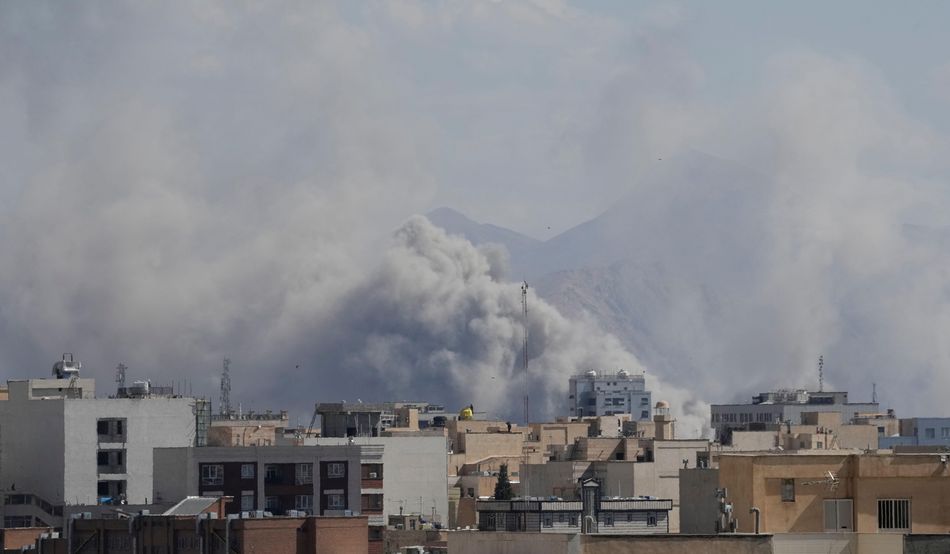
Events since the US-Israeli attack on Iran on 28th February highlight how for decades both the west and Iran have made a series of miscalculations in handling their relationship with one another. In Iran, the strikes on military infrastructure and on the regime’s senior leadership have led to the death of Supreme Leader Ali Khamenei and at least 550 civilians, according to the Iranian Red Crescent.
Tehran retaliated with drones and missiles fired across the region. Targets have included US military bases and civilian sites all over the Gulf and beyond, as well as a British base in Cyprus. There have been rockets and regular siren alerts across Israel since Saturday, with direct hits in Tel Aviv in the centre of the country, Jerusalem in the north and Beit Shemesh in the south, with at least 11 people killed. Overnight on Sunday, after Hezbollah joined the fray, Israel struck Lebanon, killing at least 31 people.
But while Tehran will likely not be able to recover from those past mistakes, western countries—chiefly the US, the UK and states in Europe—do have an opportunity to ameliorate the impact of their former lapses. Counterintuitively, the west should stop taking Iran “seriously”.
Throughout Khamenei’s rule, the Islamic Republic of Iran cultivated an aura of strength. It projected an image that did not fully match the regime’s changing reality. That image was not totally baseless; for several years Iran did exert influence across the Middle East through its network of proxies, as well as through soft power. It also invested in ballistic missile capabilities and had nuclear ambitions. And Iran collaborated with myriad terrorist actors, such as al-Qaeda, whose current leader reportedly still resides in Iran.
However, since the US-led invasion of Iraq in 2003, Iran succeeded in convincing most of the west that its might was greater than its true capabilities. At the same time, it was believed that, Iraq aside, Iran’s efforts at destabilisation would not threaten western interests. This led to widespread western complacency regarding Iran’s ballistic missile programme and its proxies, with Iran’s nuclear development becoming the west’s main concern. After Donald Trump withdrew from the nuclear agreement with Iran in 2018 and after the US killed Qassem Soleimani, leader of the Islamic Revolutionary Guard Corps’ (IRGC) Quds Force, in 2020, Iran began peddling the narrative that any attack on its soil would spark a regional war.
The threat of potential wider conflict was intended as a deterrent. And it worked. Most western countries accepted this as a fait accompli, even after Iran’s proxies were severely degraded in the aftermath of Hamas’s 7th October 2023 attack on Israel, and the ensuing US-backed Israeli retaliation. And the belief that upsetting Tehran would unleash havoc across the Middle East meant that most western countries ended up unwittingly facilitating the longevity of the Iranian regime.
Most of the west was also mistaken in thinking that diplomacy, sanctions and symbolic military action, of the kind seen during the standoff between Iran and Israel in April 2024, could change Iran’s behaviour. The truth is Tehran simply saw in negotiations an opportunity to buy time and sit out sanctions and limited strikes by unfavourable US or other administrations.
But decades of these dynamics also made the Iranian regime complacent. Tehran believed that its proxies were far more powerful than they actually were. This is why Iran ordered Hezbollah to enter the war against Israel in October 2023, resulting in the Shia militia’s defeat. And because Iran had recovered from the Iran-Iraq war in the 1980s, it assumed the regime could withstand any war with an external actor. Iran’s influence in Iraq, boosted by the military success against Isis and the dominance of Iran-backed militias in the country, reassured Tehran that it could stand up to the US.
When Trump returned to the White House in 2025, Iran assumed that his America First doctrine meant he had no appetite for large-scale war and that, despite Israel making it clear that it sees the Iranian regime as an existential threat, any US or Israeli act against Iran would be akin to the killing of Soleimani. Iran also thought that differences among Gulf Cooperation Council members would work in its favour. Iran interpreted disagreements between Saudi Arabia and the UAE on the conflicts in Yemen and Sudan as indicating significant weakness among its Arab neighbours.
All those miscalculations influenced Iran’s behaviour in the run-up to the 28th February. Iran thought it could stall, that the US and Israel would only engage in limited action against it, and that its Gulf neighbours were too divided and too weak compared with the regime’s delusions of supremacy. Despite the much-documented high-level infiltration of Hezbollah by US and Israeli intelligence that led to the killing of the group’s leader Hassan Nasrallah in 2024, and even after Trump publicly said last year that the US knows where Khamenei is, the Iranian regime continued to convince itself that it was untouchable.
Events since Saturday are moving at a pace that the existing post-Khamenei interim council of leaders in Iran is unlikely to have been prepared for. Iran seems to be continuing on the same blind path, with its latest order for Hezbollah to attack Israel only illustrating Tehran’s despair; the Israeli army’s response is certain to obliterate Hezbollah’s remaining military capacity and key personnel.
The Iranian regime is at its weakest point since the establishment of the Islamic Republic in 1979 and will not be able to recover politically, economically or militarily. The Trump administration has finally exposed the Iranian regime as a paper tiger. Iran’s wide-ranging retaliation is a sign that it would prefer to die fighting rather than surrender. It is time for the rest of the west to stop taking Iran’s exaggerated self-projection at face value. Germany, France and the UK have indicated that they could take “proportionate defensive action to destroy Iran’s capability to fire missiles and drones at their source” (and last night Keir Starmer addressed criticism about the legality of potential UK involvement). This is a step in the right direction. Whether it is proscribing the IRGC or supporting the opposition inside Iran, now is the opportunity for new western action that corresponds to reality.