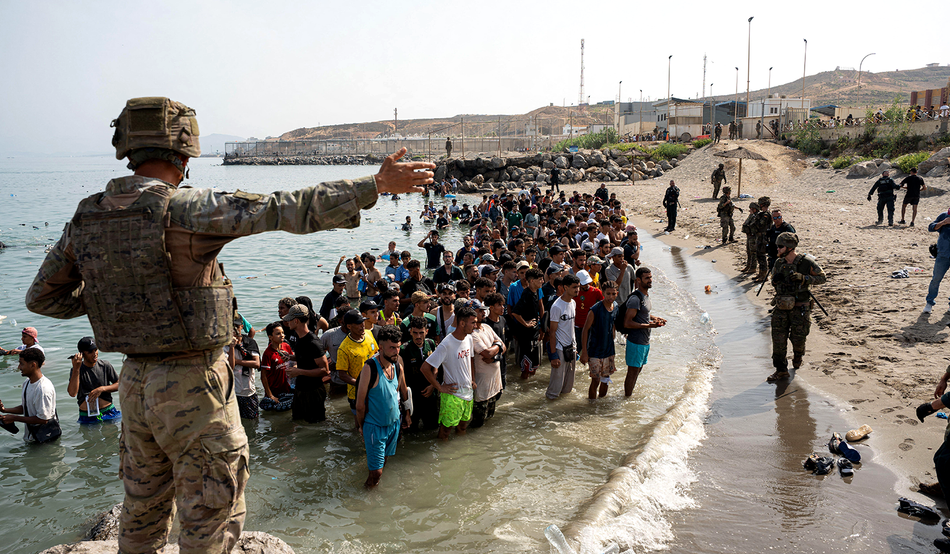
On 30th July, Europe’s right-wing populists received manna from heaven as images emerged of 78,000 people arriving on the shores of Ceuta, a Spanish enclave in North Africa. Having spent years warning that the continent faced an existential threat from an “invasion of migrants”, scenes of young men scrambling up the rocks to this small city-state gave them political dynamite.
No one can claim that what happened in Ceuta was not a disaster, with a death toll that some have estimated at more than 100.The local population also faced the near collapse of their public infrastructure, with hospitals, the sanitation system and migration centres overwhelmed. For Spanish prime minister Pedro Sánchez, this was a worst-case scenario. Having bucked Europe’s punitive trend on migration by regularising the status of 500,000 undocumented migrants in Spain, his liberal approach came under instant fire from those who sought to link it to the crisis.
These attacks were not entirely without basis. A few weeks before, the Spanish Supreme Court made a ruling that appeared to outlaw “hot returns” (a return without due process) for those who arrived in Ceuta from Morocco by sea. Reports suggest that social media misinformation about this ruling may have fuelled the sudden crossing, as well as a laissez-faire approach to enforcement by Moroccan border guards.
Nevertheless, within 24 hours, around 70,000 of those migrants had returned voluntarily to Morocco, and none of them are known to have reached the Schengen area. This, however, did not stop a vicious row breaking out in Europe, as 22 European member states signed a letter criticising Sánchez’s regularisation policy as a “pull-factor” for the influx and demanding tougher border controls. Italian prime minister Giorgia Meloni even called for Spain to be suspended from the Schengen area, and neighbouring Schengen states tightened border checks with Spain. Things looked bleak for Sanchez and his outlier migration policy, as he hit back at several countries for their “selfish” and “polarising” response.
On 4th August, however, in an emergency video call, EU interior ministers praised Spain for coping with the crisis. European Commission president Ursula von der Leyen commended Sanchez’s “swift handling” of the situation, while Danish immigration minister Morten Bødskov said he was “very satisfied” with Spain’s response. This was in contrast to earlier comments by Denmark’s prime minister, Mette Frederiksen, who sided with Meloni. EU commissioner Magnus Brunner said the crisis was “a test of our European resilience and of the security of our external borders”. But “for the time being,” he said, “Europe has passed this test”.
Europe is already undergoing its biggest migration reform in a decade
Europe’s politicians would do well to listen to him. The bloc is already undergoing its biggest migration reform in a decade, which has angered human rights groups. In June, the New Pact on Migration and Asylum came into force, introducing measures including: pre-screening checks before entering EU soil; accelerated procedures for rejecting asylum claims; and a mandatory solidarity mechanism to lessen the burden on “frontline” states for migration, such as Italy and Greece.
“For people escaping conflict, persecution or economic insecurity these reforms will mean less protection and a greater risk of facing human rights violations across Europe—including illegal and violent pushbacks, arbitrary detention and discriminatory policing,” said Eve Geddie, Amnesty’s head of the European Institutions Office and director of advocacy.
Europe should be more concerned with addressing these serious human rights risks than demands for further punitive measures. Take, for example, calls from Greek premier Kyriakos Mitsotakis to tackle the potential "instrumentalisation" or “weaponisation” of migration by states such as Morocco. These concerns are not unfounded. Given a recent deterioration in relations between Rabat and Madrid, and the seeming impossibility of such a mass crossing occurring without the consent of border guards on the Moroccan side, it is possible that Morocco was using the Ceuta crisis to send a particular message.
However, the solutions that hardliners are proposing may only exacerbate the problem, such as agreeing new migrant return hubs in countries outside the EU. “Externalisation regimes that rely on partner countries only exacerbate the threat of so-called weaponization," writes Helena Hahn, policy analyst at the European Policy Centre, as they increase the EU’s dependency on outside actors to control flows of people. This is not to mention that the pact already has a clause that gives member states extra time and flexibility to respond to cases of influx or “instrumentalisation”, which helped enable Spain to promptly deal with the Ceuta crisis.
But the debate rages on in Europe and beyond, with Donald Trump and other Maga politicians chipping in to criticise Spain. When I first saw the scenes in Ceuta, I feared they would ring the death knell for Sánchez’s progressive migration policy in Europe. He has, however, stood strong.
While Spain and the EU more broadly must calmly find ways to address the causes of Ceuta and prevent a repeat, this tragic incident cannot be used to advance a hardline migration agenda.
And those of us who want to see a more humane approach to migration should continue to watch Sánchez’s ambitious approach to regularisation with hope and interest. The test for that particular policy is yet to come, when 500,000 people gain legal status, and the impacts on Spain’s economy and social fabric begin to emerge. Ceuta was a fraught and tragic moment, but it was not that test.