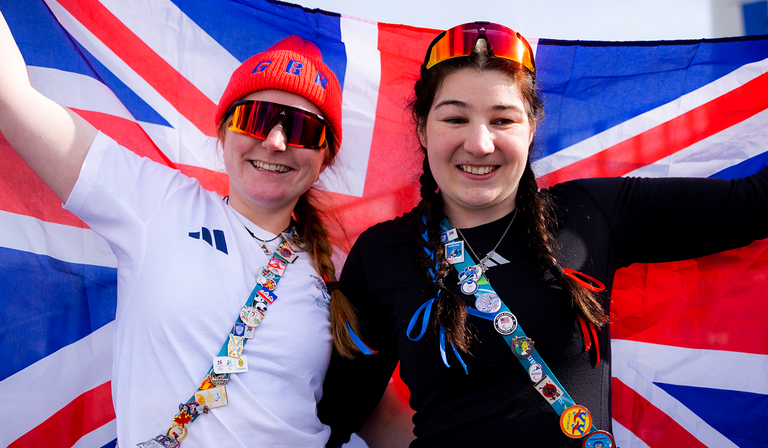
When requesting an interview with Menna Fitzpatrick, Britain’s most decorated winter Paralympian, I’m asked whether I’d also like to speak to her guide, Katie Guest. The question corrects a hidden assumption—a guide isn’t a coach or a support act, but a crucial half of an athletic duo.
By the time our video call connects, the two are seated shoulder-to-shoulder on a sofa piled high with cushions. Both wear ParalympicsGB kit (Fitzpatrick in red, Guest in pink). A window behind them reveals a crisp bluebird day and a glimpse of the white peaks of the Dolomites.
Fitzpatrick, 27, has described skiing with a visual impairment as a perpetual “snow blizzard”. She was born with no sight in her left eye and five per cent vision in her right. Introduced to the sport aged five on a family holiday, she first learned to ski guided by her father—an experience which helped build the psychological trust required with a guide today.
Guest, 30, also took up skiing during childhood in the Scottish Highlands, where it was a family pastime. She attributes a fierce competitive spirit to growing up alongside her older sister, two-time winter Olympian Charlie Guest, which drove her to consider skiing as more than a half-term hobby.
Guest has acted as Fitzpatrick’s guide since 2021. The following year, they won gold and silver at the World Para Snow Sports Championships, as well as the Overall Para Slalom world cup title.
When Guest contracted Covid just days before the 2022 winter Paralympics, they were unable to compete together in Beijing. With a stand-in guide, Fitzpatrick competed and won two medals, increasing her overall Paralympic tally to six.
But last December, Fitzpatrick sustained a major knee injury, once again threatening the pair’s chances of reaching the games, held this March in Milano-Cortina. In the end, her medical team deemed her capable of participating in the competition, albeit in a leg brace.
That they arrived together for the 50th anniversary of the Paralympics, with Fitzpatrick voted a flagbearer for the opening ceremony, feels significant.
While skiing, Fitzpatrick follows Guest’s luminescent sports bib at speeds approaching 70mph, guided by a Bluetooth headset through which Guest relays terrain changes, timing and gate cues.
When asked what communication sounds like on the piste, they both laugh and turn to each other with knowing looks. “Chaotic,” they agree.
Guest’s role demands constant multitasking—hurtling at high speeds, glancing back at Fitzpatrick, and anticipating the course ahead, while speaking clearly. Fitzpatrick’s job is equally as demanding: it’s to trust. To trust her skis, her training, and crucially, her guide.
Communication and trust, however, are built off the slopes. They’re formed at Fitzpatrick family dinners, or in Guest’s pointing out steps and the positioning of chairs. The duo take bonding exercises seriously: they’ve gone rock climbing and canyoning together and even trekked to the Everest base camp.
In the past five years, major brands have increased their sponsorship of para-athletes, but there’s still a disparity in how the two Olympics games are treated by British broadcasting. For Fitzpatrick, the main issue hindering public awareness of the Paralympics and para-sport more generally is not funding, but exposure.
“There are a lot of people I’ve spoken to in the general public who have no idea about the Paralympics,” she says. Visibility has “come a long way since where I started, but I think that para-sports should get more media [coverage].”
Ultimately, the pair view the competition as a celebration of para-sport, but also of the journey they’ve taken together. Earlier this month, Guest summed it up simply: “We’ve turned an individual sport into a team sport.”
Looking forward to the next 50 years, what will the future of para-sports look like? When asked whether human guides might be replaced by artificial intelligence one day, Fitzpatrick laughs, “I think it’s time for me to retire if that happens”. She’s only half-joking. Para-alpine skiing is less about advancing technology and marginal gains and more about partnership.
They come as a duo.