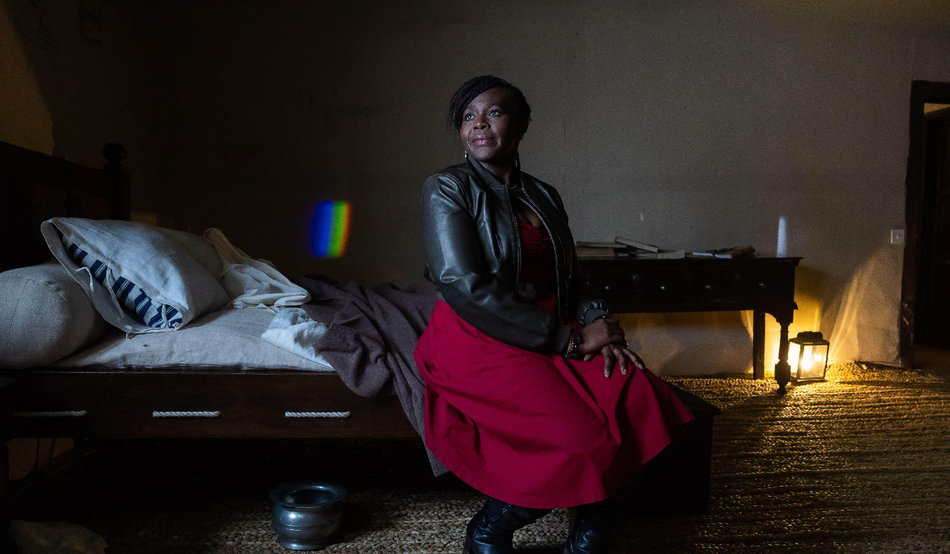
Before I can properly say hello to Maggie Aderin, she wants to apologise: the space scientist is about to take delivery of a new shed, so our interview might be interrupted.
In the end we are not disturbed. But the prospect of such a domestic event seems somehow too terrestrial for a person the British public has come to know for her deep knowledge of the universe beyond Earth and her eagerness to share it, both as an author and as a presenter of The Sky at Night.
While the BBC TV programme trains a lens on matters trillions of miles away, Aderin’s latest book looks in the opposite direction. Starchild: My Life Under the Night Sky, published this February, recounts its author’s journey to scientific success in the face of obstacles such as shuttling between the homes of her divorced parents and enrolling in 13 different schools, as well as more intangible challenges like prejudice.
Writing an autobiography was “never something I thought I’d be doing” and “far harder than I ever thought it would be”, Aderin tells me. “Some of the times I was looking back on were quite emotionally challenging for me to revisit… Fundamentally I was loved and nurtured, but mine was an unusual childhood, and I hadn’t realised quite how unusual.”
Aderin, 57, is used to feeling atypical: the sole black woman on her physics course at Imperial College London in the 1980s, she says she has often been odd-one-out in the “very white and male-dominated” world of space research. Yet her perspective on race and diversity has changed over time.
“Sometimes the onus is on the person who is ‘the other’ to try and fit in, and I think I’ve been doing that much of my life,” says Aderin, who received a damehood in 2024 for services to science education and diversity.
Institutions need people of colour, she says, to combat groupthink. “When [minorities] are ‘the other’ in the room, we shouldn’t feel on the back foot,” she says. “We should feel positive because we are making a powerful contribution…it’s something that’s needed.”
Aderin, who worked on the Nasa-led James Webb Space Telescope, has in recent months met US colleagues who have been on the sharp end of cuts made to research funding since President Donald Trump returned to the White House last year.
Those reductions have been accompanied by a rollback of diversity, equity and inclusion initiatives in the public and private sectors. “Science needs diversity, and if we’re reining back on that, science suffers as a result,” Aderin adds.
Aderin does not wish to discuss individual politicians but says she “find[s] it sort of terrifying. Progress had been made, but it sometimes feels like two steps forward, eight steps back.” She pauses. “I’ll be glad when this [presidential] term is over, I’ll put it that way.”
The answer to pressures on science, she suggests, is increased collaboration. “Nations need to unite and balance the push in one direction… Individually we have little impact, but when we work collectively that’s when things really happen. I’d like to see more of that collective mitigation.”
One of the latest organisations to team up with Aderin is the Royal Institution, whose purpose since 1799 has been scientific education and research. In December, she became its 200th Christmas lecturer—a gig she calls “one of the highlights of my life”. Featuring vivid demonstrations of magnification and a mini-rocket launch, Aderin’s three talks on the solar system captured her warm and unique approach to science communication, which has seen her speak to about 660,000 people in the past two decades.
All that work has left her “knackered”, Aderin jokes, while reminding her of the “resilience” that comes from persisting as a scientist in the face of failure. “The probability of me being here at this point in time was quite low,” she says, “but somehow it all came together. I find that always surprising.”