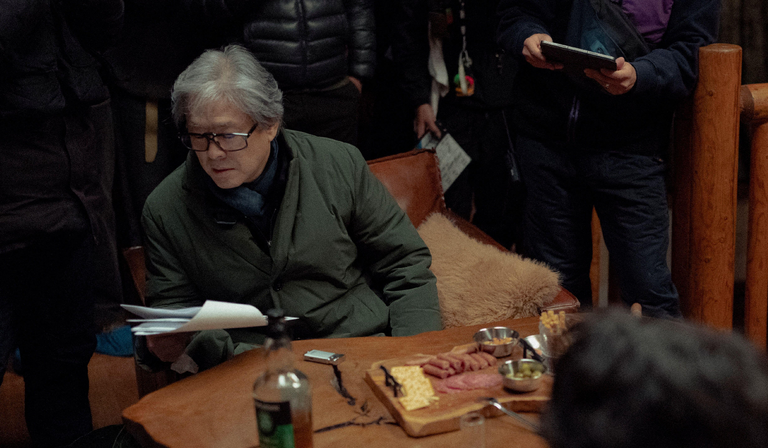
I’d been told before interviewing Park Chan-wook that, although he speaks good English, he prefers to use a translator—because he wants to make sure that his answers are “precise”. After speaking to him, I can confirm: “precise” really is the word. Precise in his responses. Precise in the fold of the blazer across his lap. Precise in the arrangement of glasses on the hotel table between us.
This precision is unlikely to surprise anyone who has seen Park’s work. Over the past quarter of a century, through films such as Oldboy (2003), Thirst (2009) and The Handmaiden (2016), the South Korean critic-turned-director has developed an aptitude for bringing exacting control—of camerawork, dialogue and editing—to crazy situations. “I put in a lot of thoughts and calculations leading up to a shoot and beyond,” he admits, dressed in dark monochrome that perfectly matches the clothing of the translator next to him.
But if this makes the 62-year-old sound like a desiccated calculating machine, he is not. His bearing, at least during our conversation, is intelligent but not intense. He laughs and smiles freely. He finishes his observations about his own method by adding, “But I think my attitude towards the bigger picture of any project can’t really be put into words… I think it comes from the heart.”
Again, this is evident from Park’s work—perhaps especially his latest, No Other Choice, which was South Korea’s official submission for the Best International Feature Film award at this year’s Oscars. It tells the story of a paper factory worker, Yoo Man-su (Lee Byung-hun), who loses his job and decides to murder everyone who stands between him and another role. And while the subject matter is as black as Park’s patent shoes, it’s also his most comedic film so far. Consider it a Kind Hearts and Coronets (1949) for the age of economic precarity.
Park has known something of this precariousness while making No Other Choice. He first read the book on which it is based, Donald E Westlake’s The Ax (1997), decades ago and immediately wanted to adapt it into a movie. “I even thought to myself,” he says, “if I were a really good writer, this is what I would have written. It almost felt like my own story.”
He then started talking publicly about the adaptation around the time of what is, to date, his only English-language feature, Stoker, in 2013 (though he has since directed two English-language television series, The Little Drummer Girl [2018] and The Sympathizer [2024]). There was a general assumption that, with Stoker done and Park feted by the likes of Quentin Tarantino, Hollywood would happily bankroll his latest endeavour.
Except it didn’t. And it is now 13 years later. When I ask Park what happened, it is the only time a note of exasperation enters his voice. “That’s a question that should be asked of the studio executives who make these decisions,” he says. “But if I could make an assumption… I think it’s because they couldn’t imagine the comedy of the film from reading the script.”
He ended up, of course, making No Other Choice in his home country, though you feel that the wounds have not fully healed. In the film, Man-su is laid off by a delegation of US businessmen; they’re the ones who trigger his killing spree.
That’s not where Park’s own spree ends, however. There is an even worse economic scourge in No Other Choice than those Americans—namely, artificial intelligence. “It’s very difficult to predict how it will continue to influence us,” says Park, “which is why I took a more sci-fi, futuristic approach when I introduce AI near the end of the film.” His vision, in that sequence, is of huge robotic machines cutting down trees to be supplied to unpeopled paper factories. The axe, it turns out, is coming for us all—with prejudice and precision.
No Other Choice is in cinemas now and will eventually stream on Mubi