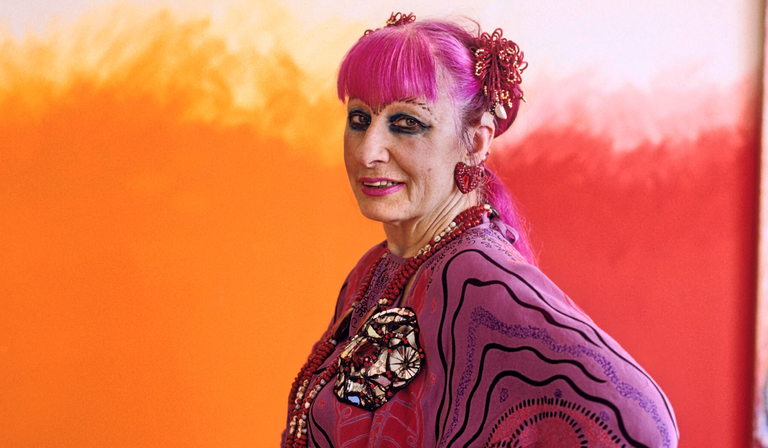
A shocking pink bob and bright blue eyeshadow form my first glimpse of Zandra Rhodes. Seated in her design studio in South London, Rhodes has just got back from Bath, where she has been viewing the work of her assistants and curator Rosemary Harden.
“Zandra Rhodes: A Life in Print”, which opened at the Holburne Museum in January, presents 34 vintage mannequins dressed in some of the fashion designer’s most recognisable screen-printed garments. Dating from the 1960s through to the end of the last century, the pieces chart key moments in her career, as well as wider shifts in the history of style. And Rhodes—who fielded queries from her team while she took part in a recent workshop in Jaipur, India (fittingly, the “pink city”)—is satisfied with the effort.
“I’ve been so lucky with some of the people I’ve worked with…it all came back to me when I saw them,” she tells me of the garments. Designed for figures such as Queen frontman Freddie Mercury and Diana, princess of Wales, the range includes the button flower coat worn by Joanna Lumley as Patsy Stone in Absolutely Fabulous.
The exhibition, which closes in May, is “exciting”, says Rhodes. “You realise just how much colour passed through my life…it’s very uplifting. I hope people will come away feeling very happy, thinking that fashion can be joyfulness.”
Rhodes, 85, has been a byword for colour ever since she founded her eponymous fashion house in 1969, applying her studies in textiles at the Royal College of Art to the realm of clothes. While she no longer manufactures garments, a vivid approach to working and living is as important as ever, even if, in Rhodes’s eyes, the world has grown duller over time.
“When I look back, I can remember that one would drift down the King’s Road [in Chelsea] in a floaty chiffon kaftan and probably a colourful headscarf,” she says. “Now, you’d be looking down the King’s Road and thinking, ‘Is there a colour anywhere?’ But it’s got to change again: we can’t have only grey or all white.”
“The only constant in fashion is change,” adds Rhodes, whose mother taught dressmaking. “I happened to have my first flowering when there were floaty kaftans... Then everything went a little more ethnic, and then punk came along and [French fashion designer] Thierry Mugler with the shoulders.”
It was a change of scene that gave Rhodes her big break—more specifically, travelling from London to the United States in the early 1970s. Brits were wary of buying clothes made by a textile designer, but Americans took her “at face value as a dress designer”, she recalls.
Rhodes, who received a damehood in 2014, is hopeful that “world travel keeps people coming here and that we’re not just a little island off of the edge of Europe”.
“We’ve got wonderful designers but they’ve got to get access outside,” she insists, calling Brexit “the most stupid thing that could have happened”.
“It’s not helped our youth… I was extremely lucky, because there was a lot more movement between the continent and America [in the early stages of my career].”
For Rhodes, the recent arrival of new talent to top roles in the fashion industry—witness Jonathan Anderson at Dior—is evidence that “the old order changes…maybe people are trying to look for new blood that will take us in a new direction”. But though design remains important, she says it is the people wearing the pieces “who make them feel wonderful”.
Beyond Bath, Rhodes is planning two exhibitions in the US and devoting more time to her foundation, but she has no intention of embracing a monochrome life.
“Colour makes me feel good… I find if I wear black, I blend into the background,” she observes. “I think if I went grey, I’d feel like a little old lady, so I’d much rather stay as a little pink person.”