Not so neet
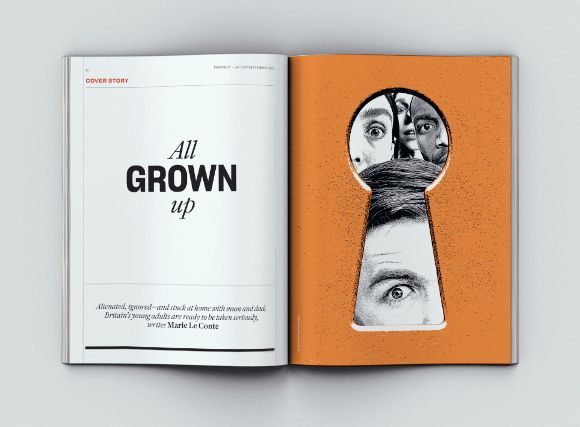
Marie Le Conte (“All grown up”, August/September) accurately describes the perfect storm that leaves so many young people feeling the traditional milestones of adulthood are out of reach. But while many such challenges are shared across a generation, those from disadvantaged backgrounds face a far steeper climb.
Long before encountering the housing market or rising living costs, many are left behind at school. Persistent absence, widening attainment gaps and unequal access to opportunities mean that too many leave education without the qualifications, confidence or support to enter employment. Here, delayed adulthood is less a cultural shift and more the consequence of structural barriers built over many years. Le Conte notes “a concerted effort from all sides of society to ensure that young adults are stuck in a teenage limbo”. We would go further. One element is a system that does not consistently support young people into work.
Impetus’s research on the youth jobs gap shows how forms of disadvantage can overlap. Young people with special educational needs, eligible for free school meals and fewer than five GCSEs are almost three times more likely to be not in education, employment or training (Neet) than average. And Neets are at much greater risk of insecure housing, poor mental health, financial dependence and long-term economic exclusion. The longer a young person spends Neet, the worse their outcomes, and every additional Neet costs the state £244,000 over their lifetime.
The story of Britain’s next generation is not simply one of delayed milestones but one of unequal opportunity. We need a stronger school-to-work pipeline that ensures every young person has a pathway into good work. Today’s young people must have the opportunity not just to grow up, but to thrive.
Susannah Hardyman, CEO, Impetus
Marie Le Conte (“All grown up”, August/September 2026) struggles for my whole-hearted sympathy. She has come of age in circumstances of plenty and opportunity, for those with the wherewithal to grasp them. Then again, perhaps it is the competition that is getting her down.
By comparison, my generation came of age in the 1970s in conditions of social and economic chaos too well known to need amplification; our parents in the wartime conditions of the 1940s. For what it’s worth, the first decade and a half of my working life were spent on the only jobs I could get. In due course I learnt enough to get the jobs I wanted. Possibly, Le Conte could do worse than buckle down accordingly—though then again, eight pages in a Prospect summer double ain’t so shabby.
Miles Saltiel, senior fellow, Adam Smith Institute
Britain’s new prime minister has a golden opportunity. Andy Burnham must do all he can to reinvigorate the industrial and retail landscapes of Britain and make work attractive for the young. Snobbery around certain manual jobs must be challenged: a cleaner is no less a valued hospital worker than a doctor; a kitchen porter is no less important than the head chef. Far too much importance has been placed on going to university. That’s at least one damning legacy of Tony Blair’s premiership. Many degree courses are a waste of time, while student debt averages out at tens of thousands of pounds.
In many ways, today’s school leavers have it good. Most working environments are a vast improvement on those of the past. Never has the British workplace been more welcoming for those with physical disabilities and mental health conditions, and employers have benefitted from their skills in turn.
Stefan Badham, Portsmouth
In your editorial (“Our next prime minister must govern for the young”, August/September) about the direction of the Burnham premiership, you start with David Runciman’s dictum that liberal democracy is a deal where voters support politicians in return for more wealth and health. The young may be missing out to older generations in regard to these material goods, but at a time of climate change, war in Europe and resurgent popular nationalism, an overarching, transcendent vision for our country was surely never more needed. Hope is always at a premium, but hope for what?
Mike McCabe, Chinley, Derbyshire
Morgan: a feeling
Please do not say Morgan McSweeney was a brilliant electoral strategist (“Labour’s hardest war is with the electorate”, August/September). In 2024, there had been three disastrous prime ministers in five years. Far from carrying a Ming vase across a slippery floor, McSweeney carried a space-hopper across a children’s playground, and in 2024 increased the Labour vote by a whopping 1.6 percentage points.
Clausewitz wrote that all military plans encounter “friction” and should be updated. Instead, Keir Starmer doubled down, again and again.
Abigail Maxwell, via the website
Wise councils
While I am strongly in support of a vibrant local government, including excellent support to councillors, I profoundly disagree that councillors should earn “a proper living” (“How much should we pay local councillors?”, Prospect online, July).
No sour grapes here. Having served as a council leader (Camden) and as chair of the Councillors Commission (as Andrew Stevens and Jack Shaw write, “the last thorough examination of councillor compensation”) I have no doubt that local government is much undervalued. But it is at its strongest when councillors represent all of their communities. To attract a wide group of able people from different backgrounds, it must be possible for them to do so. Many carers and people below retirement age either cannot or will not trade career and domestic commitments to be a full-time councillor.
Nor, in my view, is it necessary or desirable to have a bunch of full-time non-executive councillors. Well-paid officers run the council with oversight from councillors. Councillors need to be rooted in their communities, understanding and explaining issues both to and from within the council. Furthermore, a healthy democracy requires some turnover of its representatives, but if you are entirely reliant on a councillor income it is so much harder to stand down or even resign when appropriate.
My view, of course, is not popular within local government. After all, those in senior positions have benefitted from the current system, where pay has increased significantly over the last 20 years. But with both strong support within the council and effective organisation, it is entirely possible to balance councillor duties with work and domestic commitments. Our local democracy is the better for it.
Jane Roberts, London
Middling England
Gary Lineker gave a balanced outlook when he discussed England’s chances with Mishal Husain before the recent World Cup. He predicted England would not win, but said they had been knocking on the door in recent tournaments. Crucially, the ex-England striker said it was incredibly difficult to win the World Cup and results are defined by fine margins.
However, according to Stefan Badham (Letters, August/September), England players’ DNA is not to win. In the recent World Cup, England won five, drew one and lost one. That is more than respectable. Badham also said that the World Cup victory in 1966 was a fluke. Yes, England were helped by the controversial third goal in the final, but to say it was a fluke is outrageous and an insult to Alf Ramsey’s team. Failure is when England did not qualify in 1974, 1978 and 1994.
David Rimmer, Hertford Heath, Hertfordshire
Saad times
Matthew d’Ancona (“Meet the unempathetic man”, August/September) warns us not to ignore Gad Saad’s “suicidal empathy” theory and implies it has some value, not least as a check to performative “liberal” egoism. To identify too much with losers can not only be catching but fatal, is Saad’s warped idea. An essence of Trump permeates this marketing graduate’s petri dish of theories. One has to wonder, who or what came first, or are Trumpism and Saadism parasitically interdependent? D’Ancona warns that, like a mutating virus, theories like Saad’s will find a way to adapt and survive, propping up Trump-style regimes far into the future.
Had he read Tim Hjersted’s powerful counterfire, d’Ancona would have done us a service. Like a lot of right-wing theorists, Gad Saad is short on evidence. Hjersted summarises his “familiar reactionary trope” as “too much kindness equals weakness”, and adds, “Saad isn’t offering a neutral warning about policy trade-offs”. Importantly, “it redirects anger away from power and toward convenient targets: immigrants, Muslims, ‘woke liberals’, and anyone who resists authoritarian politics”.
Rosie Brocklehurst, St Leonards-on-Sea, East Sussex
Face value
Jane O’Grady’s insightful review (“The philosophy of how we look”, August/September) of David Le Breton’s book, Faces: A Cultural History, mentioned philosophical and cultural explorations of our faces from Shakespeare to Levinas and mirror neurons. Such accounts, however, neglect the experiences of those with impairment of facial appearance and function, which reveal so much.
What of someone born blind who has never known the face or, perhaps worse, someone who goes blind and loses the visual representation of others and facial readouts of emotional expression? What of those with autism who cannot decode facial movement as being expression? What of those with disfigurement who experience themselves mediated through others’ initial reactions? Perhaps most extraordinarily, what of those born without facial movement and expression; how do they develop identity and interact with others? Some years ago, I collected narratives of such experiences which revealed the relations between face and self in novel ways, (About Face, MIT Press).
Faces are often the provenance of philosophers and scientists pondering cultural, neuroscientific and cognitive aspects. But to reveal the face’s role in social identity and what might be called the embodied self, a parallel, essential form of knowledge is found in the experiences of those with impairments of facial appearance and function. These individuals are compelled to explore the face and its relation to self with a profound social and emotional depth. As French philosopher Maurice -Merleau-Ponty wrote, “I exist in the facial expression of the other…”
Jonathan Cole, Minstead, Hampshire
Defending the grid
Your sponsored article (“Defending Digital Infrastructure”, June) included the comment: “We can absolutely guarantee... if the power grid goes down, no telecoms service would work for very long”. As a former Central Electricity Board employee, I thought “How right you are!” The same applies to water, gas, sewerage system, hospitals, manufacturing. Over the postwar era we have built ourselves into a state of extreme vulnerability through pursuit of ever bigger turbines.
In the Second World War, extremely low bombing accuracy plus myriad small power stations kept the German and British grids in business. Unfortunately, drones, and cruise and hypersonic missiles could now rapidly bomb us back to the Stone Age, while both Putin and Trump have identified the grid as a legitimate military target.
I have long believed that there is only one answer: building an ancillary power network that is (a) highly dispersed: (b) does not rely on imported hydrocarbons or any movement of fuels; and (c) has the potential to deliver some basic level of electrical supply to its locality if the grid goes down. The approach would have to be bottom-up with the highest possible level of generation at point of use, be it homes, businesses, schools. At the same time we need widely dispersed, land-based wind and solar farms with a local switching capability.
From a military perspective, big is no longer beautiful, be it power stations, transmission lines or offshore windfarms.
Mike Waller, Preston on Stour, Warwickshire
Tithe barney
Alice Goodman (Clerical life, August/September) might like to be reminded that (a) thanks to the Parish Share operating in dioceses, ministry can be provided in places that could not otherwise afford it and (b) if she was minister of a nonconformist church she would only be replaced if her congregation could afford to do so.
Chris Skilton, retired archdeacon, Worthing
Correction: In our August/September issue the letter entitled “Depop happy” was mis-attributed to Sally Reckert, when the author should have been credited as Jonathan Hamston. We apologise for the error.