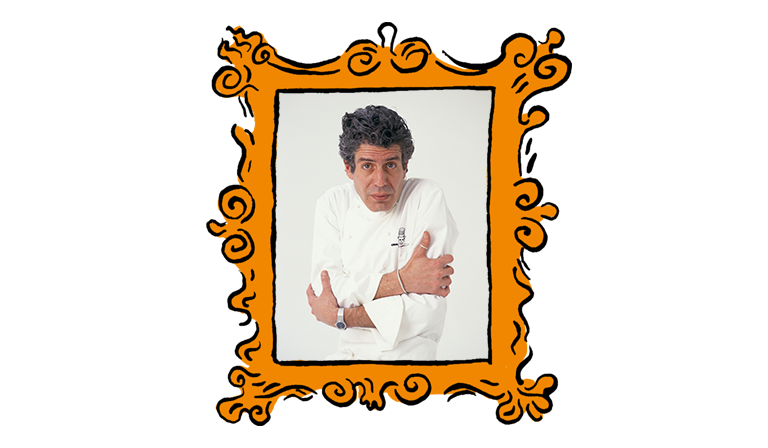
Anthony Bourdain would have turned 70 today. In the wake of his suicide in 2018, friends of the writer, chef and television host encouraged fans to raise a glass to “Tony” on his birthday, creating the unofficial holiday Bourdain Day.
His death has been no impediment to the growing space given over to his name under the “Food Writing” or sometimes “Travel” sections of bookshops. If anything, it has only driven the expansion.
Nestled next to the reissues of Bourdain’s own books are those that try to reanimate his spirit by sewing together his literary leftovers. These tend to be produced by people in his inner circle. Last year’s The Anthony Bourdain Reader came courtesy of his agent, Kimberley Witherspoon. The highly giftable World Travel: An Irreverent Guide was pieced together by his longtime assistant and collaborator Laurie Woolever.
These books have helped to perpetuate an idea of Bourdain as a singular connoisseur of places and plates. More relatable to the everyman than the average restaurant critic, he crosses with ease from street-food stand to Michelin star restaurant to the dinner table at a stranger’s home. It bears a lot of resemblance to his TV persona.
This depiction captures so much of what fans like about him. And yet: it also risks boiling him down to a thinking man’s Lonely Planet, a distillation of the voice of the most helpful Reddit comment you’ve ever read. It would not be a surprise to me if an AI Bourdain app, supposedly trained on his philosophies, has already been vibe-coded into existence (his voice was already recreated with the technology for the 2021 film Roadrunner). The direction of the Bourdain publishing cottage industry has been towards products that can be displayed by people who put “travel” and “food” as their interests on Hinge.
None of this really captures the seemingly complex man whose voice we read in his own works. So it is not surprising that other posthumous Bourdain books reckon with the less palatable sides of the chef.
Almost as soon as the hagiography of Bourdain began, so did attempts to undercut it. In his memoir, In The Weeds, Tom Vitale, the producer of Parts Unknown, reckons with Bourdain’s bullying behaviour towards his crew on that show. “Tony’s leadership techniques were CIA caliber: duplicitous, unforgivable, possibly criminal, and usually extremely effective,” Vitale writes. It’s a loving, fraught reflection—like someone mourning a family member with whom they had a complicated relationship.
Then there’s Charles Leerhsen’s controversial biography, Down and Out in Paradise. Some reviewers found it cynical and callous. Its focus is heavily on his final days and puzzling out what led him to take his own life in a way that would certainly not pass suicide-reporting guidelines. But Leehrsen argues that he is spotlighting what “Bourdain, Inc” would prefer to leave unmentioned, and that “when we try to pick and choose the lessons to take from a life, we begin to construct a lie”. This, he says, is contradictory to what the man himself would have wanted.
This whole business of how to preserve Bourdain-ness has itself come in for satire. A 2022 novel, The Lemon, was written by three friends under the pen name SE Boyd. Rotating around the death of fictional food TV personality John Doe and the struggle to keep his legacy intact, it contains barely disguised fictionalised avatars of Bourdain’s inner circle, including Witherspoon and the chef Eric Ripert. It does a good job sending up the culture of foodie fandom that surrounds Bourdain very well; one plot involves a reporter lying about having dined with the late celebrity at a Georgian restaurant, accidentally turning the business into a pilgrimage spot for fans, who rhapsodise about a bean dish he never tasted because they believe he loved it. Yet the book also borders on mean-spirited in its representation of real people. Every character is a basket for self-interest and cynicism.
The funny thing is that even books that take a more sceptical view of Brand Bourdain end up feeding into his myth. Evidence of his grouchiness with his crew becomes evidence of his commitment to a high standard. Questions about whether he embellished retellings of real-life events only underscore his skill as a storyteller. Misjudged relationships further the impression of a tortured soul. The more flawed and tragic, the more compelling a figure he becomes.
It is worth remembering that this reckoning with Bourdain’s legacy plays out primarily for the most obsessed of his fans (can you tell that I am one of them?), and that the most listened-to voice on the subject of Anthony Bourdain is Anthony Bourdain himself, in his published works.
The jewel of that canon is, of course, Kitchen Confidential. Published in 2000, it capped a decade that had begun with Marco Pierre White’s White Heat and seen a subsequent revolution in the cultural image of the chef.
The food writer Jeff Gordinier calls it an echo of Nirvana’s Nevermind. “One day chefs were fat, crusty old Frenchmen and toques; the next day, which of course really amounted to a whiplash succession of years, they were auteurs, scallywags, Picasso punks, the cast of Trainspotting, shortening their lives with pork belly instead of smack,” he writes in his book Hungry.
Kitchen Confidential remains, 26 years later, the work that will sustain Bourdain’s hungry ghost. An active Reddit forum for kitchen workers is named in its honour. It looms in the background of any cooking memoir; the upcoming Knives and Spoons by Alasdair Gill even features an encounter with the man himself. In TV, The Bear owes the book a conscious debt, while the upcoming attempt to put something of Bourdain’s life on film, Tony, is adapted from chapters of the book.
Kitchen Confidential is the text that readers will keep returning to for a flavour of the real Tony, and they will find a reminder that for, all that surrounds it, there’s nothing like the proximity to the high heat of kitchen life that it offers. “Writing and making television, no matter what some whining dipshit may tell you, is easy,” Bourdain wrote in an afterword to the 2006 edition. “Cooking is hard.”