At Christchurch Mansion in Ipswich, two of the paintings that meant most to John Constable hang (as intended) side by side. Painted in the late summer of 1815, they depict the flower and kitchen gardens of the Constable family home in East Bergholt, seen from an upper window. Washed in soft golden light, the beds, fields, hedges and woods that stretch away into puffy passing clouds seem to compose an archetypal idyll for this artist, for this area around the Suffolk-Essex border—even for an idealised rural England itself. Aptly, the grandson of Thomas Cook—whose firm began running tours of “Constable Country” in 1893, 56 years after John’s death—once owned these works.
Yet grief, sorrow, even the threat of violent ruin, crowd around the frames. These landscapes are elegies, and farewells. Constable’s mother Ann had died in 1814; his father Golding—one of whose three profitable mills (two water, one wind) lies in the background of the kitchen-garden scene—would follow in 1816. A few weeks previously, the Battle of Waterloo had not only shifted the course of European history but killed one Constable cousin, James Gubbins (another survived). Soaring grain prices (good for Golding’s business) and the Enclosure Acts had led to periodic riots in this corner of Suffolk: Constable was kind to people of all sorts but remained (to some devotees’ continuing discomfort) a Church-and-King Tory, albeit one who “hated politics”.
Endings, however, meant beginnings. Inheritances gave Constable the means to marry his longstanding sweetheart, Maria Bicknell, the (socially superior) granddaughter of the snobbish and truculent local vicar, Dr Rhudde, whose rectory we can spot beyond the garden’s edge. Constable wrote to Maria in 1815 that he was “endeavouring to catch the last of this beautiful year”—the last, too, of his protracted youth. These surpassingly—to some critics, excessively—pretty pictures encode loss, yearning, regret. Constable wrote not just that “I should paint my own places best”, but that “painting with me is but another word for feeling”. The “view” moves inwards as well as outwards.
A latecomer to fame, finally wed in 1816, Constable soon started to paint the stupendous “six-footer” landscapes—epic treatments of everyday themes—that would wow artists such as Géricault and Delacroix. By 1824, the former apprentice miller, not posh enough for the rector’s granddaughter, took a gold medal at the Paris Salon. Lucian Freud, a fervent admirer, thought the last of the iconic “six-footers”, “The Leaping Horse” of 1825, “the greatest painting in the world”. To his enduring chagrin, however, Constable was only elected a full member of the Royal Academy in 1829: 27 years after JMW Turner’s honour.
Constable’s 250th anniversary year—he was born in East Bergholt on 11th June 1776—has seeded a clump of exhibitions that allow us to view the progenitor of English pastoral in a fresh, and cliché-clearing, light. Before it closed in April, Tate Britain’s far-reaching Turner and Constable show joined the pair in a series of striking juxtapositions. It still endorsed the old idea of deep-seated rivalry, or emulation, as a key to understanding both men. For sure, there could be bristle and needle when they clashed: as when Turner upstaged the Suffolk man’s work with a late dab of red on an adjacent piece of his own at the Royal Academy. “He has been here,” grumbled Constable, “and fired a gun.” But Turner called round to congratulate his “rival” on the night of his RA election, and stayed until 1am.
The anniversary projects for Constable 250 reveal the artist before, and beyond, this duel. At Christchurch Mansion, Constable: A Cast of Characters roots the miller’s son in a rich local soil of extended family, patrons, friends and fellow practitioners, such as the gifted Ipswich artist George Frost. He managed the Blue Coach transport service to London (first departure: 7am) while not drawing or painting. Constable grew up not in some rustic backwater but a plugged-in powerhouse of advanced agribusiness. His miller father also owned barges, “lighters”, that carried flour or bricks down the Stour—widened and canalised for navigation in the 1710s—for transfer to London-bound vessels. Among the products ferried the other way was metropolitan “night soil” (in other words manure, probably mostly equine) to fertilise those sumptuously picturesque Suffolk fields.
The sweet landscapes on the Stour around Flatford and Dedham (acquired by the National Trust from the 1940s) were not charming leftovers of quaint rural ways. They hosted sites of buzzing industry. Constable painted a mill or lock as an artist today might depict a data centre or roundabout. He reverenced nature as “another word for moral feeling”, but it bore in every vista signs of productive human labour and design.
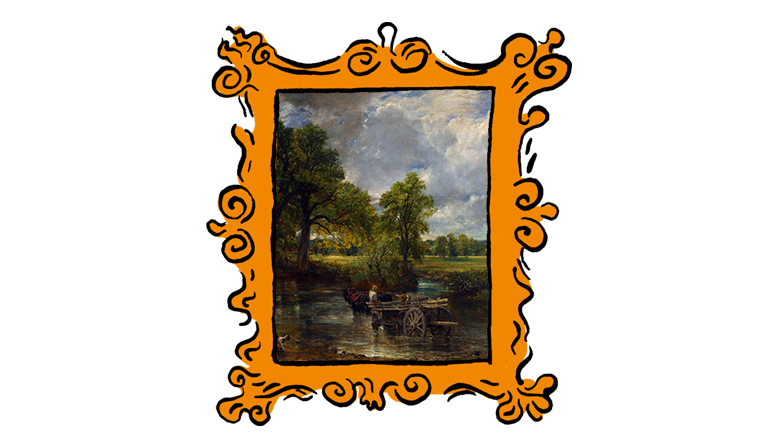
The Stour of The Hay Wain in 1821 had been a narrow mill stream until a century before. Flatford Mill, one of his trademark transformations of the working countryside, bears the utilitarian subtitle “Scene on a Navigable River”. It also serves as a kind of inventory of Constable family properties. Not only did Constable spurn the “sublime” wildernesses of peak and forest that thrilled many of his Romantic peers; decorative, idle country estates repelled him. “A gentleman’s park is my aversion. It is not beauty because it is not nature.” “Nature” became itself through cultivation: the work of soil, sun and hand.
In Ipswich, A Cast of Characters plants the local lad in a context of fertile influences—domestic, artistic, scientific and industrial. Its pattern of connections and continuities extends to haunting recent alabaster sculptures by Sasha Constable: John’s great-great-great granddaughter. Over in Sudbury, at Thomas Gainsborough’s house-museum, the exhibition Gainsborough, Constable and Turner: Inventing Landscape traces the evolution of the genre that Constable raised from sideshow to high-status main event.
Constable loved and honoured Gainsborough, whose landscapes—like his own—aimed to deliver not topographical accuracy but the expression of “a fine sentiment”. In this company, however, the two Suffolk painters still stand out for their avoidance of the crags, torrents and cliffs that enthused other landscape pioneers: not only Turner, but contemporaries such as Thomas Gilpin and John Glover. The free, bold and fluid brushwork of Gainsborough’s woods and streams opened a stylistic gate. Constable romped through it. The Leaping Horse itself makes a spectacular climax to the Sudbury selection. A humdrum event along the trade highway of the Stour (landowners’ fences frequently disrupted passage on the towpath) becomes a grand, heroic gesture, witnessed by the—artfully repositioned—church tower at Dedham. Under those ever-changeable skies, superbly rendered, daily toil itself grows sublime, even sacred.
Constable had little sympathy for political upheaval (he feared that the mild 1832 Reform Act might empower “the rabble and dregs of the people”). His art, on the other hand, achieves audacious radicalism. It finds drama and nobility, even a kind of transcendence, not just in the landscapes of mundane labour but in the objects and elements that enable it. “The sound of water escaping from Mill dams,” he wrote, “Old rotten banks, slimy posts, & brickwork. I love such things”, and “shall never cease to paint such places”.
If William Blake could see a world in a grain of sand, Constable could paint it in a grain of wheat—or a “slimy post”. The two artists seemed to share little in common when Blake praised a Constable sketch of an avenue of trees as “not drawing but inspiration”. In his down-to-earth Suffolk countryman’s way, Constable replied that “I never knew it before. I took it for drawing.” But Blake the utopian visionary was right; Constable’s visual poetry illuminates and elevates the everyday. On his home turf, the anniversary exhibitions help us appreciate the origins of this water-logged, windblown and muddy-booted magic.
Constable: A Cast of Characters continues at Christchurch Mansion, Ipswich, until 14th June, to be followed by The Hay Wain: Walking Constable’s Landscape, from 11th July to 4th October. Gainsborough, Turner & Constable: Inventing Landscape is at Gainsborough’s House, Sudbury, until 11th October. Click here for more on the Constable 250 programme