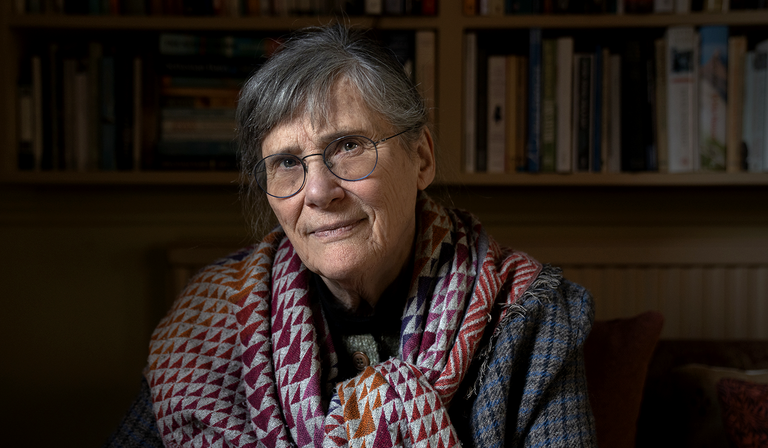
Halfway up the stairs to the tearoom at the Athenaeum Club, Hermione Lee stops to point out a picture on the wall. For a moment, the author of six major literary biographies marvels at an exquisite photograph of the 1927 full solar eclipse. When Lee later recalls tracking down Tom Stoppard’s “dentist, accountant, hairdresser, and his children’s nanny” while researching his biography, it is clear she knows how to navigate through the dark until a life is visible in full.
Lee begins her research not in the archives, but by tracing her subject’s footsteps. While writing about Virginia Woolf, she recalls “visiting Talland House in Cornwall and willing myself into thinking I’m seeing what she saw”. Although the connection is “illusory”, Lee explains that “you’re getting a frisson, a sense of layering your own consciousness on top of the historic”.
When she visited Stoppard’s birthplace in Zlín, Czechia, however, there was a hitch: two houses claimed to be the original. “I thought that was hilarious; you’re trying to get the exact place, and it turns out to be ambiguous—often that’s the case with biography.”
Lee finds satisfaction in uncovering truths through her biographies. But as the relationship between public and private “shifts hugely”, she wonders whether the practice is at risk. “I don’t know whether biography the way I do it is going to be read much… maybe it’s gone.” Self-publicisation is partly to blame, Lee suspects. Personal details that would have been hidden away a century ago are happily revealed today: “The way we think about secrets has changed; there are fewer.”
I ask if she has something specific in mind. Lee appears to think of something before stopping herself and saying, with a biographer’s discretion, “yes, that’s one I’m not going to use.” There will always be some secrets.
In 2011, Lee founded a centre for the study of life-writing at Wolfson College, Oxford, while serving as its president. Academic habit has left its mark. At moments in our conversation, Lee appears to be grading in real time: sound questions receive a nod and “very good”, factual error is corrected with “no, not true”, and foolish remarks meet sceptical, raised eyebrows.
Her teaching career began in 1970 at the College of William & Mary in Williamsburg, Virginia, a place she had discovered while touring America with a student Shakespeare company. As a new member of the academic staff, Lee confessed to the drama department that she would “love to act in plays”. She remembers “a very clever man running it, who said, ‘we’re doing Twelfth Night, and we want a Viola who has come from elsewhere.’” In the same production, Olivia was played by a woman called Glenny Wade—“the young Glenn Close”, Lee reveals.
Some years earlier, Lee’s love of theatre had come into conflict with academia during her time as an undergraduate at Oxford. “I had to choose between working for a first-class degree and playing Masha in Three Sisters.” Lee secured the first, but parental oversight influenced her choice. “There were expectations; my parents were severe in lots of ways and thought I should excel.”
“For my generation, women recognise having mothers who were enormously clever but didn’t have any advantages and [so] educated their own offspring to have what they didn’t. But also, when you become a success, there is then jealousy,” she says. “It’s painful to talk about; it’s painful to remember.”
Lee acknowledges that every life contains suffering. “Tragedies happen,” she says, with characteristic composure—but they encourage biographers, she senses, to ask the wrong question. “The central question that gets asked is: ‘who is to blame?’; I think looking for fault is not the right way of thinking about a life story.
“It’s better to think about circumstances, serendipity, the nature of someone’s character; biography isn’t punishment.” One of Britain’s most acclaimed literary biographers is also, it seems, the most forgiving.