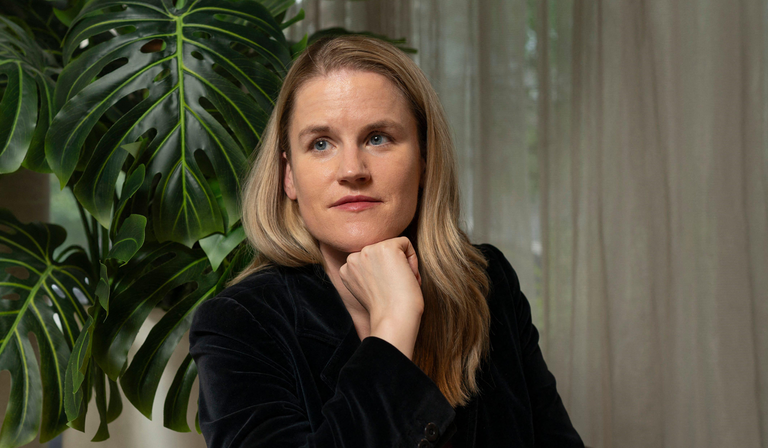
Midway through talking about her time working at Facebook, Frances Haugen’s laptop battery goes flat. Her image, superimposed onto a glossy, virtual co-working space, abruptly disappears. She returns a few minutes later, her phone awkwardly propped up in front of a piece of blue fabric crudely pegged to the ceiling to create a makeshift backdrop. “You’re my first stress testing of the whole setup,” she apologises.
This is the dichotomy of Frances Haugen: one of the world’s most high-profile whistleblowers, who rocked Meta in 2021 by leaking thousands of internal documents detailing the tech giant’s awareness of the harms its platforms cause to users. Despite the stature of her revelations, she cuts an entirely unimposing figure, fiddling with her camera set-up in a pair of knitted arm warmers and feeling perplexed that her life story is soon to hit cinemas.
Haugen is dialling in from a hotel in New York, where she has encamped for press interviews ahead of the release of The Social Reckoning, on 9th October. The film is a dramatisation of The Wall Street Journal’s publication of the “Facebook Files”—a series of investigative reports, based on Haugen’s tip-offs, that revealed the company’s own research found that its algorithms worsened teenagers’ mental health and amplified inflammatory posts, including hate speech. The film, directed by Aaron Sorkin, features an all-star cast, including Anora actress Mikey Madison as Haugen herself.
“It’s not that Mark [Zuckerberg] is evil,” says Haugen, who was a consultant on the film. “It’s not that there’s something intrinsically special about Facebook. It’s that they’re the first big company of the modern era.
“We developed a whole bunch of rituals for governance around [new physical technologies] over the course of 150 years. We do safety testing on cars; any environmentalist can scrape the paint off your coffee mug and be like ‘this mug has lead in it’. Meta is just the first company to make an intangible, personalised product that got [to] scale.
“If we don’t, as a society, acknowledge that Mark Zuckerberg is under very historically unique conditions, and we don’t do something about those conditions, he will continue to make bad decisions that will impact us all.”
Haugen, 47, grew up in Iowa; she had an “idyllic” childhood, but one that was plagued with health issues. “In retrospect, [I was having] neurological problems when I was seven years old. I started getting repeated ankle injuries, which I now know is a muscle weakness thing.” In 2011, she learned she also has coeliac disease, an autoimmune disorder where eating gluten damages the small intestine. Complications from late diagnosis cause her extreme pain and are the reason why she often wears arm and legwarmers.
As a young woman, she was accepted into the Massachusetts Institute of Technology, but declined the offer in favour of another university, because she was “worried she’d end up an academic like her parents.” In 2006, she relocated to Silicon Valley for a graduate position at Google, which led to engineering roles at Yelp and Pinterest. But it wasn’t until 2019, when she was hired to join Facebook’s Civic Integrity team (created to combat misinformation around elections), that she began to feel concerned that social media was putting profits before people.
In 2021, she testified against Facebook before the US Senate. Though Zuckerberg’s company disputed Haugen’s claims, a lawsuit was not filed. A week after the leaks went public, amid intense backlash over user safety, Facebook changed its company name to Meta.
Haugen has since devoted her time to campaigning for greater transparency for social media firms, but has sought out a quieter life in Puerto Rico, where she lives with her partner and daughter.
She is not naturally comfortable in the spotlight: “I’m very tall and I have an odd set of skills. I’m a gardener at heart; [but] I find it very soothing to sit and do data science”. But the attention that followed the leaks, she says, changed her for the better. “I don’t feel like I really showed up in my own life until after I got forced ‘on stage’.”
Now she hopes Sorkin’s film will close that chapter: “I’m hoping, at the end of this movie, I will have done my tour of duty—and I can go back to building things.”