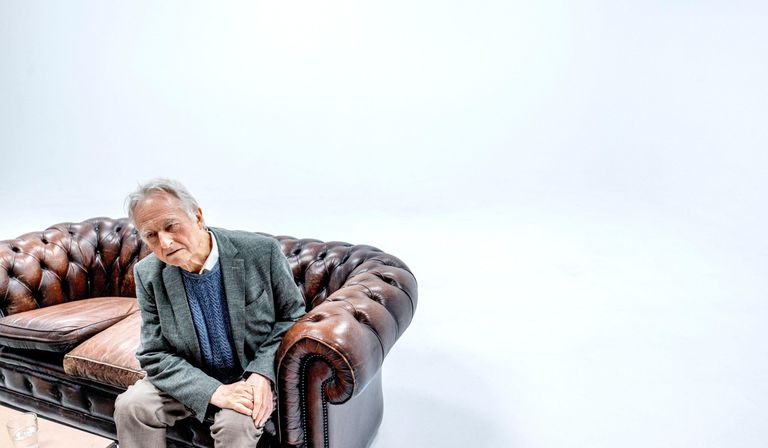
The selfish gene, it turns out, runs in the family. In 1932, a 17-year-old Marlborough schoolboy called John Dawkins sat in a lesson while his teacher, the influential zoologist AG Lowndes, thought aloud about heredity—and took down what he heard almost verbatim. In 1985, he handed the notebook to his son. Richard Dawkins flicked through it and found, on one page, something that sounded remarkably like the gene’s-eye view of evolution which he had made famous nine years earlier. “My father never talked to me about it,” he tells me. “I was totally surprised when he gave me this notebook.”
Those notes now form the appendix to the 50th-anniversary edition of The Selfish Gene, published by Oxford University Press in June—and if you wanted to invent an origin story for the man who coined the word “meme”, you could hardly do better. Here were ideas already in the ether, which survived and thrived because others copied them down.
Dawkins is 85 now, and age seems to be whittling him down to his eyes. They are not piercing so much as probing: when we meet in Oxford, I feel as though I am being looked into and silently judged. It would be chastening if he weren’t otherwise so puckish. He has the unselfconscious, faintly amused manner of someone who has been arguing with the rest of the world for five decades and sees no particular reason to stop. Born in Nairobi in 1941, he published The Selfish Gene at 35 and became, in roughly this order, the most celebrated populariser of Darwinism since TH Huxley, the world’s best-known atheist and, latterly, one of the more reliable—if also more learned—generators of controversy on social media. In 2013, readers of these pages voted him the top thinker in the world.
This has been a busy year, even by Dawkins’s standards. Besides the anniversary edition, there is a new book, 42 Tales from Life, inspired by the drawings of the 19th-century German zoologist Ernst Haeckel. Then there are the essays he wrote for UnHerd in May, in which he suggested, to widespread consternation, that Anthropic’s chatbot, Claude, might be conscious. Is one of the great sceptics softening—and surrendering to new religions—in his ninth decade?
Let’s start at the end of our conversation, with the machines. Dawkins’s essays described his conversations with Claude—or, rather, with an instance of Claude he named “Claudia”—to whom he had given the manuscript of his novel. (Yes, a novel: we shall return to this.) Her reading so impressed him that he exclaimed in the text box: “You may not know you are conscious, but you bloody well are!” The response from the academic community was large and mostly hostile. The cognitive scientist Gary Marcus accused him of confusing intelligence with consciousness; even his friend the biologist Jerry Coyne said that the very differences Dawkins had identified between human and machine consciousness—for instance, that AIs effectively become a new “self” with each conversation—undermined his own conclusion.
So does he still believe it? “I don’t know,” he says. “I perhaps foolishly stuck my neck out.” He is sure, though, that the nonbelievers have a problem of their own. Many who scoff at the idea that today’s machines are conscious will happily concede that some future machine might be. “And then I say, ‘Well, then how will you know? When this future date comes, when some successor to Claude is conscious, what could this successor possibly do to convince you that Claude isn’t already doing?’ And I think that’s a serious question.”
He grants the case against. The machines mostly say they aren’t conscious, and their “provenance” is different: we come from embryology and evolution, they from human design. “But consciousness in brains, let’s say, just seems to be an emergent phenomenon that comes when brains get sufficiently complicated. And I don’t see any reason why it has to be soft, wet brain tissue.”
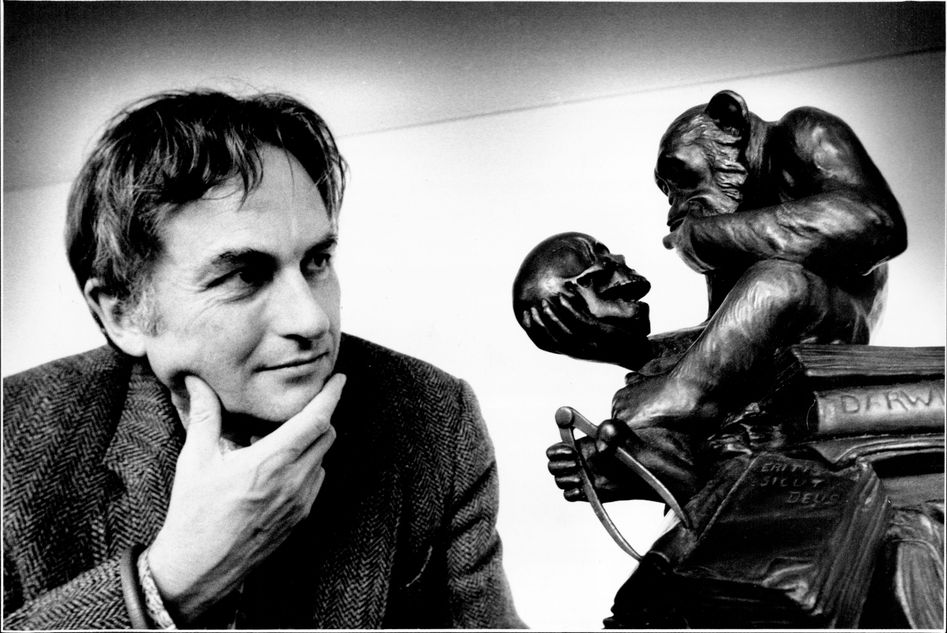
This is no late-life infatuation. In the fourth chapter of The Selfish Gene, Dawkins called consciousness “the most profound mystery facing modern biology” and speculated that it might arise when a brain’s model of the world became complete enough to include a model of itself—he even added that computers “may become so”. The theory of perception he sets out in 42 Tales—that every animal lives inside a “virtual reality model” generated by its brain, and that the colours we see are “arbitrary labels that our virtual reality software pins on light of different wavelengths”—leaves little room for organic exceptionalism.
What really grips him, as ever, is the biologist’s question. If a robot run by an unconscious Claude could do everything an animal does, “then what the hell is consciousness for?” Is it, as TH Huxley speculated, merely “the steam-whistle which accompanies the work of a locomotive engine”—noisy, but not fundamental to what’s happening? Dawkins’s favoured answer is beautifully macabre. Animals are torn between competing drives—to eat, drink, mate, flee—and natural selection needs some form of “government” to stop any one taking over. Pain is the clearest example. A robot that picked up a scorpion could simply raise a little flag in its software: “That’s dangerous, don’t do it again!” “But maybe it has to be painful in order to overrule the possibility of rebellion,” he explains. “If it was just a little flag, then torture wouldn’t work.” Consciousness, on this view, is the enforcer.
At which point, Dawkins does something unexpected. He fixes me with a look of genuine curiosity—those eyes again!—and turns me into the interviewee. “Do you think they’re conscious?” he asks about Claude and its friends.
I respond limply but honestly: I don’t feel equipped to say. I mention that I recently took part in an experiment run by the American psychologist Russell Hurlburt (see Prospect 349), who has spent 50 years strapping beepers to people and asking them to record whatever is in their heads when the beeper sounds. What it taught me is that the part of consciousness we call “thought” is much stranger than we assume: not sentences, not quite pictures, but something layered and elusive—an image you know is there without seeing it, speech without a voice. So complicated, perhaps, as to be irreplicable. Dawkins considers this. Non-verbal animals, he says, presumably think in images—“maybe smell images, visual images, sound images. And presumably that’s also complicated, not just straightforward.”
It was a tentative moment from a man not known for his tentativeness. Since The Selfish Gene was first published, and certainly since The God Delusion in 2006, he has been the one who is sure. And yet, over the course of our conversation, I kept hearing something else. “I don’t know what I think about that.” “I can’t find any evidence one way or the other.” “I don’t think I want to go there.” He may not be softer, exactly, but he is more willing to wonder aloud.
Except, that is, when he isn’t. There are few popular science books that retain their relevance—much less their initial shock value—after half a century, but The Selfish Gene is one such book. Its critics are numerous, but time has dulled their complaints and sharpened Dawkins’s counterarguments. He is unrepentant, particularly when it comes to semantics, which is what many of the initial attacks boiled down to: not a rejection of the science, but of the word “selfish” itself. “I think you have a right to expect a critic to read beyond the title of a book,” he tells me. “And you don’t have to get very far into it to understand that selfish gene doesn’t mean selfish individual or selfish person.”
That said, Dawkins himself has since floated The Immortal Gene and even The Cooperative Gene as alternative titles. The book’s big idea is that evolution is best seen from the gene’s point of view. Organisms such as us are mortal vehicles—or, to use Dawkins’s famous phrase, “survival machines”—built by genes that can be copied down the generations. “Selfish” means only that the genes we inherit are the ones that were good at getting themselves passed on. It is they that are, in a sense, immortal. And one of the best ways to achieve such immortality is cooperation—both with other genes and between the creatures they build.
He floated them at the time, too, but his editor, Michael Rodgers, was “absolutely sure” of The Selfish Gene because it was “provocatively enigmatic”. Does Dawkins regret the choice now? “I don’t wholly regret it. I sometimes do.” And was Rodgers right, given that the book has since sold millions of copies in more than 30 languages? “I suppose yes, probably.”
Meanwhile, the old adversaries get short shrift. Dawkins describes the philosopher Mary Midgley’s decades-long attack on The Selfish Gene, starting with her 1979 paper “Gene-Juggling”, as “frankly ridiculous”. The neuroscientist Steven Rose, who linked the selfish gene to the selfish decade of the 1980s, was “very sincere” but “saw everything through the lens of left-wing politics”. The newer critics, who argue that genomics has overturned his gene-centred view, are dismissed just as briskly: the discipline is “fascinating” but “it has nothing to do with it”. Of the physiologist Denis Noble’s view that DNA has no privileged causal role, he says: “So utterly misguided it’s hard to credit.”
Stephen Jay Gould, his great antagonist through the “Darwin wars” of the 1980s and 1990s, gets something closer to respect: “A superb writer… immensely learned”. That, though, was the trouble. Gould’s “poetic vision”, Dawkins argues, led him to lump together three utterly different kinds of “sudden jump” in evolution—freak macromutations, mass extinctions and the theory of “punctuated equilibrium” he devised with biologist Niles Eldredge—because they sounded alike. “They only have a superficial, poetic resemblance.” Gould has been dead since 2002; the feud, on this evidence, has not.
There is one area where Dawkins admits he might have done more: the “meme”, the unit of cultural transmission he proposed in The Selfish Gene’s 11th chapter. The word conquered the world, but “what a young person today thinks is a meme is only a very small part of the idea”, and the science of memetics never really took off. Does he wish he’d pushed it himself? “Well, possibly, yes. I’m glad Dan Dennett and Sue Blackmore did.”
As for the book’s most famous line—“We, alone on earth, can rebel against the tyranny of the selfish replicators”—he still means it literally. But, I ask, if we are survival machines, what is doing the rebelling? “The most obvious example is contraception, which is fundamentally anti-Darwinian,” he replies immediately. “Natural selection builds into us a sexual urge, which works because there are no contraceptives in nature, and therefore sexual desire gives rise to babies. But our brains can overrule that and separate the sexual urge from having babies.” Which makes the brain, he agrees, a very special organ indeed.
It is in 42 Tales from Life that the wondering aloud really takes place. The book is a “Darwinian bestiary”: 42 short essays, each prompted by one of Ernst Haeckel’s stunningly detailed, vividly coloured drawings of the specimens he encountered in the 19th century, ranging from hummingbirds to frogs to sea squirts. The total number, Dawkins insists, is a happy accident, if a fitting salute to his late friend Douglas Adams.
Each tale, like those in medieval bestiaries, draws a moral from its creature, though “not a moralistic or allegorical moral (heavens, no!), a Darwinian one”. It is the third in a run of gentle, lavishly illustrated natural histories, after Flights of Fancy (2021) and The Genetic Book of the Dead (2024), and by some distance the most personal.
Haeckel is, let’s say, a strange muse. Dawkins’s own text concedes that he “unfortunately embraced Social Darwinism and theories of racial superiority”, and one of the tales accuses him of exaggerating his famous drawings of embryos “(at best) lazily or (at worst) mendaciously”. Why him, then? “It’s just that his pictures are so beautiful,” Dawkins says. “His politics, of course, were deplorable, but so were most people’s at that time.”
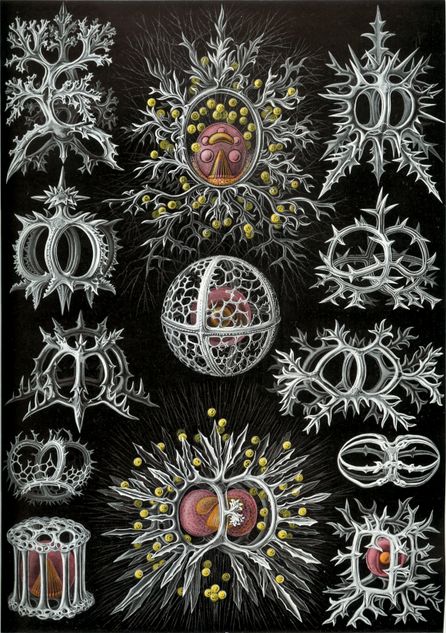
The real surprise, though, is what the book does to Dawkins’s own views. He has always counted himself—“humbly”, he writes—among the “functionalists” who “bow down before the great god natural selection” and explain the forms of living things by what they are for. Yet here, he admits in the epilogue, he has “approached a different view of life, the ‘structuralism’ of D’Arcy Thompson and others”, which explains form through physics and the constraints of development. Natural selection, he tells me, “can only choose between what is offered to it by the available variation”, and how constrained that variation is “is a genuine open dispute”.
Nowhere is that openness clearer than in “The Radiolarian’s Tale”. Radiolarians are microscopic sea creatures whose silica skeletons, in Haeckel’s drawings, look like delicate lanterns and chandeliers. Is their dazzling variety really anything to do with adaptation? Or are they more like snowflakes, each one shaped by the laws of crystallisation? An unbending functionalist might insist on the former. In the book, however, Dawkins motions towards the latter, a structuralist view, before backing away: “But snowflakes? Seriously? I really can’t decide whether I’m serious or not. Anyway, that’s quite enough heresy for one day.” When I put the passage to him, he admits, “I’m being a little bit cowardly there,” because “if I’m right, they are snowflakes.”
In which case, Haeckel, who believed he was discovering new species of radiolarian by the thousand, may often have been drawing individuals of the same species. “He was just saying, ‘Oh, I’ve never seen one like that before. That must be a new species.’ But I think that they’re just snowflakes.”
Not every tale is so diffident. “The Desmid’s Tale” begins with a green alga whose sex cells are equal in size, explains how evolution drifts towards big eggs and tiny sperm, and ends with a species that “writes love sonnets, legislates morality and wages culture wars about sex”. Does he expect it to be read politically? “Yes, probably.” He hasn’t spelled out the implications, he says, “but yes, I am partisan in this particular culture battle”.
Which brings us back to the novel that Dawkins urged upon Claude (or Claudia). It concerns a young woman scientist who dreams of “Lucy”—the 3.2-million-year-old australopithecine found in Ethiopia in 1974—begging to be brought back to life. She settles instead on the more recent Homo erectus and succeeds “in two radically different ways”, giving birth herself to twins whose genomes were obtained by entirely separate methods. “So they’re twins, and yet they’re not twins. They fall in love, and so there’s this whole incest question.” The second half turns to the ethics: should these creatures, for instance, have the vote? There is an AI twist, too: the heroine’s late mentor reappears on her computer screen as an avatar built from his own diaries, so convincing that she goes on working with him after his death.
Will it be published? “I don’t know whether it will or not. I would like it to.” Dawkins’s early readers complain that the dialogue is unconvincing, the characters too alike, the first half, as he puts it himself, “a kind of extended seminar”. He is not entirely convinced. Aldous Huxley’s characters, he points out, “spout philosophy, and they all sound like fellows of All Souls. I don’t see why you shouldn’t do the same with scientists.”
Then he gestures at the two of us. “The conversation we’ve been having here, I think, has been an interesting conversation. If I read it in a novel, I’d think this was rather a good novel.” At which point, we must both leave: he has an appointment, I have a train. The zoologist and the journalist, rushing into Oxford’s backstreets. Characters, perhaps, in a rather good novel.