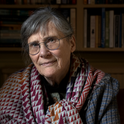
Altheia Jones-LeCointe is pragmatic about the past—and about foxes. The former de facto leader of the British Black Panthers is admiring a russet fox in the garden of her London home. “You’re beautiful,” says Jones-LeCointe, “but keep to your side.”
In 1971, Jones-LeCointe became one of the Mangrove Nine, a group of protesters whose landmark trial marked the first judicial acknowledgement of racial prejudice within London’s Metropolitan Police. The case arose from a demonstration against repeated police raids of the Mangrove restaurant in Notting Hill, run by the Trinidadian-born civil rights campaigner Frank Crichlow. No evidence of illegal activity was ever found and community members, who saw the Mangrove as something of a local sanctuary, marched for an end to police harassment. After clashes broke out during the protest, Jones-LeCointe and eight others were arrested and charged with offences including incitement to riot.
Born in 1945, she grew up in Trinidad as the movement for independence gathered momentum, while her parents were involved in the People’s National Movement, a liberal party founded by politician Eric Williams. Her childhood was busy with political meetings at her home, delivering leaflets, and gathering in the square to hear Williams speak . “We would say ‘masa day done’, which meant the master’s day was over.”
Enrolled at Trinidad’s prestigious Bishop Anstey High School for girls, Jones-LeCointe recalls placing a poster proclaiming “masa day done” on her desk. I suggest that the possibility of change must have felt potent from an early age. “You’ve hit the nail on the head,” smiles Jones-LeCointe.
Aged 14, Jones-LeCointe discovered only Latin, French and Spanish were available for further study, effectively reserving science for boys. She transferred to a mixed school to study physics and chemistry. Her white headmistress was furious.
Another education followed her arrival into Britain in 1965 for a PhD in biochemistry at University College London. As a black woman walking into an all-white class, Jones-LeCointe was asked by a fellow student: “Are you sure you’re in the right place?” “I thought to myself, ‘who the fuck do you think you are, boy?’”
Jones-LeCointe’s armoured internal response came, she believes, from being part of “the generation liberated from the trap of the colonial structure.” She pauses. “Britain had an empire that spread through Africa, the Caribbean and all over the place. He was saying, ‘you're not part of any power structure that we recognise.’ I've never forgotten it.”
“There are crude expressions of racism, such as the National Front, and there are lethal ones,” she reflects. She became leader of the British Black Panthers, a civil rights organisation modelled after its American counterpart, in late 1968.
London brought with it radical friendships and a “conglomerate of interesting people” formed, vigorously discussing postcolonial thinkers like Frantz Fanon. “Everyday life was politics,” she remembers. In places like Ladbroke Grove, “normative relationships between black and white people could take place.”
During the three-month Mangrove trial, a pregnant Jones-LeCointe represented herself at the Old Bailey. Acquitted of the most serious charge, she received a suspended sentence for assault. She describes the judge as “patronising” but also “kowtowing to status, saying, ‘Dr Jones-LeCointe, I’m giving you every latitude.’” The trial was a “shambles”, she adds. “Because they [the prosecution] weren’t on solid ground.” Five of the nine were acquitted of all charges.
A 2025 review confirmed systemic anti-black racism within the Metropolitan Police. Nonetheless, Jones-LeCointe believes the resistance of that period helped transform police policy in how they “handled immigrants and regarded our presence here.” Does she feel proud? “Nobody’s ever asked me that question,” she responds. “I don’t have proud feelings about anything. I responded as the situation required.”
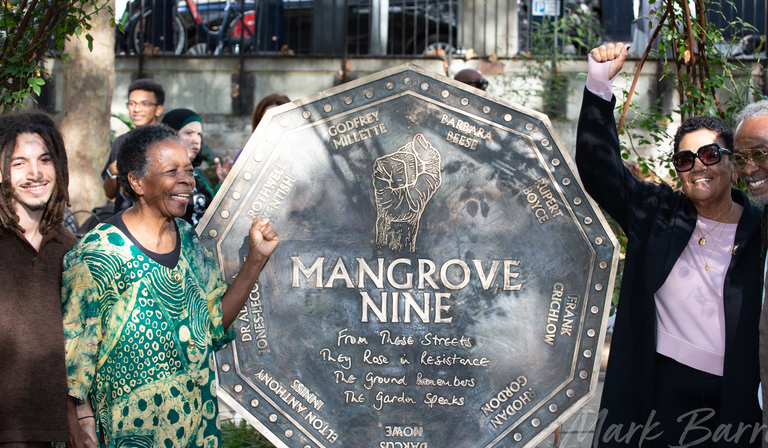
In October, a commemorative plaque to the Mangrove Nine was unveiled near the original restaurant, accompanying a sculpture titled Hands off Mangrove. Yet, Jones-LeCointe is characteristically phlegmatic. “I have reticence about focusing on [individual] people. We’re a drop in the ocean compared to the experience African people have had with Britain.” Last week, Prime Minister Andy Burnham indicated he was “open” to the possibility of issuing a formal apology for Britain’s role in the transatlantic slave trade, yet ruled out the possibility of reparations.
Speaking of her two daughters, her face fills with warmth. “Raising children is a daily labour of love. You have to make them value what they’ve just said. You have to teach them that their life here is real and they’re entitled to it.”
Then Jones-LeCointe, 81, pauses again. “My grandchildren experience the ideological effects of colonialism. My great-grandchildren will experience it. It’s not that nothing has changed, but what needs to be done is vast. We shouldn’t fool ourselves with ‘masa day done’. It’s not so.”