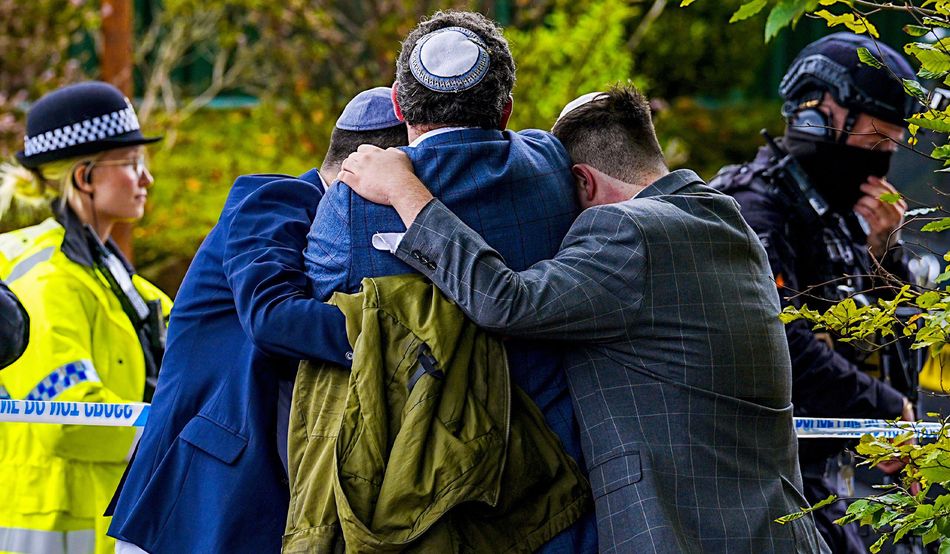
Early on 23rd March, four ambulances were torched in Golders Green, northwest London. The attack on Hatzola, a community ambulance service open to all, was the latest in a string of antisemitic incidents in the UK that include a shooting at a synagogue in Manchester last year on Yom Kippur, the holiest day of the Jewish calendar. At time of writing, two men have been arrested for the Hatzola attack and the police are treating the incident as an antisemitic hate crime.
Around the world there has been a sharp increase in the targeting of Jewish spaces. In March, a Jewish school in Rotterdam was attacked; there was a car-ramming at a synagogue in Michigan; shootings at synagogues in Toronto; and an explosion outside a synagogue in the Belgian city of Liège. We find ourselves in a stark new reality, in which violence against minorities is increasing in frequency and severity. In the UK there has also been an increase in attacks on mosques.
On social media platforms owned by billionaires who promote white nationalists, and in a politics where presidents flaunt their inclination for authoritarianism, it’s unsurprising that antisemitism is becoming more commonplace. One Instagram account that has millions of followers and posts AI-generated material portrays a “Rabbi Goldman” talking about Jewish power and money (and there are plenty of other examples). And commentators such as Tucker Carlson—who has been credited for rejuvenating the Great Replacement Theory—are repeatedly asserting that Israel is controlling the US, and having their reputations laundered by those on the left who now see them as allies because of their antipathy to Israel, and supposed support for Palestine.
Israel’s warmongering in Iran and Lebanon has happened not long after the release of the Epstein files, which generated allegations about global Jewish cabals and the ideological rupture among Republicans over support for Israel. The war is now fuelling an increase in anti-Jewish violence across the world. This violence is increasingly justified online, as well as in parts of the media and more general public discourse, by diaspora Jewish communities’ support for Israel or Zionism.
Antisemitism in these instances can be confusing or hard to identify because it is usually incorporated into legitimate calls for Israel to be held accountable for its war crimes, for the US to stop attacking the Middle East or for those named in the Epstein files to be brought to justice. The problem is that conspiratorial ideas about Jewish power ultimately do the opposite; they distract our attention and understanding away from those who are actually responsible for these horrific acts and the political systems that led us here, and redirect ire towards ordinary Jewish people.
The spate of antisemitic violence should concern everyone. Historically, rising antisemitism has been an indicator of a destabilising society. In times of polycrisis, such as the current moment, conspiratorial thinking can sweep through as a response to hopelessness, working to boost politics that wreaks havoc on democracy and scapegoats minorities. Antisemitism acts as a smokescreen, ultimately shielding those in power who should be held to account.
The problem is that the chasm between public sentiment across the west and the actions of elected representatives regarding Israel gives ammunition to those who want to see democracy replaced with a strongman, authoritarian politics. Conspiracies originating from everywhere from the manosphere to the far right have seeped into the mainstream: that Muslims are trying to take over Europe and replace white “indigenous Europeans”; or that antisemitic attacks are “false flag operations” by Israel’s security forces to manufacture consent for its wars and devastation in the Middle East. In reality, Jews around the world are not responsible for the actions of an ethnostate thousands of miles away. And Israel’s actions, committing war crimes ostensibly in the name of all Jewish people and using the symbols of Judaism to do so, have made Jewish people a lot less safe. To live in this world today is to navigate numerous injustices simultaneously without trying to find equivalences or justifications (because of course, there are none).
Antisemitism is nothing new, but the world leaders who failed to stop Israel’s genocidal onslaught in Gaza, the destruction of southern Lebanon and the bombing of Iran, bear much of the blame. Their inaction, coupled with harsh crackdowns on advocacy for Palestine under the guise of “combatting antisemitism”, has only reinforced a narrative of Israeli exceptionalism. This has spurred conspiracy theories about Jewish power and influence. Benjamin Netanyahu has only exacerbated this by making it something of a government policy to accuse detractors of antisemitism. Punitive measures such as criminalising protest—as has been seen in some cases in the UK, Germany, the Netherlands and the US—are often meted out with far more enthusiasm and speed than any attempts to curb or criticise Israeli violations of international law. Such steps have also contributed to growing public derision about the presence of actual antisemitism—a worry development in light of the increasing frequency of antisemitic attacks.
To attack Jewish communities as a form of retribution is both morally repugnant and politically stupid. It is a distraction from the dilemmas of this moment, from standing up to the illiberal forces and political systems that have led us here. Our bleak reality means that we must go back to basics: shared safety, solidarity and collective care. These are not mere platitudes, they are a strategy. When the well-resourced monster of the extreme right, of incipient fascism, is on the doorstep, political power lies in recognising that strength lies in coalitions aligned by values, even when we don’t always agree.