It’s been two decades since mathematician John Garnett made an offhand comment to describe his colleague Terence Tao—“like Mozart” with music, he said, “mathematics just flows out of him”. The “Mozart of maths” tag stuck, though it is a title Tao himself isn’t particularly enamoured by. “I love the movie Amadeus,” Tao says. “But Mozart comes off as rather eccentric and a bit annoying, and he dies young.”
At 51, Tao has already outlived Mozart by more than 15 years. But it’s easy to understand the point Garnett was making. Growing up in a suburb of Adelaide, Australia, Tao showed early signs of being gifted. His parents recall their son, aged two, teaching some five-year-olds how to count using number blocks. “Apparently, I’d self-taught myself numbers from watching Sesame Street,” he says.
In 1988, aged 13, Tao became the youngest ever person to win the gold International Mathematical Olympiad, a record that still stands. His early life was certainly unique. During primary school, “I was with people my own age for English and other subjects, but I would take some high-school math and physics classes,” he explains. “In one of them, I had a special cushion because I couldn’t reach the table.” Tao admits he had “a very complicated schedule—my mother drove me around all the time. But when I went home, my best friends were my own age. I’d ride my bike and play with them.”
Tao moved to the United States three years later, aged 16, to study for a PhD at Princeton University, which he completed by the time he was 20. He has since won a string of awards, including the prestigious Fields Medal. For more than 25 years, Tao has taught at the University of California Los Angeles (UCLA); he speaks to me over Zoom from his home in Westwood, within biking distance of the campus.
His new book, Six Maths Essentials: How to Model the World, distils the subject down to its core concepts. “I wanted to convey how mathematical thinking is just an extension of how we see in regular life,” he says.
This year, Tao became involved with the Advisory Group on Mathematics and Artificial Intelligence, an independent panel formed after tech giant OpenAI claimed that one of its models had generated a solution for the Navier-Stokes problem. He believes AI could accelerate mathematicians’ ability to crack other previously unsolved problems. But he also worries that it “can produce answers to questions, without any understanding of where the answers come from”. For human mathematicians, on the other hand, much of the value lies in the working-out stage.
“The interests of the AI companies are not always aligned with the communities artificial intelligence is supposed to help,” he says. Tao isn’t overly anxious that AI poses an existential threat to humanity, but he does believe it presents a near-future risk to essential infrastructure. “The modern world relies on delicate networks: electricity grid, oil supply, food supply, internet, banking… There are a lot of vulnerabilities in these networks.
“AI has become very good at mathematics, and hacking into a secure server is quite similar to solving a difficult math problem. There is a serious risk that that in the next year or so we’ll have a major outage—the internet might go out for a few days or we’ll lose the banking system in the United States,” he explains. It won’t destroy the whole world, he thinks, but it will have a significant impact. “There’s not enough attention on this yet.”
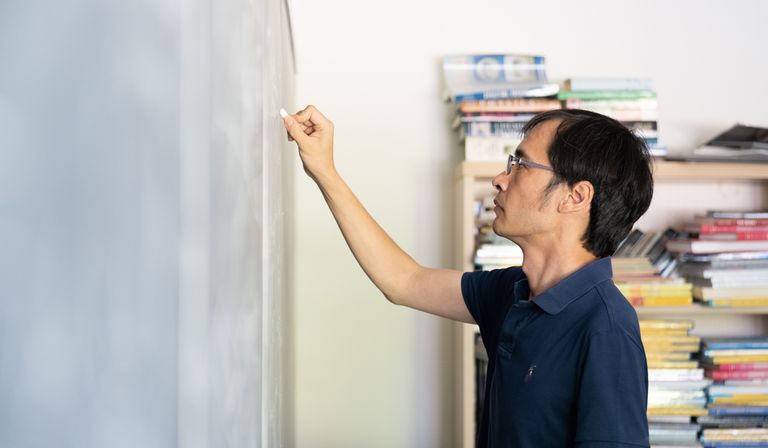
If humans are still making films in the future and one is made about Tao, he hopes it will avoid a few tired tropes. “It’s a running joke in our community that [mathematicians] are never portrayed as ordinary people,” he says. “If the film is about an athlete, people don’t see them as a completely different species of person. But with maths, you see portrayals in movies, like John Nash in A Beautiful Mind, where he sees equations in front of his eyes. I wish I had that ability—it looks cool. But I have to write things out on a blackboard.”
Terence Tao’s ‘Six Maths Essentials: How to Model the World’ is published by Pelican