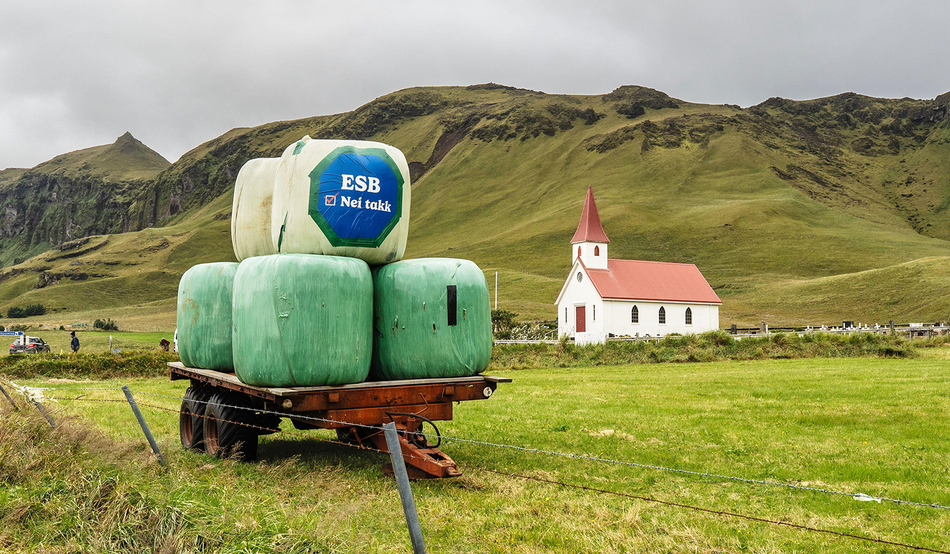
I may be old enough to remember the cod wars of the 1970s, but I was too young to understand why Iceland beat us Brits so comprehensively. It wasn’t just their intrepid trawlers and coast guard, with their warp cutters, which featured nightly on the TV news. It was also the Icelandic threat to leave Nato and close its Keflavík airbase, a vital US resource for tracking Russian submarines and bombers during the Cold War.
The same factors, in different context, were at play in Iceland’s European Union membership referendum over the weekend. The “no” vote was galvanised by the scare that Europe was coming for the fish (fishing accounts for almost 40 per cent of Iceland’s exports). The “yes” vote was driven by the scare that the US won’t be around much longer—or that a Greenland-bating Donald Trump might even switch sides and become foe instead of friend.
My best explanation for the narrow “no” vote is that the threat to the fish loomed larger than the threat from Trump. Particularly since Iceland is already in the EU’s single market and Schengen, so its fish—and its people—can circulate freely around the continent without the need for full EU membership.
As for Iceland’s security, the recent addition of Finland and Sweden to Nato, in direct response to the greater Russian threat, has given Iceland a stronger buffer against Vladimir Putin even if the US wobbles or withdraws.
So, for those of us concerned with strengthening European prosperity and democratic solidarity, there is no immediate concern. This isn’t another Brexit; rather, it was a vote for a fairly EU-aligned status quo.
Nonetheless, observing the campaign and the result, I was struck by three similarities with the UK’s Brexit referendum which, taken together, are a red flag when it comes to Europe, and need to be treated as such.
The first, obvious similarity was the break-down of the vote—In Iceland, 52.8 per cent against joining the EU versus 47.2 per cent for joining; in the UK, 52 per cent versus 48 per cent. But that is no cause for complacency because, as with David Cameron’s 2016 referendum, Iceland’s vote was—here comes the second similarity—called by a government which expected and wanted the vote to go the other way decisively. It looks to me as if a key part of the reason why it went the wrong way for Europe—a third parallel with Brexit—is that there was a failure by the EU to make the best case for itself.
A big issue in the vote was always going to be fish. The big and obvious political step was for Ursula von der Leyen, supported by Emmanuel Macron, Friedrich Merz and other EU political leaders, to have announced in advance of the referendum that Iceland would definitely keep its fish if it joined the EU. More precisely, Von der Leyen et al should have guaranteed that Icelandic fishing companies would retain the sole right to fish within the country’s existing 200-mile exclusive fishing zone.
Had they done this, the narrow “no” vote might well have been a narrow “yes”.
In 2016, the stark staring issue of the Brexit referendum was EU immigration and the threat of still more in the event of Turkish membership. Had the European Commission at the time, supported by Angela Merkel and François Hollande, the leaders of Germany and France, been decisively pro-active, they would have given Cameron the “emergency brake” he sought in respect of existing EU immigration. They could have guaranteed in advance that there would be no automatic right for Turks to move and work in the rest of the bloc if Turkey had indeed joined the EU. If these concessions had been forthcoming, the UK may well have voted to remain.
EU purists would pose fundamental objections. But in truth neither of these concessions—fishing in the case of Iceland, or immigration in the case of the UK—was “impossibleist”. It was obvious in 2016 that immigration was becoming politically unbearable and unsustainable not just in the UK but across most of Europe. This is partly why Turkish membership of the EU has gone nowhere. And not even the purest Eurocrat seriously thinks that Iceland would ever join the EU if it had to sacrifice its most iconic industry.
The red flag is that there will inevitably be more EU-related referendums before long, including mega important ones akin to Brexit in 2016. One could easily imagine a Le Pen government in France next year holding votes on new immigration controls and/or cuts to the EU budget. Supreme political agility is required if the EU is to weather them successfully. And that might start by the European Commission propounding, with a bit of pragmatism and humility, its failures in the cases of the UK and Iceland.