Just over 20 years ago, I called for the House of Lords—half of parliament—to be moved to Manchester. I did this for the same reason that Andy Burnham wants to do the job of prime minister partly from that great northern city: because our national politics is too concentrated in London. You didn’t need to be a genius, then or now, to see that the combination of northern deindustrialisation and southern decision-making was becoming toxic.
The populist forces that gave us Brexit wax cynically about the “London metropolitan elite”, for their leaders past and present—pre-eminently Nigel Farage, Richard Tice and Boris Johnson—are thoroughly part of that elite. Andy Burnham, by contrast, is a northerner who went to a state school (though he is also a Cambridge graduate). He has built a unique political career in London and Manchester, and is now seeking to turn it into a Labour governing project to drive growth and defeat the populists.
Burnham’s leadership launch speech in Manchester on Monday accordingly majored on the politics of place. His slogan is “place first, not party first”.
At one level this too is self-serving, in that he actually means “place first, particularly poorer places north of London, so that Labour becomes the first party at the next election.” However, as a mainstream governing project it is founded on the glaring reality that deindustrialisation since the 1980s has chronically disfigured most of England and Wales beyond London and the southeast. Those regions have flourished because of the continuous growth of the financial and business service industries, while the regions elsewhere have suffered badly from the decline of former manufacturing—and in some cases mining—industries which have never been adequately replaced.
So the big question is: will “place first, not party first” generate a plan for the north and other declining parts of the country that might actually improve their fortunes?
Unsurprisingly, as the outgoing mayor of Greater Manchester, Burnham puts greater devolution at the heart of “place first”. And to devolution (that is, the handing down of power to sub-national institutions) he proposes to add decentralisation (that is, the exercise of national power in places well beyond London, as in his proposed “Number 10 North”).
Both devolution and decentralisation have a part to play in driving regional growth. Manchester’s renaissance owes much to the success of Burnham and the city’s former long-serving chief executive, Howard Bernstein, in harnessing planning powers, alongside national and local resources, to attract jobs and build crucial infrastructure. Manchester Metrolink, the UK’s largest light rail system, and the new Bee Network, an integrated bus system, are visible manifestations, together with the city’s high-rise skyline.
The irony is that in all these respects Manchester’s success lies essentially in copying London, which, aside from being the national capital, has benefited from more than a century of strong city leaders and mayors who built infrastructure (notably Transport for London) and redeveloped vast areas like the Docklands, creating new jobs and attracting industries.
“Place first” needs to enable other city-regions to copy London and Manchester in similar ways.
However, national policy is at least as important as local and city leadership in generating successful regional growth. The relative decline of the north was exacerbated by decades of national policy that undervalued manufacturing and the tax, investment, education and training systems on which those industries depended.
Alas, to this list can now be added Brexit, which has decimated the UK’s goods export industries while its service industries have been far less badly affected. Trump’s tariffs have been similarly savage in their impact on British manufacturing, not least his huge import levies on cars, steel and aluminium.
“Place first” needs therefore to be as active in Brussels and Washington as in Manchester and regional capitals beyond London. An ominous sign is the cancellation of the proposed UK-EU summit which had been scheduled for 22nd July, a few days after Burnham would take office, if he does indeed become party leader. For nothing is more important to regional growth than renegotiating Boris Johnson’s disastrous Brexit deal and its complete withdrawal from the EU customs union and single market.
To “rewire Britain”, as he has promised this week, Burnham needs to accelerate Keir Starmer’s EU reset, not delay it.
Andy Burnham must think local, but act global
To ‘rewire Britain’, the former Greater Manchester mayor needs to accelerate Keir Starmer’s EU reset, not delay it
July 01, 2026
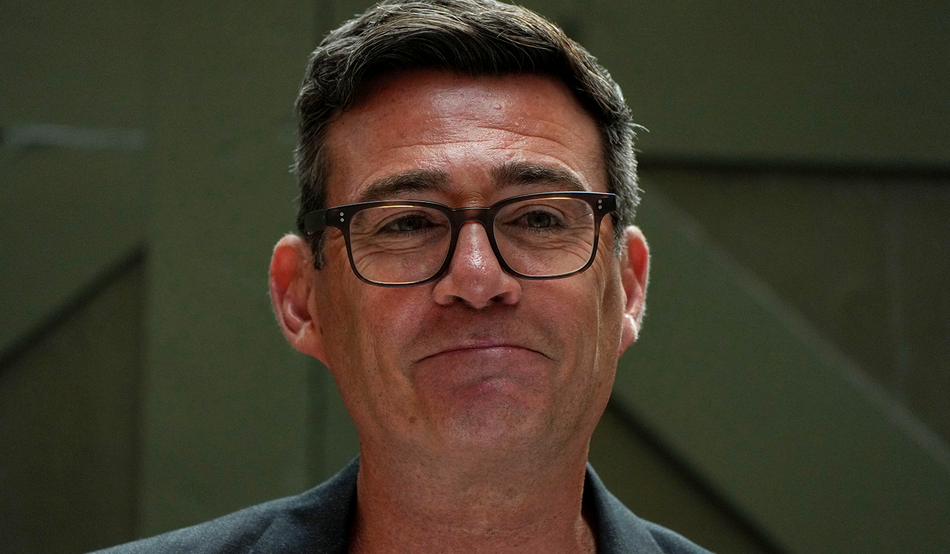
Andy Burnham delivering his speech at the People's History Museum in Manchester. Image: AP/Alamy