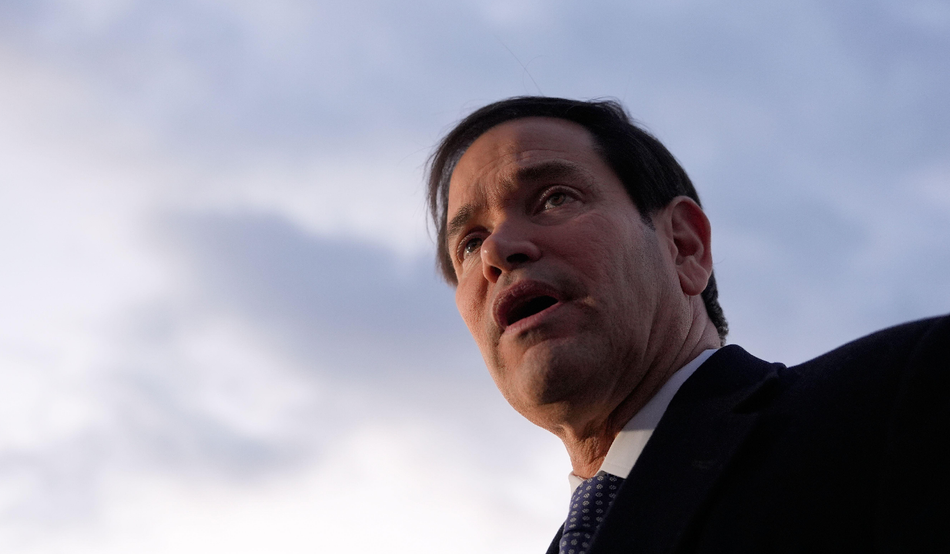
It was a terrible, imperialistic speech by Marco Rubio at the annual Munich Security Conference on Saturday. But at least the US secretary of state didn’t repeat JD Vance’s vitriolic abuse of Europe from the same event last year, shortly after Donald Trump’s inauguration.
In his speech, Rubio made no new threats against Europe. There was no mention of seizing Greenland. There was no mention of withdrawing from Nato. There was no clear bombast about tariffs or wokeism. There was even a lingering hope that transatlantic relations may not be beyond repair, and that the urbane Rubio might be the antidote to Trump and Vance. He did, after all, refer to “our friends here in Europe” and declare that the United States and Europe “belong together”. It was for these reasons, perhaps, that he received a standing ovation.
If it weren’t so obviously weird, the ostensible argument of the speech would be dangerous, given its implicit threat to every non-Christian nation across the globe. For 500 years until 1945, Rubio suggested, there had been an expansion of “western civilisation” forged by “centuries of shared history, Christian faith, culture, heritage”. Since 1945 this civilisation has been in “terminal decline”, accelerated by “godless communist revolutions” and anti-colonial uprisings that he framed as a western “retreat”.
What of the future? The Rubio prescription is for Europe to join with the US in a “western civilisational renaissance” and engage in a new era of international expansion. The mission should be for a “new western century” focused on “shared heritage, history, and specifically the Christianity of the west.”
Completely missing from this extraordinary narrative is the rise of democracy and human rights within the west itself, and the obvious incompatibility between democracy and imperialism, whether cultural or territorial. This goes to the heart of the real existing threat to today’s European civilisation: namely, an undemocratic and imperialist Russia whose dictator claims to be a thoroughly Orthodox Christian even as he invades and seeks to subjugate a neighbouring European Christian nation. And a dictator much admired by Trump, whose position as both US president and leader of the democratic west is undermined by his own strain of populist, right-wing politics.
Rubio obviously realises all this, hence the complete absence of Russia from his speech. The pre-Maga Rubio was vocal and unequivocal about the Putin threat to Europe, and would have made a radically different speech about democratic values as the bedrock of the west.
But if we are to assume that Rubio’s position on Russia has in fact not changed very much, despite its glaring omission from his speech, we can look at the address in a different light: the “Christian imperial west” becomes a notion carefully crafted to enable Rubio to proclaim an underlying unity between Trump’s America First and the modern democratic European Union, without dissing either Russia or Trump’s own profoundly illiberal neo-imperialism. All while at the same time lambasting the impact of immigration in the US and Europe.
In other words, the Atlantic alliance isn’t necessarily dead, and the critical issue of the west’s approach to Russia is left in limbo while different factions around Trump fight it out. Which isn’t great for democratic Europeans seeking to repulse a Russian invasion, or wishing to fight against the populist enemies of liberal democracy. But it is better than a US secretary of state proclaiming the end of Nato and openly siding with Putin.