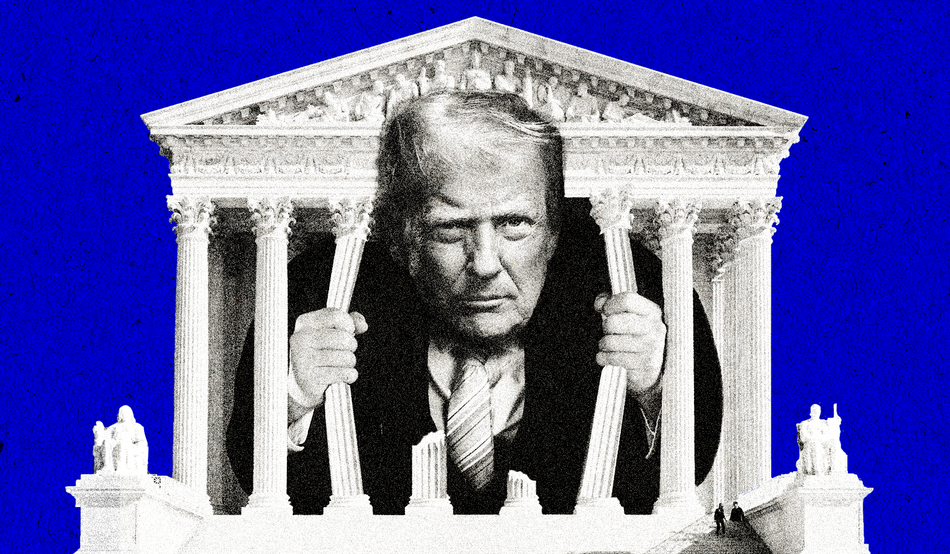
For about an hour last Friday, after the United States Supreme Court struck down most of the tariffs that Trump had imposed on much of the globe last year, it looked as if the monster might at last have been shackled. Then, in a statement laced with vicious personal attacks on the justices, Trump simply reimposed most of the cancelled import duties by another route at least as legally dubious as the one just condemned.
There will now be new legal challenges on the way, alongside a legal quagmire as importers seek to recover the tariffs they have already been paying for the past year. But it took a year for the Supreme Court to rule on those tariffs, without suspending them in the interim, so the Trump tariff rampage looks set to continue for the rest of his presidency and perhaps well beyond. Free trade isn’t returning to the US any time soon.
It is no great revelation that Trump has zero respect for legal judgements which go against him and will do everything he can to subvert them. It will take more than an isolated Supreme Court ruling to force him to stop acting arbitrarily. It requires determined and agile opposition of a kind that this Supreme Court is unlikely to provide even in its modestly emboldened state.
The content of last week’s tariff judgement was anything but strong and agile. Despite Trump’s chronically weak legal case, it was a split 6-3 decision, with three conservative judges allying with the three liberals while the other three remaining conservatives denounced their counterparts in terms that make it hard to see that they would ever rule against Trump on any policy question.
Moreover, the six in the majority engaged in fierce and lengthy written arguments among themselves as to the basis of a decision on which they were ostensibly agreed. The conduct of these arguments delayed the ruling itself by weeks if not months. A repeat of this process will doubtless take place before any further rulings on tariffs, even if they eventually go against Trump.
However, the good news is that the Supreme Court has at last shown it is not simply a rubber stamp. There are other hugely controversial cases pending, such as Trump’s denial of birthright citizenship, and he could now lose on some of those, too. The rule of law is severely strained, but the worst fears of a dictatorship have yet to be realised.
The critical test for this year, echoing the 2020 crisis at the end of Trump’s first term, is whether the president loses Republican control of the House and/or the Senate in the mid-term elections in November, and whether he is forced to respect such a loss.
A Democrat-controlled Congress would make it harder for Trump the narcissistic authoritarian to prevail in the final quarter of his eight-year reign. In fact, it would have far more willpower than a conservative majority in the Supreme Court to go after him, what with all the levers that the Democratic party would have at its disposal.
In this regard, it is significant that even this partisan Supreme Court has not—yet—shown any inclination to connive with Trump to rig the mid-terms. The court has not intervened as Democrat-majority states, led by California and Virginia, retaliated in kind against the big Trump play to gerrymander the electoral districting of Republican-majority Texas. I doubt that the court would seek to interfere with any of the results, however badly the Republicans perform.
The real significance of the Supreme Court’s tariff ruling may not be in its effect on tariffs, but rather in marking the high watermark of Trump’s arbitrary rule. And not a moment too soon.