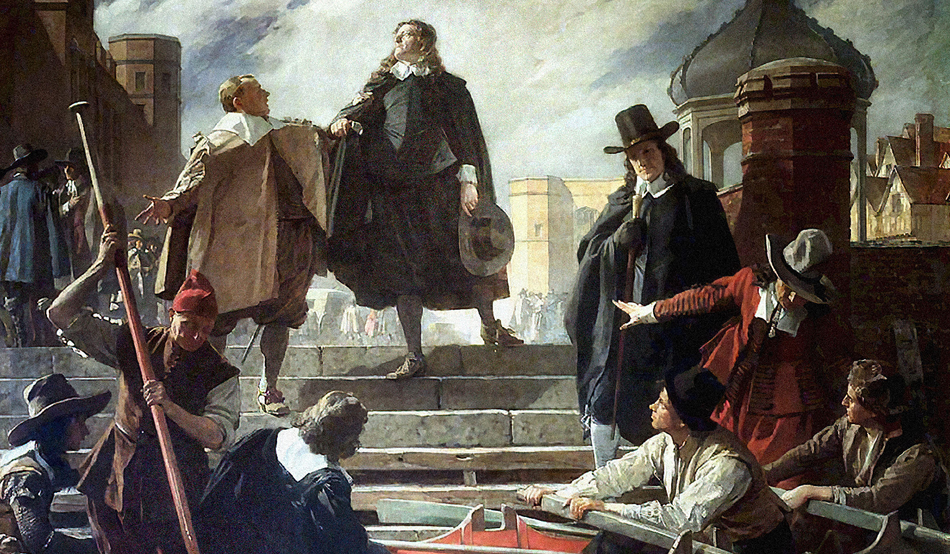
There was once a ruler who was displeased with a handful of legislators and so he sought to arrest them for treason. But the attempt failed and became instead a symbolic moment, showing the limits of executive overreach.
That ruler was Charles I, and his foiled effort to arrest five members of parliament and one peer is a celebrated event in English constitutional history. Even now it is the reason why the door of the House of Commons is slammed shut in the face of the King’s messenger at the state opening of parliament.
This week another head of state sought and failed to bring criminal charges against legislators that displeased him. This time the head of state was President Donald Trump and the legislators were the six members of Congress who contributed to this video.
The content of the video is unexceptional, in that the members of Congress state generally what is the law of the United States and many other countries: that people in the armed force and intelligence services are not obliged to follow unlawful orders. As this blog has set out previously, that unlawful orders should not be complied with is even set out in the US government’s own court-martial guidance.
It was not the text of what was said, but the context in which it was said, that so irked Trump and others in his administration. The video was published and promoted when there was mounting concern at what Trump and his circle were ordering the armed forces and others to do both domestically and abroad. The video intended to strike a chord, and that chord was struck.
Trump, like Charles I before him, was not happy with what he heard. On social media he explicitly said that the six members of Congress should be put to death for sedition. In his own words: “SEDITIOUS BEHAVIOR, punishable by DEATH!” (His spokesperson later claimed this was not the case.)
The Department of Defense (which has been rebranded as the Department of War) sought to punish by deemed demotion one of the six members of Congress, Senator Mark Kelly. Kelly is now challenging the move in the courts. But it seemed otherwise the federal government had realised it could not go further, especially with the right to free speech under the first amendment to the US constitution.
And then this week we had the news that federal prosecutors had sought indictments against the six members. But the federal prosecutors failed to convince a grand jury, a step required when bringing such indictments. This is rather contrary to the old saying that a prosecutor could get a grand jury to indict a ham sandwich.
Indeed, federal prosecutors are now often failing to get indictments where it appears that the prosecutions are politically or otherwise wrongfully motivated. One commentator has pointed out that there is “a stunning pattern of grand jurors rejecting indictments sought by the Justice Department in President Donald Trump’s second term — specifically when it comes to allegations of assaulting law enforcement in connection with protests against the administration’s abuses of power”. And recently attempts to indict New York attorney general Letitia James, who had successfully brought legal cases against Trump, were also rejected by a grand jury.
Grand juries consist of normal citizens, and it would appear that they are slamming metaphorical doors in the face of the federal government. This is not happening all the time: some questionable charges, like those brought against the journalist Don Lemon, are still getting past grand juries. The trend is thereby not universal, but it is significant. The federal government is not getting its way, all the time.
And so one ugly feature of American politics—the use by Trump and his administration of the Department of Justice to go after those who displease them—is prompting an equal but opposite reaction of grand juries generally saying no.
There are still checks and balances in the US polity, even if the current majorities in Congress and the Supreme Court have abdicated their constitutional responsibilities. In the US it now appears that grand juries are generally, if not universally, preventing some of the grossest abuses of executive power.
Many things can and are said about juries: they are an imperfect mechanism for deciding legal questions. But the great value of juries is not so much the powers they have, but the powers they prevent others from having.