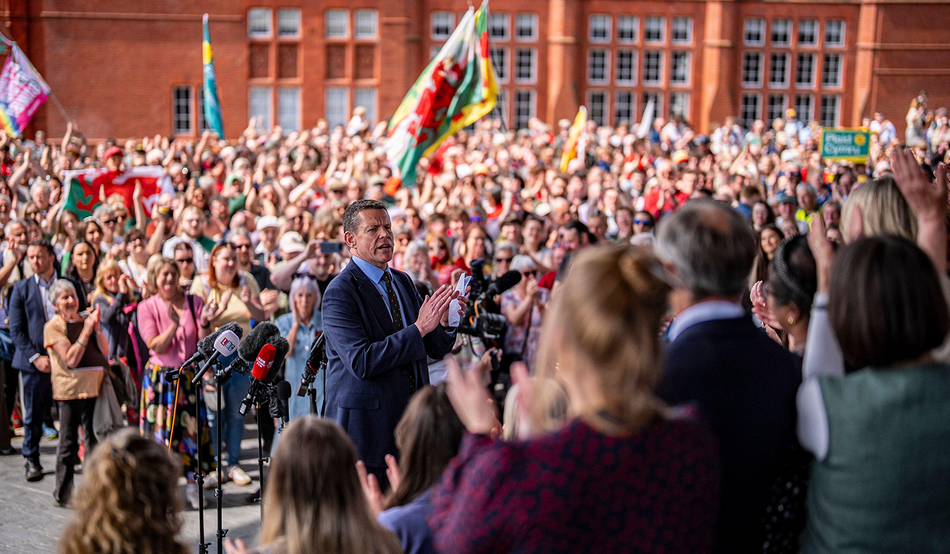
Farewell, Welsh Labour. So ends over 100 years of political, cultural and social hegemony.
While Keir Starmer’s unpopularity will be blamed (not least by many in Welsh Labour), this collapse into a distant third place in the Senedd, behind Plaid Cymru and Reform, has been a long time coming. Labour’s vote share has been steadily atrophying in its South Wales heartlands since at least the Blair era, and the Labour party at both ends of the M4 must share the blame.
Until now, the decline was masked by Welsh Labour continuing to limp over the line in devolved elections through a mixture of apathy (until 2026, turnout had never passed 50 per cent in Senedd elections) and the skilful deployment of a “soft-nationalist” brand that neutralised Plaid Cymru. This led many within the party to believe all was well. As recently as the early 2020s, Welsh Labour’s ”radicalism” was being held up as a model for the wider party to emulate.
But contradictions have finally burst through, aided, ironically, by a controversial new voting system designed to keep Labour in power by only allowing voters to choose one party rather than state an order of preference.
The reasons for the collapse are not complicated. When it arrived in the late 1990s, devolution was noisily sold by Labour as an economic dividend, yet living standards have continued to plummet in Wales on every single measure. Successive Welsh Labour governments have decided they are powerless in the face of neoliberal globalisation, and instead focused on tinkering at the edges of everyday life via symbolic, toothless legislation and bans (such as the new law against lying in parliament, or banning GB News from the Senedd TVs), all while proclaiming their “radicalism”. A recent Times report from Pembrokeshire captured the disillusionment well when one voter said: “They’ll shout about all the things the Welsh government has brought in, charges for plastic bags in Tesco, fine, brilliant. But whoever thought of that could have been working on something more urgent.”
And the social and cultural apparatuses that birthed and sustained Wales’s distinct, Labourist political culture have been allowed to wither. In South Wales, the heavy industry has gone, replaced by low-paid, non-unionised service work in care or call centres; the chapels, miners’ clubs and libraries have been sold off; on high streets, formerly thriving pubs and bracchis (Italian cafes and ice cream parlours) have been boarded up or turned into vape shops. The distinct sense of community and habitus remains, but with civil society hollowed out, the link between these communities and Labour was bound to follow.
Wales has changed, yet Welsh Labour never seemed to grasp this. Journalist Vaughan Roderick noted the striking reliance of the party’s election broadcasts on the iconography of a world that’s gone: male voice choirs, mines, rugby. One-partyism produced an anti-intellectual party culture, impervious to criticism and incapable of understanding or responding to social and political upheavals.
Ultimately, the forces behind the collapse of the two establishment parties are the same in Wales as across the UK and Europe: falling living standards, downward social mobility and a hapless government content with managing decline. But the Welsh electorate’s is refracted by distinctive, deep-rooted patterns of national identity (themselves often proxies for language and social class) forged by Wales’s uneven economic development.
Political scientists and sociologists often split Wales into three socio-cultural areas, sometimes called the “three Wales model”. This comprises the Welsh-identifying, Welsh-speaking area “Y Fro Gymraeg” to the rural north and west; “Welsh Wales”—the strongly Welsh-identifying, Anglophone, working-class parts of South Wales that have historically voted Labour; and “British Wales”, the less Welsh-identifying border areas without the working-class political tradition or Welsh language presence, which tends to act more in line with the wider UK. These geographic identity regions have been a relatively reliable predictor of political behaviour for many years.
The new blocs tell a tale about new and old Wales
Now, the country appears to have split in two distinct socio-cultural geographic blocs: Plaid Cymru has ostensibly absorbed the anti-Reform “progressive” vote, including a majority of ex-Labour voters, while Reform has cannibalised the Tory vote and some of the more British-identifying old Labour voters. The new blocs, albeit greatly accentuated by the new voting system, tell a tale about new and old Wales and shifting patterns of identity.
Historically, Plaid Cymru struggled in Welsh Wales, where it has been viewed (at best) as a party of Welsh speakers, at worst as the racist “nationalist bogeyman”. But Welsh Labour’s “soft nationalist” or “devolution-unionist” discourse —designed to co-opt and neutralise Plaid Cymru’s nationalism—has, ironically, created a progressive, nationalistic consensus that over time has detoxified Plaid and allowed it to absorb Labour’s vote. For a generation of younger people in Wales, devolution is the natural state of affairs; likewise, Welsh-language education means the language is not something to fear, while Britishness has lost many of the positive connotations that bound an older generation of Welsh people to the UK.
Other long-term shifts have helped Plaid finally break out of its old heartlands in this election: the agglomeration of jobs and opportunities in Cardiff has drawn young people from rural Welsh-speaking areas to places like Grangetown and Canton, with the latter, close to Cardiff city centre, now one of the most Welsh-speaking parts of Wales. This powerful, progressive cohort has helped drive record gains for Plaid in constituencies such as Cardiff Penarth.
Cumulatively, then, the historic political barriers faced by the “nats” have significantly diminished. Plaid Cymru had long been second choice for many Labour voters, meaning the final leap to voting for the party was not difficult, particularly as it was seen as the only way to stop Reform winning the Senedd. The Caerphilly by-election victory last October was hugely important in consolidating this narrative, and will be remembered as a historic turning point for Plaid.
The rise of Reform, on the other hand, marks the revenge of a demographic largely ignored by a Welsh political class which had long insisted that devolution was the “settled will” of the people. Yet anti-devolution sentiment never went away, it just never found political expression. Reform’s “anti-politics” populism targeted devolution itself during this campaign, something the Welsh Tories have long baulked at. Reform’s base in Wales is a coalition of ex-Thatcherites (a strong tradition in Wales that has historically been masked by first-past-the-post elections) and some old Labour voters with a weaker attachment to Welsh identity and devolution. In coastal parts of rural Wales this local vote will have been significantly augmented by English retirees. Reform’s vote is substantial everywhere, but is predictably strongest in British Wales, reinforcing the link between national identity and voting.
These two worlds are not necessarily oil and water. The grievances driving the rise of Plaid and Reform are similar but, as Jac Larner has demonstrated, there is a clear fracture emerging, articulated through the language of national identity: one side pulls towards Plaid and an identity of Wales, Welshness, social liberalism and further devolution; while the other doubles down on social conservatism, anti-devolution, anti-politics and a British identity. If it is to make a success of government, Plaid will have to find a way of bridging this divide or using it to create a steady progressive majority.
For Welsh Labour, meanwhile, if it is to have any way back, its task will be to attempt to finally understand the country it governed so poorly, for so long.