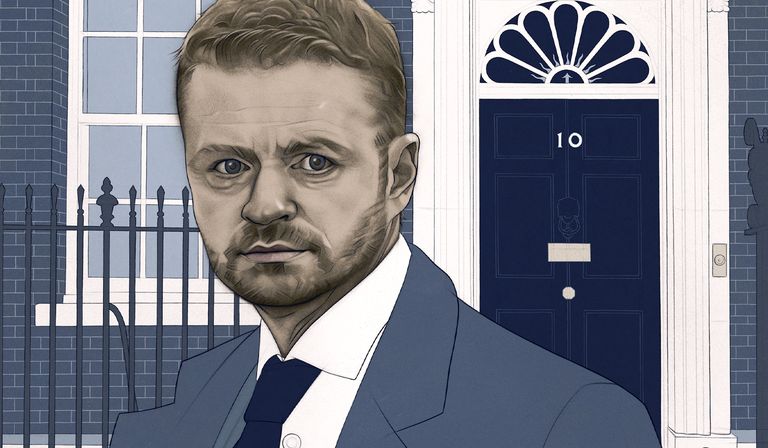
Twelfth November was an unremarkable day in British politics. Another day when the topic of debate wasn’t one of voters’ main concerns—immigration or healthcare, say, or the budget, or the farmers—but an Irishman named Morgan McSweeney.
The charge—that McSweeney had led a briefing operation against the health secretary Wes Streeting, accusing him of plotting a leadership challenge—was the latest controversy for Keir Starmer’s highly controversial chief of staff. It was also the third time in six months, following a revolt by Labour MPs against welfare cuts and then damaging revelations about his role in the appointment of Peter Mandelson as the UK’s ambassador to the United States, that there had been calls for McSweeney to be sacked.
In the House of Commons, Kemi Badenoch said that McSweeney had created a toxic culture in Downing Street. Starmer replied that McSweeney and the rest of his team remained focused on running the country. “Is it over for Morgan McSweeney?” asked the New Statesman. “Has he got too much power?” asked Jon Sopel on The News Agents podcast. “What the F-U-C-K is going on here?” asked Alastair Campbell on The Rest is Politics—Tony Blair’s former spin doctor was quoting texts he’d received from Labour MPs.
“Is he,” Sopel went on to ask, “more powerful than the prime minister?”
There was perhaps another, deeper question too. How did this softly spoken 48-year-old—a self-confessed former slacker who used to work on building sites and who was first employed for Labour on reception—become the most consequential man in British politics today?
How can a behind-the-scenes figure, someone who has never given an on-the-record interview, already have two books devoted to him—one breathlessly charting how he engineered Labour’s rise to power (Patrick Maguire and Gabriel Pogrund’s Get In), the other eviscerating the manner in which he did so (The Fraud by Paul Holden)?
Some say he is less a campaign manager hired by a leadership candidate than an operative who hired a frontman. And, almost uniquely in British politics, they add, he is someone who plotted over the course of years to end Jeremy Corbyn’s grip on the Labour party not by opposing Corbynism, but by infiltrating it.
In defending McSweeney, supporters I spoke to often cited a single, simple mantra, one born as much from internal victories as electoral ones: “McSweeney always wins.” For others—disgruntled MPs, Corbynites, former staffers, those who were once friends before their usefulness waned—crucial doubts remain. Can you run the country in the same merciless manner as you grasped it? Can someone who always favours strategy over philosophy hope to lead?
“He’s brilliant at faction-fighting,” says Neal Lawson of Compass, a centre-left pressure group. “But the skills to fight a factional war are not the skills to run the country. You can’t compel the country to do what you want. You can’t coerce them. You can’t expel them. You can’t suspend them. You can’t lie to them. You could in the past. But you can’t now.”
Talk to anyone about McSweeney and they find it difficult to pin him down. “It’s not Blairite managerialism,” says one. “He’s a centre-right Christian democrat,” offers another. “He is still a bit of an enigma to me,” says Paul Holden, who spent two years and 568 pages in his book at least partly trying to solve the riddle.
Most describe his time as an organiser in the 2006 local elections working under Steve Reed, then Labour’s leader in Lambeth, as foundational. Until then, not much about McSweeney’s CV had screamed Svengali. He grew up in Macroom, a picturesque market town in County Cork in Ireland. His father was an accountant and his mother an office worker. His family was steeped in local politics—his Aunt Evelyn, who runs an old-fashioned sweetshop, was a councillor for Fine Gael—yet he showed little interest in the subject beyond, perhaps, a knack for telling people what they wanted to hear. Evelyn has said that McSweeney would tell her she was his favourite aunt, before popping down the street and saying the same to her sister. Mostly, McSweeney drifted, working on building sites in London, enrolling and then dropping out of university, travelling.
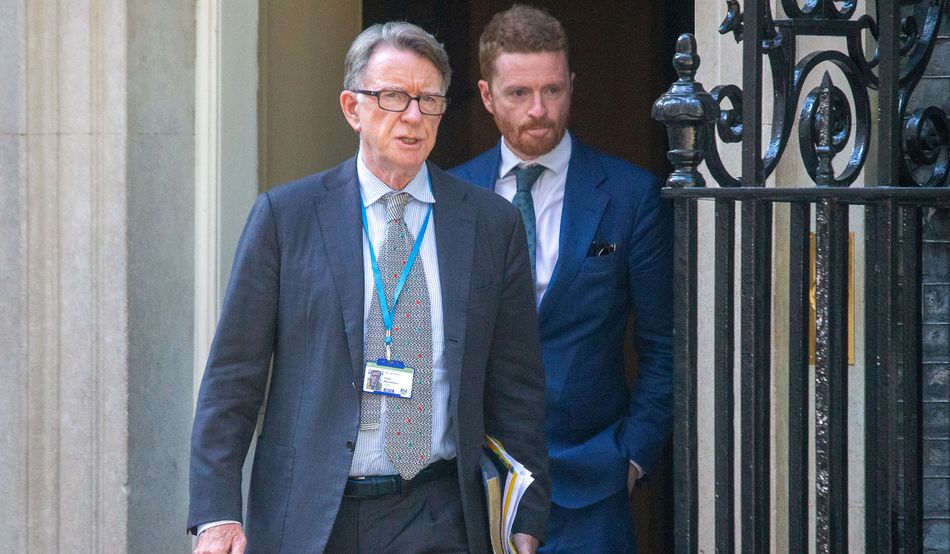
It was only when he returned to education—studying for a degree in politics and marketing at Middlesex University—that he found his calling. On a work placement at Labour party HQ in Millbank Tower, his job was to add press cuttings from newspapers to a database devoted to attacking and rebutting the Tories. He was hooked. His boss: one Peter Mandelson. Mandelson would become a mentor, inviting him for dinners at his Regent’s Park home. McSweeney would later strongly advocate for Mandelson’s ambassadorial appointment in December 2024, a move that would prove disastrous after emails emerged revealing Mandelson’s close relationship with the convicted sex offender Jeffrey Epstein.
In Lambeth, McSweeney focused on life at street-level: bins, blinking lights, repairs. He personally reported burnt-out cars to the police
McSweeney isn’t given to sentiment, so tales of his political origins are sparse. Yet several staffers remember a speech he gave on the eve of the 2024 general election, just before people scattered to get out the vote. He spoke, movingly, of being an unemployed young man sitting on his sofa, watching Tony Blair enter Downing Street and, for the first time, feeling hope. “He’s not an overtly emotional person,” says one. “But I remember it being a really emotional speech.”
By the time McSweeney became an organiser in Lambeth, the target was the people who’d taken that hope away. Ted Knight, an avowed Trotskyist, had led the council for two terms while Thatcher was in power: ideology was all. Knight refused to fly the union flag at the council building and set an illegal budget when Thatcher’s government attempted to rein in council spending. When police attended the Brixton riots in 1981, Knight called them “an army of occupation”.
Mandelson, a young Lambeth councillor at the time, said: “Given the choice between having the Labour party and Ted Knight in the borough or the police, 99 per cent would vote for the police.” He later resigned in disillusionment at the council’s left-wing leadership.
The locals, seemingly, were forgotten. A child abuse scandal in Lambeth-run children’s homes broke out. By 2002, the council run by Knight’s successors and acolytes had debilitating debts and some of the worst public services in the country. The former Labour stronghold flipped to a new Lib Dem/Tory coalition.
McSweeney realised the 2006 campaign needed to move on from Labour’s past. He focused on life at street-level: bins, blinking lights, repairs. He personally reported burnt-out cars to the police. He also wasn’t above the dark arts. Organisers in Clapham told residents the coalition was closing the local swimming baths. In fairness, they were closed—but for refurbishment.
The 2006 local elections were a disaster for Labour across the UK—the last that the Blair government would contest. Yet in Lambeth, Steve Reed won: a small stemming of a blue tide. McSweeney was on his way. He didn’t so much have an ideology as an ethos: lead by following. The voters’ concerns were everything. Just give them what they want.
When Neal Lawson first met McSweeney in 2017, the Irishman pitched a project Lawson couldn’t help but warm to. Now 40, McSweeney had recently become the director of a little-known thinktank called Labour Together. Its goal, he explained to Lawson, was simple: Corbynism without Corbyn.
The Labour leader had surpassed all expectations at the recent general election by increasing the Labour vote by 30 seats—a vainglorious failure that meant, for now at least, he was untouchable. But McSweeney was planning ahead. He wanted to harness the movement, he told Lawson, but stamp out antisemitism. He wanted to keep the policy—but professionalise it. The 2008 financial crash had been a gamechanger for the left, he said. That couldn’t be forgotten. The agenda was broadly right, but how to make it electable?
Labour Together had been formed to infiltrate and then eradicate Corbynism
For Lawson, who had worked under both Blair and Gordon Brown, this reading made perfect sense. “It seemed logical, rational,” he says now. He was impressed by McSweeney’s enthusiasm. “I didn’t suspect there was a deceitful plan afoot. And, frankly, more fool me.”
The truth, he would eventually learn, was that Labour Together had been formed with the explicit intent of infiltrating and then eradicating Corbynism. Just as supporters of McSweeney will cite Lambeth as the reason for his rise to power, his detractors will highlight Liz Kendall’s disastrous bid for the Labour leadership in 2015, a campaign McSweeney managed, as being key to his subsequent success. Of course, both things can be true.
Kendall, on the prompting of Blair and against McSweeney’s wishes, ran as if contesting a general election, rather than pandering to members. The idea: show you’re serious about winning power. She got 4.5 per cent of the vote to Corbyn’s 60 per cent. McSweeney’s instincts were confirmed. If he was to gain control of the party, he had to play to the crowd. The crowd that elected Corbyn as leader.
“The lesson he learnt,” says Lawson bluntly, “is that you can only win by deceit.”
Between 2017 and 2020, McSweeney became a regular visitor to Lawson’s flat on the banks of the Thames. They would sit in his kitchen to hash out plans and policy. Lawson introduced him to friends and colleagues on the left. McSweeney was animated and energised, yet he never joined them for drinks afterwards. He attended weekend retreats in Devon to talk left-wing strategy, yet he rarely spoke.
Looking back, Lawson does remember one sign that all wasn’t as it seemed. McSweeney would occasionally reference incredibly detailed data from polling on the Labour membership that Labour Together had carried out, yet he never shared it. By that point, McSweeney knew the membership better than Lawson did.
The key donors behind Labour Together—Martin Taylor, a hedge fund manager, and Trevor Chinn, a businessman who had funded anti-Corbyn MPs—weren’t declared until after Starmer became Labour leader, leading to a £14,250 fine by the Electoral Commission in 2021. The £740,000 in thinktank funding was declared late because of an admin error, said McSweeney. Others claimed a cover-up. Revealing the thinktank’s donors would have uncovered its political leanings and given the game away.
By the time Steve Reed, McSweeney’s old mentor, recommended him to Starmer to run his nascent leadership bid in 2020, Labour Together had spent more on YouGov polling than Labour and the Conservatives combined in the preceding two years.
McSweeney travelled to Camden to meet Starmer. He explained that the hard-left, the voters Starmer would never win over and whom McSweeney called “ideologues”, accounted for just 25 per cent of the Labour membership. Another 25 per cent were “instrumentalists”, those who believed in compromise, while half were “idealists”, those disillusioned with New Labour spin, and who valued honesty and radicalism. Starmer, naturally, was impressed.
Several MPs had contacted McSweeney to offer themselves as leadership candidates, according to Get In. Yet none were quite right. Most were too obviously antagonistic to Corbyn: a tough sell for the Labour membership. Starmer—a member of Corbyn’s cabinet but not a Corbynite—was ideal.
“I’m actually in awe of Morgan. His focus, ambition, determination. He was an incredibly good undercover agent”
The resulting 10 leadership pledges that drove Starmer’s leadership campaign, which included scrapping university tuition fees, nationalising public services and a green new deal, helped him win with 56 per cent of the vote. The pledges have since nearly all been abandoned.
In a rare video of McSweeney, captured at a 2019 event hosted by Labour Together, he told the assembled crowd: “Too often [and] for too long the focus has been on our differences, and that can come at a cost. The party is divided, and unity requires reconciliation.” And yet at its offices, though few knew it at the time, Labour Together had pinned a Jolly Roger on the wall. A sign, if one were needed, that the real plan was to plunder.
In May 2023, Lawson received an email from Labour. He was under investigation. A two-year old social media post—a retweet of a Lib Dem MP’s call for supporters to back some Green candidates in local elections, in a spirit of progressive cooperation—was the charge. After 44 years as a Labour member, he was threatened with expulsion. After an 18-month investigation, Lawson was cleared.
“I’m actually in awe of Morgan,” says Lawson now. “His focus, ambition, determination. Because back then, you wouldn’t have said someone was trying to play that game. It would seem almost impossible.” He was, he adds, “an incredibly good undercover agent”.
To supporters of Corbyn, the subsequent purge of left-wing voices overseen by McSweeney, from Faiza Shaheen’s deselection to Corbyn’s own expulsion, was less a show of political strength than of weakness. A reactive political project almost solely defined by what it isn’t? That would be easy to pick apart.
“He [McSweeney] has no theory of society,” says James Schneider, the founder of left-wing grassroots movement Momentum who became a key adviser under Corbyn’s leadership. “If you look at Tony Blair or Gordon Brown or Ed Miliband or Jeremy Corbyn, they all had an analysis of where they thought society had been, where they thought it was now, and where they would like it to go. They’re different visions. They have different analysis. Some are more right than others. But it’s entirely lacking from Starmerism, and Starmer is a kind of cypher for McSweeney.”
Those who’ve worked under McSweeney, however, say the focus on Corbyn misses the point. In a recent strategy session, Reed, now the secretary of state for housing and widely known to be the person most in step with McSweeney’s thinking, told the assembled staff something that many hadn’t heard before. That Labour hadn’t simply taken a wrong turn with Corbyn, but since the Second World War: that was when the party lost its way.
“Labour,” he said, “works best when it’s for the working class and by the working class.” For McSweeney, it was as much a class war as a factional one. Corbyn’s Labour—with its focus on global causes, from Palestine to climate change—was simply the latest leadership to betray that purpose. Retaking Labour wasn’t a coup d’état. It was a counter-offensive.
In conversation with McSweeney, however, many realise midway through that they’re doing all the talking
In fairness, Schneider adds, he wishes Momentum and Corbyn had been as ruthless when they were in charge. McSweeney’s faction “got rid of all of them [Corbyn supporters] and I wish we had gotten rid of the anti-socialist senior staff, because they were blocking what people had voted for as members.”
McSweeney is described, variously, as serious, soft-spoken, driven, shy, hard-working, determined. It doesn’t much matter who you talk to, friend and foe will say the same. Even his loyal supporters describe him as intense.
A Labour staffer who worked under McSweeney in the run-up to the 2024 general election remembers him as unsmiling and prone to patronising staff; even, at times, “a bit sinister”, due to a pervasive culture of fear he created. People felt afraid to speak freely during the campaign in case they were seen as Corbynite. Lifelong staffers were dismissed for attending Palestine solidarity marches. Most kept their heads down.
“We all felt just like tools to get him what he wanted,” the staffer remembers. “This wasn’t a carrot-and-stick group of people. I mean, they used the stick, but there was no carrot. It was stick-and-shit.”
For all his instincts for political organisation, no one would describe McSweeney himself as organised. In Get In, he’s characterised as the colleague who would arrive late to meetings, “jeans caked in mud”. During his time at Labour Together, McSweeney alighted on an idea for a podcast—Changing Politics—where an independent journalist (Marie Le Conte) would debate issues with a Labour supporter (comedian Gráinne Maguire). It was not a success. Mostly, though, Le Conte remembers they were never paid on time, and were forced to constantly chase McSweeney over email.
“At one point I came reasonably close to being kicked out of my house,” Le Conte tells me. It got so bad that the duo even considered going on strike. Le Conte is aware that the jokes write themselves.
Among special advisers, however, there is great loyalty. “He is very inspiring when he addresses spads,” says Oliver Longworth, who used to run McSweeney’s attack team in opposition and now works as Reed’s chief of staff. “You can hear a pin drop.”
In conversation with McSweeney, however, many realise midway through that they’re doing all the talking. This, says Longworth, is by design. While politics often attracts those who like to espouse their big philosophies, he says, McSweeney is the opposite. He lets others talk, asks a key question or two, and swiftly moves on.
When people come to him with problems, he doesn’t pretend to have all the answers or try to devise instant solutions. Instead, he’ll ask “incisive questions about how that policy will be understood by the voter and get the person to come to their own conclusion. In my view, it’s a much better leadership model, as it encourages independent thought.”
“I’m not convinced a strategy aimed at people who will never vote for you, at the cost of people who desperately want to, is sensible or sustainable”
Mostly, Longworth says, a key tenet under McSweeney is keeping quiet and working under the radar—ironic, considering the attention he has attracted, not least over the recent internal briefing war with Streeting, a former McSweeney ally. According to reports, there was a furious phone call between the two after the story briefing against Streeting broke.
When planning attacks on the Conservatives prior to the election, McSweeney’s team took great pride, I’m told, in working undercover. They would ensure stories were fed to the press in such a way that they were reported as members of the Conservative cabinet briefing about each other, all the better to stir internal dissent.
A particular favourite was a story a few months before the 2024 election regarding Penny Mordaunt and a Conservative plot to replace Rishi Sunak, which landed in the right-wing press. When the supposed plot was denounced by former cabinet ministers Jacob Rees-Mogg and David Davis, it just attracted more headlines.
In this light, acting against Wes Streeting seems even more curious and self-defeating, an act perhaps of pique more than politics. After all, it caused the same sort of unrest for Labour as the Mordaunt story did for the Conservatives.
Speaking about the briefing war on BBC Radio 4’s Today programme, Streeting did not hide his disgust. “I can tell you without having even spoken to the prime minister what he thinks of briefing, what his reaction will be to the front pages and the broadcast bulletins overnight, and the words I’m sure he’ll use are not suitable for a family show.”
The questions remaining for many people I speak to are deceptively simple ones: is Morgan McSweeney cut out for leadership? Is an expert in campaigning, subterfuge and faction-fighting the right person when the task is to unite rather than divide? Is he a wartime consigliere ill-suited to peace? He may have won the internal battle against Sue Gray, his predecessor as Starmer’s chief of staff, but is he losing the war?
Labour’s post-election lurch to the right in order to tackle Reform on immigration may be classic McSweeney—it is, after all, a major voter concern—but at what cost? Alastair Campbell tells me: “I’m not convinced that a strategy aimed at appealing to people, most of whom will never vote for you, at the cost of people to your left who desperately want to, is sensible or sustainable.”
I spoke to an MP who remembers asking McSweeney explicitly what the plan was for tackling Reform prior to its gains in the local elections in May this year. She was not impressed with the reply.
“He said, ‘We’re having discussions with those MPs in those constituencies that are most affected.’ And that was it. And it’s not good enough.”
Everything, she added, “is very reactive, instead of being committed to our party values and ethos, and talking about challenging child poverty, removing the two-child cap, looking at tax reform, and all of those things expected from the party. They won in 2024 on a mandate of change and hope. And that hope has eroded. People are feeling betrayed.” (It should be noted that in the recent budget the two-child limit was lifted.)
McSweeney’s limited knowledge of political history was most exposed in Starmer’s disastrous use of the phrase “island of strangers” in a speech on immigration in May, which echoed a passage in Enoch Powell’s “Rivers of Blood” speech about the British population feeling like “strangers in their own country”. Starmer later said he deeply regretted the phrase, adding that neither he nor his staff were aware of its resonance. Few doubted he was telling the truth. Indeed, for them that was the most worrying thing.
Perhaps the most important issue is Starmer and McSweeney’s unique relationship. Most people I speak to marvel at it—for both good and ill. Other prime ministers have had powerful and influential advisers—Boris Johnson and Dominic Cummings, Tony Blair and Peter Mandelson—yet only McSweeney has effectively chosen a leader to promote to power, after the groundwork at Labour Together had already been done.
When I asked Schneider if, while working as an adviser to Corbyn, he would have been forced to step down if he had become involved in a Mandelson-esque controversy, he said simply: “Yes, and I think in a lot of teams that would be the case.”
Yet while some suggested to me Starmer is finally changing his mind on McSweeney, most say that’s simply not true and that the bond remains as strong as ever. After all: McSweeney always wins.
“There’s obviously a media narrative that Keir was turning on McSweeney,” says Longworth, speaking prior to the briefing war over Streeting. “It never happened. There’s a massive amount of mutual respect.”
He adds: “They probably both look at the other and think: I wouldn’t be walking into 10 Downing Street to work without you.”