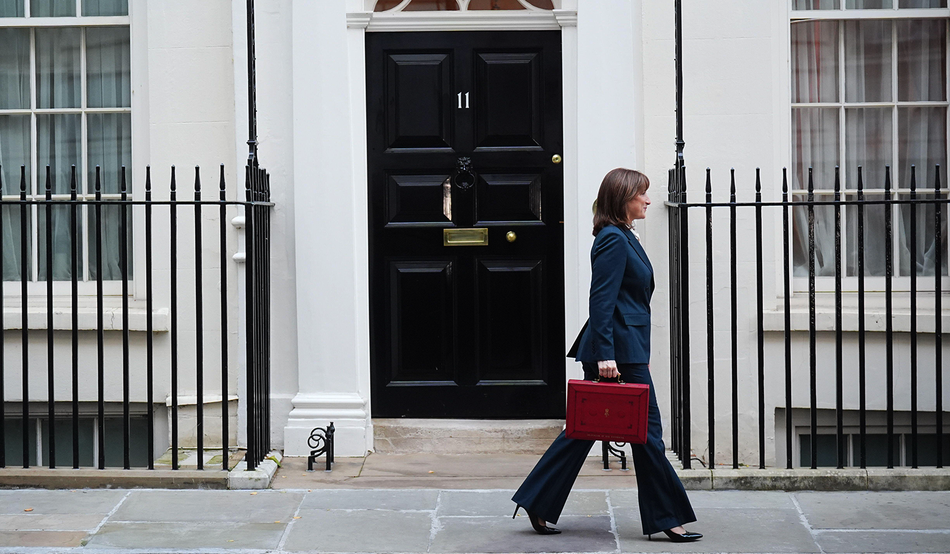
Politics, as we political scientists love to note, is about trade-offs. What happens if you pretend trade-offs don’t exist? In November, the government put forward two major policy strategies. Rachel Reeves’s budget tried to strike a balance between not spooking the bond markets and satisfying the soft left on Labour’s backbenches. The chancellor hoped this would conjure sufficient economic growth to make the maths of her policy choices add up.
Some weeks earlier Shabana Mahmood, the home secretary, launched an immigration strategy which restricted the rights of asylum seekers to stay in the UK and extended the time that legal migrants would have to wait for permanent residency.
But these two policy moments, targeted at different political audiences, cannot possibly work together. They are like two scissor blades poised to snip Labour’s electoral lifeline.
Here is the unpalatable truth for Labour strategists. In 2024, the Office for Budget Responsibility (OBR), which sets the fiscal parameters in which chancellors operate, estimated that, for each reduction in net migration of 100,000 people, the government must increase net borrowing by at least £7bn. This is because migrants cannot access most benefits, pay (high) immigration fees and tend to be young and relatively well-paid, which means they put more into the economy than they take out.
The general problem for Reeves is that she doesn’t have much fiscal room for manoeuvre. While between 2010 and 2022 her predecessors enjoyed more than £30bn of fiscal headroom, Reeves’s much-debated budget left her with £21bn.
And here’s where things get messy. One day after the budget, the Office for National Statistics (ONS) published immigration estimates for the year to June 2025. Net migration, which was 649,000 in the previous year, had declined to 204,000. A drop of almost 450,000 people—or in other words, just over £30bn in potential revenues.
The OBR knew that migration had been dropping, so some of this was already baked into the chancellor’s calculations. But not enough, it seems. In its own budget document, the OBR estimated current net migration to be substantially higher than 200,000 people. Indeed, it still expected it to be above 260,000 in 2026 and then to rise to 340,000 by the end of the parliament. If migration rates continue as they are, according to the ONS’s figures, that would mean another gap of £10bn to fill.
It’s not obvious things will continue as they are. The downturns in migration come from James Cleverly’s restrictions to student, working and dependant visas. The former Tory home secretary announced these at the end of 2023 to counter the surge from Boris Johnson’s more liberal visa regime and his openness to refugees from Hong Kong and Ukraine—what initially the alt-right, but apparently now everyone, calls the “Boriswave”.
Rather than cunningly taking credit for the impending “Cleverly Crash” in migration, Mahmood has opted for cutting numbers further. Blue Labour thinkers have urged the home secretary, their protégée, to go hard on migration to fend off Reform voters. She plans on making it ever harder for medium-skilled migrants to come to the UK, and to massively increase the length of time migrants must wait to receive permanent residency.
There is a danger here of oversteering the ship of the British economy. Migration statistics are slow to update. Net migration is already back to a level below what it was in most years over the past two decades. James Bowes of the University of Warwick recently argued that Mahmood’s policies might set the UK on the path to net emigration: that is, more people leaving the UK than coming to live here.
The massive uncertainty Mahmood has caused for potential migrants doesn’t solely affect the so-called lower-skilled migrants she clearly wants to dissuade. It also affects the wealthy, so-called high-skilled migrants that the UK still allegedly wants to attract. Who would move to here from the US, Canada, Europe, South Korea or Australia for potentially lower wages, exorbitant visa fees and no certainty of being able to stay very long?
Meanwhile the Treasury is still hoping, Mr Micawber-like, for economic growth to turn up and bail Labour out of its foolhardy manifesto pledge to rule out raising taxes. As migration figures plummet, this task will only get harder.
There is one quick trick that could boost British growth. That, of course, is to rejoin the European Union, or failing that, the single market or customs union. But Number 10 has ruled that out for political reasons, too. The same Number 10 that is monomaniacally focused on reducing migration numbers. Oh, and apparently also increasing economic growth.
Labour’s election victory in 2024 contained the seeds of its own demise. It drew “red lines”—on reducing migration, on not raising taxes, and on not joining the EU’s customs union or single market. Those markers are still holding up. But the other “red line” —the one you see on graphs showing how many people intend to vote for Labour? Not so much.
If you need growth to balance the budget and shore up crumbling public services, but you insist on preventing growth that might come from migration or Europe, then something will ultimately have to give. Possibly your time in government.