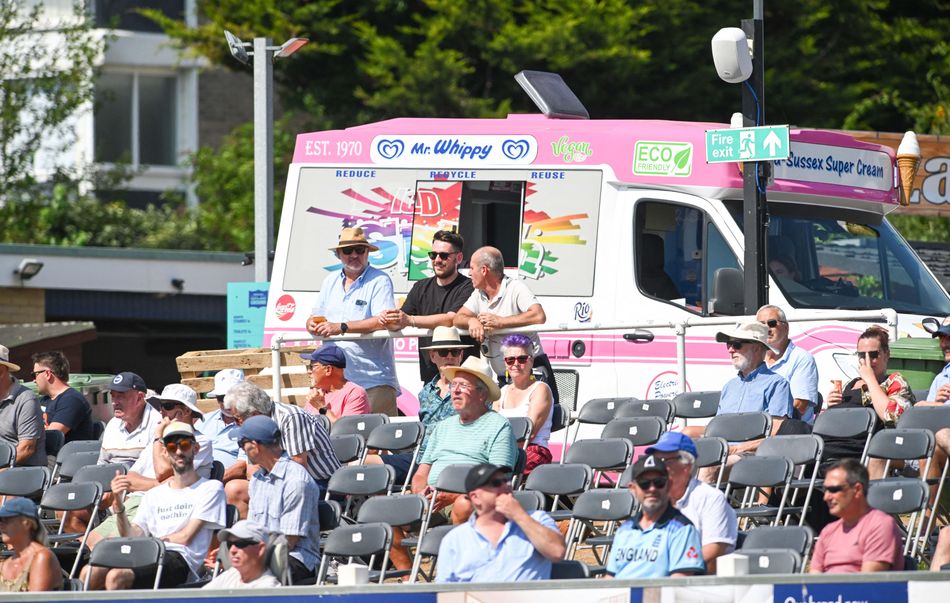
Thirty years ago, when I reported on politics for BBC Newsnight, we occasionally dipped our toes in the murky waters of political theory. As ours was a television programme, we needed pictures. Which was why we ended up one day filming ice cream vans on London’s Exhibition Road...
All will be explained soon. Please be as patient as a child queueing quietly for a 99 Flake from Mister Whippy.
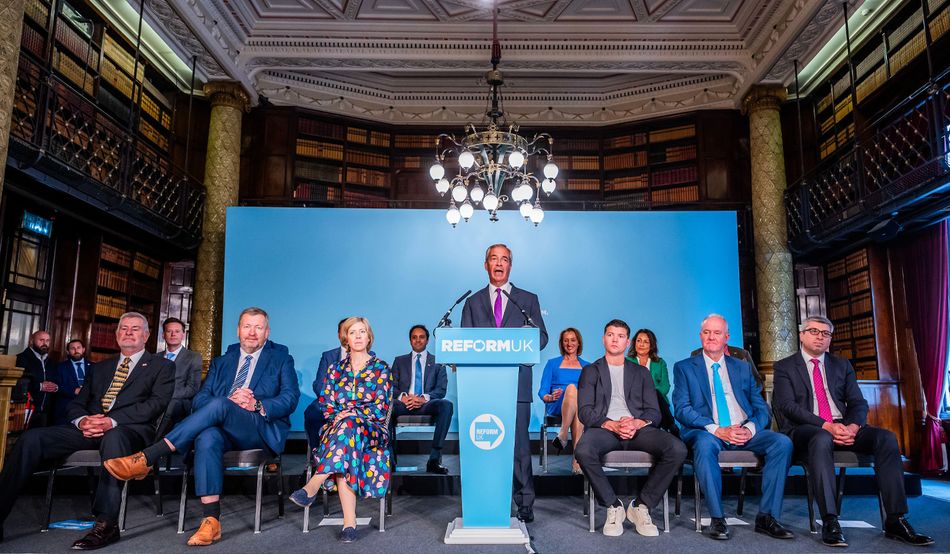
The rise of Farage and Polanski
Let us start with an overview of how politics has changed over the past 12 months. The big story, and it is huge, has been the rise of the insurgents; not just Reform UK but the Greens. As they have risen, support for both of the main legacy parties has slumped.
In last year’s election, support for the two main legacy parties was 59 per cent across mainland Britain (Labour 35 per cent, Conservatives 24 per cent). The insurgency total was just 22 per cent (Reform 15 per cent, Greens 7 per cent). By the end of 2024, the gap had narrowed to 53-29 per cent. This year has seen a steady shift to the insurgents, who overtook the legacy total in September, following Zack Polanski’s election as leader of the Greens that month. For the first time in polling history, the combined popularity of insurgents overtook that of the legacy duo. Insurgents now lead the legacy parties by 46-36 per cent.
Let’s separate what we do know from what we don’t. We know that surges against the two main legacy parties have happened before—in 1981 when the Social Democratic Party (SDP) was formed and joined forces with the Liberals; more briefly in 2010 for the Liberal Democrats following the “I agree with Nick” TV debate between the three main party leaders.
But those surges came from the centre, within the conventional span of political debate. This year’s surges by Reform and the Greens have come from outside it. Further, at last year’s general election, the gap between the legacy and insurgent forces (59-22 per cent) was narrower than ever—but still large. By last December it had narrowed a bit. The big change has happened this year. Meanwhile, other polling, about party leaders and the reputations of the parties themselves, confirms that one of the main drivers of the insurgent surge has been the simultaneous disenchantment with Labour for messing up its first 18 months in office, and with the Conservatives. The opposition has not been forgiven for its record in government, and its divisions and horror shows, from Partygate to Trussonomics.
Deadlock between left and right
While the polls tell a story of voter volatility, in one respect they also tell a story of ideological stability. Here the action took place soon after the election, with an 18-point lead for the Britain-wide parties of the left down to just three points by the end of the year. But since then, there has been little change. Averaging the polls month by month, the five-party total on the left has stayed within a range of 48-51 per cent, compared with a combined total of 47-49 per cent for the two parties of the right. Statistically, the left-right contest has been deadlocked all year.
In recent months, this combination of volatility and stability has generated discussion among political number-crunchers about what is going on. They include Jane Green and Marta Miori of Oxford University and Ben Ansell, also from Oxford (and a columnist for this magazine). They say that Britain has moved from two-party to two-bloc politics, as I have also argued this year. The crucial fact is that many voters have been moving between parties within the two blocs this year, but far fewer have moved between the blocs. Disgruntled Labour voters have shifted mainly to the Greens or Lib Dems in England, SNP in Scotland or, massively, Plaid Cymru in Wales—and from the Tories to Reform everywhere. To be sure, some voters have moved between blocs, most notably Labour to Reform. In a close election they could be decisive. But in 2025 that has been secondary to the main shifts.
Now to what we don’t know. Will the legacy parties recover, or have the loyalties of decades gone for good? If the old days of straightforward Labour-Conservatives combat are truly over, will some kind of new two-party, left-right contest take their place? Or will two centuries of essentially binary battles be replaced by multi-party elections, with majority single-party governments consigned to the history books?
Enter the ice cream vans
Nobody can give a simple, foolproof answer. But here is one way to think about what is happening, which is where we come to ice cream.
In March 1929, shortly before the Wall Street crash and while America’s high streets were still booming, the Economic Journal published “Stability in Competition” by Harold Hotelling, a mathematician at Stanford University. Hotelling wondered why burgeoning competitors were often so alike in what they sold, and why the shops that sold them were so often close to each other. Over the years, Hotelling’s Law, shorn of its complex algebra, has also become known as the ice cream van theory.
Stripped to its essentials, it goes like this. Imagine a 200-metre long beach at the seaside on a warm, sunny day. Two ice cream vans arrive to serve the eager swimmers and sunbathers. Where should they set themselves up? The best answer for the families is 100 metres apart, 50 metres from each end of the beach. Then no customer would be more than 50 metres from a van.
However, that is not what tends to happen, as Newsnight’s crew confirmed when we filmed on Exhibition Road all those years ago. True, this central London street is not by the sea, but it is far nearer the BBC’s headquarters and fitted the bill of being a magnet for tourists, given that it is the site of the Science, Natural History and Victoria & Albert museums.
We arrived in the morning, as two ice cream vans took up their positions some distance apart. After a short while, one of the vans moved closer to the other. Then the second van moved towards the first. After a short while they ended up right next to each other, and there they stayed.
Hotelling’s theory explains why. Each van had a monopoly of the customers at their end of the road. The competition was for the customers between the two vans. The vendors moved in turn to attract more of that business. The process ended when they were next to each other, halfway along the road. Neither had any incentive to move away. The competitive process had resulted in an odd, but perfectly logical and stable outcome, even if it irritated customers at either end of the road who had to walk further for an ice cream.
With ice cream, so with political parties. When Westminster was dominated by two big parties, elections tended to be won and lost in the centre ground. Parties that thought democracy required “a real choice”, such as Labour in 1983 and 2019, and the Tories in 2001 and 2005, were like ice cream vans that moved away from halfway along the beach (or road). They lost more customers than they gained in the process.
Of course, this theory does not explain everything. Different voters are swayed by different factors, whether individual circumstances, the government’s performance, how people view the rival party leaders, passions for particular issues or whatever else. That said, politics shares a basic truth with economics: while individual variations matter, aggregate totals matter more. Being on the right side of the big trends is a necessary, if not always sufficient, condition for victory.
That is why Hotelling’s theory is relevant. What is more, it has been extended over the years to three-way contests and races with more than four competitors.
In three-way contests, there is no configuration that produces a stable outcome—that is, one that leaves all three vans, or parties, satisfied with the position they are in. The theory predicts that one of the three is likely to lose out. This was the fate of the Liberals for much of the twentieth century.
Four-plus contests are different, and change the very nature of political competition. They are never as stable as two-way rivalries. However, the vans, or parties, have an incentive to keep apart to some extent, rather than all crowd together in the middle. This is where British politics finds itself today: not just with more parties, but with a greater variety in where they place themselves on a left/internationalist versus right/nationalist scale.
Lessons for the parties
This analysis suggests clear lessons for each of the Britain-wide parties, and their need to think afresh about how they plan for elections. By “lessons” I mean specifically where they should place themselves on that scale to maximise their support, not what is best for economic growth, law and order, social harmony, personal freedom, averting climate change or securing world peace. It’s an exercise in calculated self-interest. Think of it as the political equivalent of the personal finance pages in the Sunday papers, but “how to look after your votes” rather than “how to look after your money”.
Reform and the Greens are in a similar situation on opposite sides of the spectrum. They are near enough to the end to be distinctive, but not so near that they are dismissed as extremists by potential supporters. Nigel Farage plainly recognises the point, hence his consistent rejection of Stephen Yaxley-Lennon and his ilk.
Zack Polanski has moved the Greens away from the more centrist Liberal Democrats. Were the Greens fighting a life-and-death battle for government, that would have been the wrong choice. But as a niche party, they are like the owners of a van selling only vegan ice cream. Distinctive positioning gets them noticed. Sure enough, the Greens’ polling average under Polanski’s leadership has climbed from 10 to 14 per cent.
On the face of it, the Conservatives have a dilemma: how to reconcile their wish to attract votes from Reform, and at the same time from Labour and the Lib Dems? To return to government they must do both. But the dilemma is solved if their main goal for now is to regain their place as Britain’s biggest right-of-centre party. In that case, they are in a two-party battle with Reform.
In ice cream terms, we have a two-van battle on one half of the beach. Hotelling’s advice would be for Kemi Badnoch’s policies to be “next” to Farage’s, just fractionally to the left. Yes, I know, that conclusion makes me queasy, too. The trouble is that if Badenoch, or her successor, were to make their party significantly more moderate, they would allow even more of the space to their right to be dominated by Reform.
Obeying such advice would leave the Conservatives needing to avoid the reputation of being a pale imitation of Reform. After all, wouldn’t voters on the right prefer the real thing? Saying that it would be wise to follow Hotelling’s advice doesn’t mean to say it’s easy, but that’s politics.
Keeping close to Reform would of course offend all those, and not just Tories, who deplore the absence from British politics of a socially liberal, internationalist party of the centre-right. But as with ice cream vans, competition theory does not always ensure the best outcome for customers.
In their successful years, the Lib Dems have solved their squeezed-third-van problem by engaging in two different forms of two-party competition at local level—mainly against the Conservatives but sometimes, especially in council elections, against Labour. Comparisons between local Lib Dem campaign literature in the two types of contest have demonstrated more cunning than consistency. Whether or not he would have approved, Hotelling would have understood what they do.
Which leaves Labour, the one party that faces in two directions at once. Labour wants to attract the voters it has lost to the Liberals and Greens (and nationalists in Wales and Scotland), but also the fewer but far from trivial votes it has lost to the right, mainly to Reform. Part of the solution lies in whether enough voters, wherever they stand on a left-right scale, end up judging that the government has got enough right to deserve re-election.
But positioning also matters, hence the debate among MPs and ministers over campaigning priorities. Should they look right and target Reform supporters? Or should they look left and win back the larger number of progressive voters who have peeled off to the Greens, Lib Dems, SNP and Plaid Cymru ? The Hotelling answer is clear: if it can’t do both and is forced to choose, Labour should give priority to reasserting its domination over Britain’s progressive voters.
Two battles will decide the next election
In short, as we end 2025, British politics is heading towards two separate contests at the next general election, one between Reform and the Conservatives on the right, the other between Labour and its rivals on the left. Whether the majority in the next parliament comes from the left or right may well depend on which of these two battles ends most decisively, as well as on the impact of tactical voting. Given our electoral system, these could count for more than whether the right or left bloc attracts more voters overall. In Hotelling terms, it’s as if a wall has been built in the middle of the beach, and different ice cream vans are competing with each other on either side of it.
The key point is that the two-van theory of politics, which worked so well throughout the 20th century, no longer operates as it did. The symbols of past battles for the centre—Mondeo man, Worcester woman and the rest—can be retired, at least for the time being. The past year has opened up new opportunities for the insurgent parties. In so doing, it has not just stripped the two main legacy parties of much needed support, but forced them to rethink their strategy for recovery.
March 2029 will mark the centenary of Hotelling’s article being published. At that time, we could be just week’s away from the next general election. Whoever the victor, they might raise a glass, or perhaps a cone, to the man who, even if they do not realise it, set the rules that helped them win.
A version of this article first appeared on Peter Kellners Substack