Day 35 of a hunger strike is generally considered a critical day, in medical terms, for a person refusing food. On day 35, damage done to the brain and organs can become irreversible and an advanced stage of starvation begins. The body starts attacking itself in order to survive, digesting muscle. By day 45, there is a real risk of death.
In the UK, at least seven of the 29 people being held on remand for incidents related to Palestine Action have been on hunger strike; five are currently refusing food and two of them have been for 48 days. All are now in a critical stage, and have begun the process of writing their wills—though none are aged more than 30.
The hunger strike is the largest coordinated one in the UK since the 1981 hunger strike by Irish republicans, which resulted in the deaths of ten prisoners due to starvation.
A letter from the strikers’ lawyers to the government reads: “We are concerned that… there is the real and increasingly likely potential that young British citizens will die in prison, having never even been convicted of an offence.”
Four of the strikers were arrested in connection with the Filton 24, a group charged with criminal damage, aggravated burglary and violent disorder at the site of Israeli-owned weapons manufacturer Elbit Systems UK in Filton, Bristol. The rest were detained after spray-painting two fighter jets at RAF Brize Norton.
All are now in a critical stage, and have begun the process of writing their wills—though none are aged more than 30.
The catalyst for the strike was poor prison conditions, which detainees allege worsened after the proscription of Palestine Action as a terrorist organisation in August of this year. None of the strikers have been arrested under terrorism charges, though—rather, prosecutors say their direct action may have a “terrorism connection.”
One hunger striker, Teuta Hoxha, also previously refused food earlier this year because, following the proscription, the prison had stripped her of a library job and other privileges, in what Hoxha describes as “retrospective punishment.” Prison officials told her that the call to remove Hoxha from her library job came from the Joint Extremism Unit (JEXU), a counter-terrorism body jointly run by the Home Office and the prison service, after the proscription of Palestine Action. This was despite a risk assessment group determining she posed no threat to the library environment. The strikers accuse prison authorities of withholding letters, phone calls and books, and allege that they are being mistreated by guards.
HMP Bronzefield, a privately owned high-security women’s prison in Surrey, did not internally acknowledge 20-year-old Qesser Zuhrah’s hunger strike in its system for nine days, despite being required to record it by day three at the latest. On its record, she has only been on hunger strike for 38 days, not 48. That means she was not afforded the medical treatment that is warranted for a detainee who has been in a potentially critical condition for a number of days. Zuhrah’s designated “loved one” and next of kin, Ella Moulsdale, says that it is hard to watch her walk. “You can see a visible difference… you can see her bones,” she says. “It’s harder for her to pray, to go down on her knees.”
“I have yet to see a single day on which a hunger striker has received an adequate and comprehensive medical check-up,” says James Smith, an NHS emergency doctor. He calls the amount of force used against the strikers “disproportionate” compared to the standard set out for prisoner treatment. More than 800 British healthcare professionals have also signed a letter expressing “grave concern” about the prison healthcare system’s adherence to certain medical and human rights protocols in relation to the hunger strikers.
Zuhrah has been hospitalised on multiple occasions. The fact of hospitalisation, much less the hospital’s location, is not disclosed to Moulsdale. Last week, after an assessment at the hospital, Zuhrah was offered intravenous (IV) treatment and asked to call her lawyer first, a request which was refused. She was returned back to the prison in a worse condition than when she left, Moulsdale says.
Another hunger striker—Kamran Ahmed, who is held at HMP Pentonville—was handcuffed to his bed in a hospital for the duration of his medical examination, and later handcuffed to a prison guard while taking a shower.
At a press conference, Smith said that “the shackling of prisoners while in hospital, even when using toilet facilities, showering or undergoing medical examinations… is something I have never seen [before] or experienced in my medical career”. He says Ahmed’s experience in the hospital was so humiliating that he has refused to go back despite the nurse advising him to return. He has developed ulcerations in his mouth and an irregular heartbeat.
Smith, who is familiar with prison healthcare protocol, says that if someone doesn’t pose a risk of violence or flight, there is no real reason that they should be restrained. During their time in prison, none of the hunger strikers have engaged in an act of violence.
“The shackling of prisoners while in hospital, even when using toilet facilities, is something I have never seen in my medical career.”
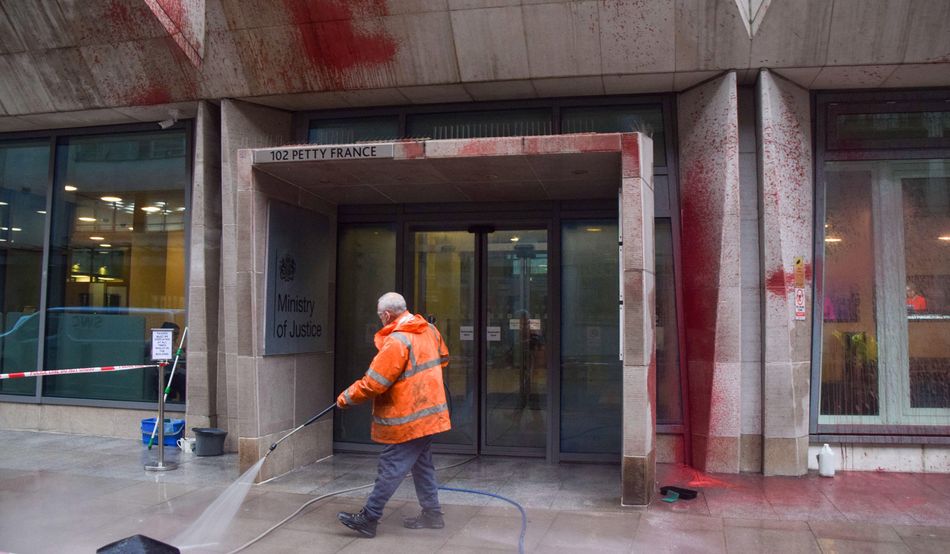
The Ministry of Justice (MoJ) responded to a request for comment by saying that all actions are documented and reviewed to ensure compliance with HM Prison and Probation Service (HMPPS) policy and the UN Standard Minimum Rules for the Treatment of Prisoners. It added that the ministry has had no record of complaints from NHS staff that prison officers have obstructed health care.
Two weeks ago, justice secretary David Lammy appeared to have no knowledge of the strike. When confronted by Ahmed’s sister Shahmina Alam, who stressed that five of the hunger strikers had been hospitalised, he asked if this was happening “in the UK?”
Letters from lawyers and MPs to the prime minister, deputy prime minister and Ministry of Justice have largely gone unanswered and suggested meetings have been declined, including one proposed by more than 50 MPs and peers. At Prime Minister’s Questions on Wednesday, Starmer responded to a request to meet with representatives of the strikers by saying there “are rules and procedures in place in relation to hunger strikes and we’re following those rules and procedures.”
James Timpson, minister of state for prisons, probation and reducing reoffending, says systems for dealing with hunger strikers are “robust and working”. He adds, “I don’t treat any prisoners differently to others. We have a justice system that is based on the separation of powers, and the independent judiciary is the cornerstone of our system.” For that reason, he said, the government “will not be meeting any prisoners or their representatives”.
Even if the hunger strikers survive, they could face long-term physical and neurological consequences. Umer Khalid, who suffers from limb-girdle muscular dystrophy, was already finding it difficult to sit on the third day of striking. On day seven, Umer made an emergency call for medical attention from his cell, which was not responded to. A nurse at the hospital allegedly accused Khalid of “dragging on her day.” Khalid and one other have now ended their hunger strikes, though five others are continuing.
On Thursday evening this week, Zuhrah began experiencing sharp pains to her chest, dizziness and shaking limbs. Moulsdale says Zuhrah couldn’t get up from the cell floor, but buzzed for a nurse. She was made to wait for two hours until the night nurse began her shift. After checking her vital signs, the nurse promised to return in 10 minutes. Two hours later, Zuhrah buzzed again, asking: “Can you ring an ambulance? I’m scared.”
Prison authorities apparently hung up on Zuhrah, her next of kin, as well as her lawyers, who were requesting health updates. A nurse arrived at 2am, and reportedly told Zuhrah: “You don’t decide if you go to hospital, I do.” She was only taken into the hospital the next morning after losing consciousness, almost 12 hours after an electrocardiogram had reportedly flagged anomalies in her reading.
When asked to comment on these claims, the MoJ noted that prison healthcare services can manage and respond to a wide range of health conditions, including food refusal, and said that it may not be necessary to take prisoners to hospital when services are available in the prison. It said that prisoners are taken to hospital on the advice of prison healthcare staff.
Mousdale alleges that the Muslim detainees and detainees of colour have been treated differently to the other hunger strikers. She says that Zuhrah received medical attention significantly later than the two other hunger strikers in Bronzefield, and to a lesser extent. She further says a security chief threatened to forcibly remove the keffiyah used by Heba Muraisi, another striker, as a hijab during prayers. Muraisi, who has family in Gaza, was also allegedly refused a Covid mask, and is now unwell.
In a diary entry from the days before she began striking, Zuhrah wrote: “I can admit to being worried that I’ll let you all down. How can I know I’m strong enough to override my body’s demands? How can I know that our demands are worth overriding my body’s?”
The strikers’ demands include being allowed immediate bail with conditions, and a fair trial, which they say involves the government disclosing what Home Office officials discussed in a meeting with Elbit Systems representatives in December 2024, seven months before the proscription of Palestine Action.
According to a police file viewed by investigative journalists at Declassified UK, Elbit Systems UK has “its own intelligence cell and share[s] information with the police on a two weekly basis”. Elbit Systems, its parent company, is Israel’s largest private arms contractor, supplying 85 per cent of Israel’s deadly UAV drones and land-based equipment. In the past, Elbit has also manufactured weaponised white phosphorus munitions and cluster bombs, controversial weapons which human rights bodies have also recorded being used in Gaza. The demands also include the de-proscription of Palestine Action as a terrorist body and the shutting down of all Elbit sites in the UK.
The strikers’ demands include the government disclosing what Home Office officials discussed in a meeting with Elbit Systems representatives in December 2024.
Zuhrah, in a critical condition, is now on day 48 of her hunger strike. In 1981, Irish republican Martin Hurson died on day 46. Katherine Bains, Moulsdale’s mother, worries that “because this is not in the public eye, the British state will once again let [the hunger strikers] rot in a prison and die”. Zuhrah’s trial is currently scheduled for April 2026. On Friday, she was denied bail.
I ask Ella Moulsdale what her biggest fear is with regards to Zuhrah. “She is turning 21, and she was incarcerated at 19. She has so much life to live,” she says. But Moulsdale thinks that the state’s seeming indifference to the hunger strikers echoes its lack of regard for Palestinian lives. “They treat her this way”, she says of Zuhrah, “because they don’t care if she lives or dies”.
HMP Bronzefield and the NHS did not respond to additional requests to comment.