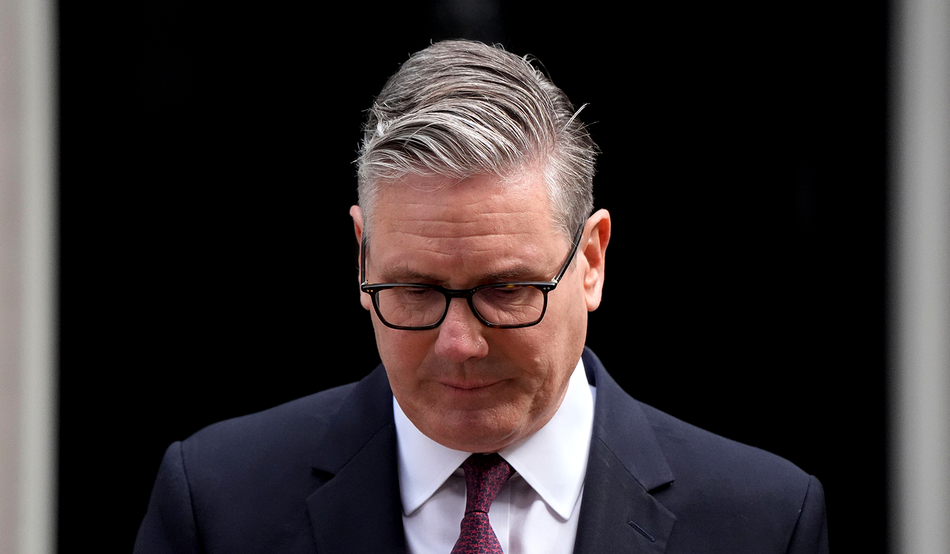
An English funeral hits with full force at the moment when a stiff upper-lip momentarily wobbles and a steady voice begins to choke. Keir Starmer’s eulogy to himself achieved the same effect. Arguably the most buttoned-up prime minister of recent times opened the door of Number 10 on Monday morning and held back tears as he conceded that his game was up. The palpable intensity of his feelings on being driven from office contrast with his failure to engender a true sense of purpose while he held it. Starmer’s tragedy is that he never figured out a way to govern as himself.
His central problem wasn’t the (real) difficulties of the times in which he served, nor a lack of practical action. At least some of the achievements that the PM rattled through, before he reached his accidentally emotional denouement, were real wins, from stronger renters’ rights to mended relationships with European allies. Unfortunately, he could never join the dots between what he was doing and what he wanted to do next in a way that showed the country where he sought to take it.
It is tempting but misleading to dismiss his failing on this count as superficial, merely the lack of a silver tongue or poetic way with words. The issue has not merely been the absence of a media-friendly “narrative”. It has been that the colleagues and officials around him, of the sort that any prime minister must rely on to translate their vision into reality, never developed a reliable feel for the instincts of the man at the top. From the very start, his aides were disorientated and fighting like ferrets. Transformative prime ministers, by contrast, need the room to be strategic. Armies of aides should already understand the spirit in which they are expected to plough through the minutiae. That was true not only of Margaret Thatcher but also of Clement Attlee, even though he was an even more restrained personality than Starmer: he let his programme do the talking.
Starmer, on the other hand, was a social democrat who eventually landed on a reading of public opinion as so irredeemably reactionary that he came to doubt decent social policy could ever be squared with electoral success. The two most notable achievements on the long list he read out were falling NHS waiting lists and lifting hundreds of thousands of children out of poverty. The first was achieved by reaching for the “tax lever” which he had vowed not to touch; the second by abolishing George Osborne’s two-child limit on social policy, which he had made a great show of insisting he wouldn’t change. Two years of Starmer has improved the UK in various ways, but bequeaths no trace of an argument about what needs to happen next.
The hesitancy about standing up resolutely for anything goes deep, perhaps back to the father whom he has described as stingy with praise. It also goes a long way to explaining why a leader whose record on public policy is no worse than mixed has plumbed such ruinous depths of unpopularity. As human beings, long before we engage with the substance of what someone is saying, we can tell if they are speaking freely from the heart, or instead with suspicion-inducing calculation.
Speak to anyone who knew Starmer in his long career in radical lawyer-land and they’ll say he would have been turned off by the flag-waving patriotism he attempted to make his signature in office. This former human rights champion was, at best, hesitant in condemning Israeli war crimes abroad. At home, meanwhile, he ended up criminalising some of the activists opposing Israeli rights abuses and labelling them as terrorists.
The indifference with which he discarded the pledges he made to the Labour members who made him party leader is notorious. A political leader who was keen to take the knee and happy to publicly contemplate sending himself on unconscious bias training ended up, just a few years later, having his X account run by someone who thought it a good idea to post pictures of black men being fingerprinted by border guards. The prime minister who—surely and rightly—loathes Donald Trump didn’t just signal his practical readiness to do business with him. He insisted, “I like and respect him.”
When, in time, we get the Starmer memoirs, I doubt that many of these many inauthentic postures will command much space. Instead, I suspect, we’ll get the story of the big election win, a lot of detail on individual policy reforms and then bemusement about Westminster’s lack of regard for substance. What the despondent country and a fracturing Labour coalition needs, however, is not merely a prime minister who works hard. It needs a prime minister who is sure enough of who they are, and of what they believe, to put themselves into the job.