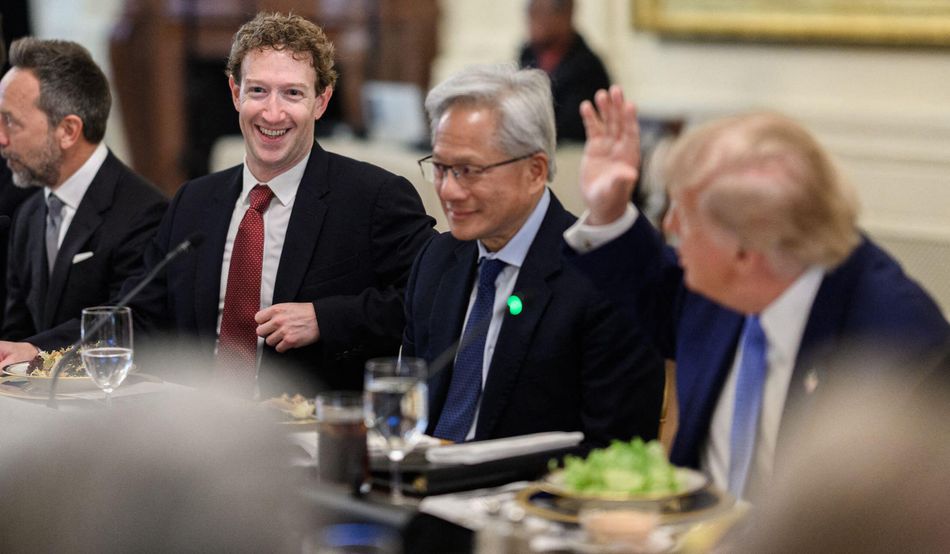
We do not, as a rule, televise blood sports these days. But periodically there are still moments when we watch excruciating dismemberments on live TV. They are called congressional hearings and involve bumbling, out-of-touch legislators asking inane questions of tech bros.
We will all have our favourite moments. Was it in 2018, when former senator Orrin Hatch demanded of Meta’s Mark Zuckerberg how on Earth he could sustain a business model if the product was free? A startled Zuck took some moments to process the question before responding: “Senator, we run ads.”
A flummoxed Hatch responded: “I see. That’s great.”
Or perhaps it was in the same year, when Representative Steve King challenged Google’s CEO, Sundar Pichai, about how offensive language had popped up on his iPhone. How had Google allowed that to happen? Pichai was obliged to explain that the iPhone was made by a different company.
Another senator thought he had Zuckerberg on the ropes when he demanded: “If I’m emailing within WhatsApp, does that ever inform your advertisers?” The Facebook boss pondered how politely to explain to his interrogator that a) WhatsApp doesn’t do email; and b) WhatsApp messages are end-to-end encrypted.
Those with longer memories will savour the performance of Senator Ted Stevens, in effect the main guy in charge of creating internet policy at that time (2006), trying to get to grips with his brief: “I just the other day got, an internet [sic] was sent by my staff at 10 o’clock in the morning on Friday and I just got it yesterday. Why?… Because it got tangled up with all these things going on the internet commercially… They want to deliver vast amounts of information over the internet. And again, the internet is not something you just dump something on. It’s not a truck. It’s a series of tubes.”
You get the point. The elected body charged with overseeing the defining technology of the early years of the 21st century has often floundered, barely comprehending how it even works. Twenty years after Facebook’s public launch, legislators are still struggling to figure out how, or even whether, to regulate social media.
And here we are in 2026 faced with an even more complex technology which, some of its creators themselves argue, comes with a 10 per cent chance of wiping out humanity itself within a decade. How does a democracy oversee something so potentially lethal when its leaders are still struggling to get to grips with TikTok?
In one way, this is simply a new variation on an old theme. In 2008 it became apparent that few MPs had the foggiest clue about the financial derivatives which crashed the global economy. Not only MPs, but regulators and bank boards: the expertise sat almost exclusively inside the firms which were themselves spiralling out of control.
The same legislative cluelessness was exposed by the Snowden revelations in 2013. It soon became obvious that most lawmakers, in the UK as in the US, had no real grasp of bulk collection or what metadata reveals. I remember watching Philip Hammond, then defence secretary, being reduced to incoherent rambling as he tried to explain how bulk interception warrants were supposed to work. The only people who truly understood it were the nerdy hobbits inside GCHQ and the NSA. And there appeared to be no meaningful oversight of their work.
I turned to AI itself to find out how many MPs today might have the real expertise to begin to interrogate the companies which are urgently flagging up warnings about the risks involved in their own work. ChatGPT reckoned that, out of 650 MPS, there was only one—Dr Allison Gardner—who might have the intellectual chops, based on her PhD in computational biology. In the upper house there is Lord [Lionel] Tarassenko, who has been involved in the practical applications of machine learning.
In Congress, Claude identified for me just four representatives who, on paper, might be equipped to go head-to-head with the people designing and building the technology which might wipe us out. For the most part, on both sides of the Atlantic, our lawmakers lack the conceptual literacy, a grasp of the policy implications or the research understanding to weigh up issues around risk, safety testing or how models fail.
But, unlike the banks in 2008 or the spooks in 2013, it appears that even the insiders are themselves struggling to comprehend what’s going on. Dario Amodei, Anthropic’s CEO, wrote in 2025 that “people outside the field are often surprised and alarmed to learn that we do not understand how our own AI creations work”. He added: “They are right to be concerned: this lack of understanding is essentially unprecedented in the history of technology.”
The dilemma is not dissimilar to the arguments, 40 years ago, over the threat of nuclear annihilation. A key text of the time, Robert Dahl’s 1985 book Controlling Nuclear Weapons, foreshadowed the debate today. As with AI, nuclear strategy is extraordinarily complicated; knowledge is specialised; mistakes can be catastrophic; and citizens cannot possibly master all the relevant physics, command-and-control systems, intelligence, game theory and military doctrine.
Dahl questioned whether wisdom was more important than democracy: he explored the concept of what he called “guardianship”—decisions being taken by a small group of supposedly better-qualified experts. He rejected it.
But, as he conceded, experts aren’t necessarily equipped to make political or moral judgements. There’s no reason to suppose that “guardians” are themselves reliably benevolent or disinterested. Which takes us back to democratic oversight—always assuming that there is sufficient competence—both among voters and their representatives.
Dahl was candid about how far reality fell short: “We have in fact turned over to a small group of people decisions of incalculable importance to ourselves and mankind, and it is very far from clear how, if at all, we could recapture a control that in fact we have never had.” As one reviewer wrote at the time: “His trust in a better educated and involved public means that the book ends with a whimper rather than a bang.”
That debate in the Eighties was itself an echo of the famous and prolonged discussion in the 1920s between the philosopher John Dewey and the journalist and social critic Walter Lippmann. In crude terms, Dewey believed that the press played a crucial role in creating a better-informed public which would, in turn create a better democracy.
Lippmann was not so sure. It was a nice idea in theory, but he was more sceptical about the nature of the press, the function of journalism and the capacity of the public to participate in democratic discussion. The modern world was too complex for the public to play the role that liberal democracy demanded.
A century later, here we are facing the same intractable problem—only worse. The American public, in their collective wisdom, have elected a president who is self-evidently clueless about this technology which, its creators argue, could at any point veer out of control and finish us all off. For Trump, it’s all about beating the Chinese and fluffing the stock market.
We urgently need more lawmakers to be better informed about the technological revolution that seems certain to dramatically alter our societies. But we also need philosophers, historians and political scientists to grapple with issues of language, oversight, control and democracy.
Don’t close down those humanities departments just yet.