In an office on the first floor of an unassuming building in Harwell, Oxfordshire, on a campus that is quietly becoming one of Europe’s busiest hubs of space innovation, Martin Soltau is proposing something that sounds like science fiction.
Trained as a mechanical engineer, Soltau today believes he holds the key to the United Kingdom’s clean energy future: a cheap technology that would create thousands of skilled jobs and put the country at the forefront of a new era of abundant, clean power. He wants to build a power station, but it would not be in Britain: it would sit in geosynchronous orbit, matching the Earth’s rotation, approximately 36,000km above, beaming power back down 24 hours a day.
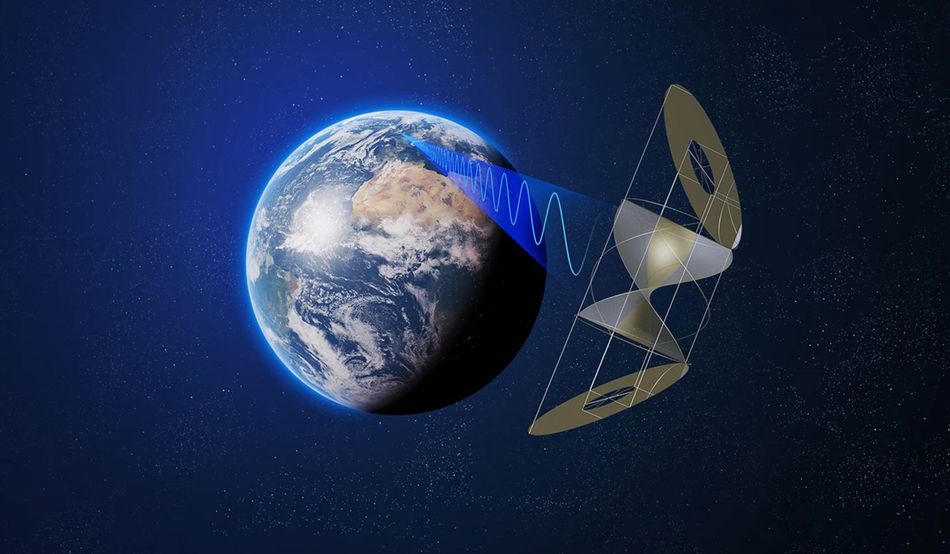
Soltau is co-CEO of Space Solar, a startup he founded four years ago with Sam Adlen to realise the vision of space-based solar power. Their ambition, shared with chief technical officer David Homfray and chief architect Ian Cash, is staggering: to build a sun-pointing satellite more than a kilometre wide and weighing 800 tonnes that would beam more than 600 megawatts of electric power via microwave to Earth, where receiving stations some 3.5km in diameter would convert the satellite’s radio energy back into electricity.
Since the sun always shines in space, this would be steady, predictable power that would help the UK and the rest of the world cut emissions to net zero, and would suffer from none of the factors that interfere with solar energy generated on the ground. In space there are no clouds, no nightfall, no seasons, just an uninterrupted stream of sunlight roughly 13 times more intense than anything a solar panel receives on a cloudy afternoon in Britain. It could help grids deal with intermittent renewables, while bringing jobs to the nations able to seize the opportunity. This plan, which still sounds like a fantasy solution, may be inching towards reality.
The idea of beaming electricity wirelessly is as old as the electric age itself: Nikola Tesla imagined using landbased transmitters to power moving targets such as airships at the end of the 19th century, and in 1923 a Russian rocketry pioneer, Konstantin Tsiolkovsky, predicted that concentrated sunlight might one day be reflected from orbiting mirrors in space to provide clean heat on Earth. In the 1940s, a young biochemistry student and science-fiction writer named Isaac Asimov published a short story in Astounding Science Fiction, the popular American monthly magazine, about two engineers who are sent to Solar Station Number Five, a space station run by robots that collects solar energy and beams it by microwave to Earth.
Decades later, Czech-American engineer Peter Glaser had turned Asimov’s fiction into an engineering proposal. In 1968, he published a paper in the journal Science arguing that the United States needed to develop alternatives to oil and gas because those finite fossil supplies would inevitably run out. Then, in 1973, Glaser, who had worked on the Apollo 11 moon programme, was granted a US patent for what he called a solar power satellite: a design comprising two satellites in geosynchronous orbit, positioned so they would always be exposed to sunlight. This would ensure a constant supply of energy beamed down to the ground. It was a remarkably detailed plan, complete with estimates of transmission losses and the likely size of the ground infrastructure that would be required.
Yet even in the era of Apollo-fuelled optimism, when the sight of men landing on the moon seemed to open infinite possibilities in space, Glaser’s proposal required technologies that were far from mature: solar cells were less common, and they were heavy, expensive and inefficient. Still, Glaser was convinced that space-based solar power would soon become achievable and affordable. He also believed that it was a more viable option than both nuclear fission, which he saw as expensive, hazardous and productive of toxic waste, and nuclear fusion, which he regarded as a physicist’s impossible dream.
Although the US government was sufficiently persuaded to give Nasa and the Department of Energy $20m over the following decade to spend on research, and although they concluded in 1979 that a 300-gigawatt (GW) system built from 60 satellites was technically achievable, the government scrapped the project over uncertain costs and worries about environmental impact. The idea was appealing, but the moment had not arrived.
China has demonstrated in earthbound tests that it can beam power to multiple targets
There has been intermittent interest elsewhere over the years. In 2009, the Japanese government called for a programme to “lead the world in space-based solar power” with the aim of creating a fullscale system by 2030—though that ambition has since slipped. The Solaris initiative, from the European Space Agency, assessed the case for gigawatt-scale orbital power stations, but garnered insufficient enthusiasm among member states to put it into practice.
China, meanwhile, has approached the technology with characteristic scale—and some success. After two senior academics wrote to Xi Jinping in 2013, urging him to invest in the technology, the president ordered a vast review which duly produced a national roadmap. The China Academy of Space Technology, a major institute in the country, has since demonstrated in earthbound tests that it can beam power to multiple targets, and a national committee on space solar power was established in 2021. Researchers in China have now designed a system called Omega, which they say will supply 2GW of power to Earth by 2050. Space solar power was included in China’s recently published five-year plan for the first time.
After decades of fickle federal interest, it was private philanthropy in the US that was to produce a breakthrough. In 2013, the property billionaire Donald Bren, whose wife sat on the board of trustees at the California Institute of Technology, gave the private university a secret $100m donation to fund a mission. Launched in January 2023, the Space Solar Power Demonstrator successfully beamed power from space to Earth for the first time. The project wrapped up, mission accomplished, in November of that year.
The success followed breakthroughs in two of the critical challenges for space-based solar: how to get a giant structure into space and how to keep it pointing at both the sun and the Earth when the angle between them constantly changes.
After more than a century of false dawns and cancelled budgets, the moment may have finally arrived for the technology to take off.
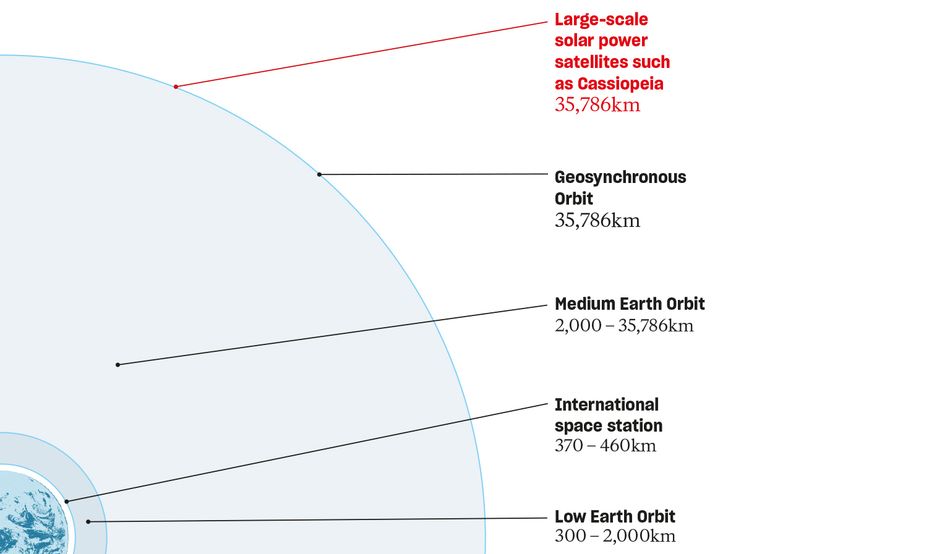
As Peter Glaser predicted, the technologies necessary to make space-based solar a reality have become cheaper and far more efficient. A key breakthrough was the development of partially reusable rockets by SpaceX and Blue Origin, which reduced the cost of space launch dramatically. The next generation of fully reusable heavylift rockets promises to cut launch costs further still.
But it was Ian Cash, the electronics and computer science graduate and now the chief architect at Space Solar, who had solved one of the other problems: how to capture the sun’s energy continuously on a fixed object, despite the solar system’s constant movement.
In 2017 and 2018, he filed the core patents for a radical design called Cassiopeia (an acronym for “constant aperture, solid-state, integrated, orbital phased array”). Before Cassiopeia, the proposed solutions had been mechanical and fatally cumbersome. But Cassiopeia’s design uses large, fixed mirrors to keep its solar cells receiving the sun, and steers its power beam electronically across a full 360 degrees with no moving parts. The result is a satellite that is lighter and cheaper. Critically, it can also be assembled in space from hundreds of identical mass-produced modules, rather than built and launched as one huge, bespoke structure. As a kilometre-long network of small parts, it would also be resistant to any attack or accidental strike, since the whole would continue to function even if a part of it was damaged.
When Cash presented Cassiopeia at the National Space Society’s 2018 development conference in Los Angeles, to an audience that included Amazon founder Jeff Bezos and former astronaut Buzz Aldrin, it was hailed as a game-changing conceptual breakthrough.
Meanwhile, others have reached similar conclusions: John Mankins, a Nasa veteran who had spent 25 years working on space solar power projects, has developed SPS-Alpha, a modular design that found inspiration in the way a hive of bees or a colony of ants can build structures from large numbers of small, identical, “intelligent” modules. A Nasa-funded study that Mankins led in 2012 concluded that, with the right technological advances, such a system could eventually deliver electricity at around 9 cents per kilowatt-hour—equal to, or cheaper than, conventional sources. “If we’d pursued space solar power in the 1980s,” Mankins has said, “the platforms would be operational today.”
The UK government’s formal interest in space-based solar power only began in 2020, when it commissioned the consultancy Frazer-Nash to assess whether it could help the country meet its 2050 net zero emissions target. The resulting report, which was led by Soltau, then a partner at Frazer-Nash, concluded that it was technically feasible, could be competitively priced against other clean energy sources, and would deliver substantial economic benefits in manufacturing capacity and jobs. It proposed a “first of a kind” satellite that would deliver roughly 2GW of power to the grid, the equivalent of the output of a nuclear power station, with receiving antennas that would need only one third of the land area required by a terrestrial solar farm and that could be located alongside offshore wind farms to minimise the land footprint and to share grid connections. It suggested that a staged development programme start right away, aiming to demonstrate the technology in space by 2031, a first operational system feeding the grid by 2040, and space-based solar systems capable of meeting some 15 per cent of UK electricity demand by the early 2040s. The estimated cost was around £16-17bn, with the expectation that the public sector would fund the first phase of roughly £350m over five years, before private capital could take over.
Following the report, in 2022 the UK government launched a £6m feasibility study, split between the Department of Business, Energy and Industrial Strategy (BEIS) and the UK Space Agency, to examine photovoltaic cells, wireless power transmission and systems engineering. It was, by the standards of national infrastructure spending, a modest sum, but it proved to be the high-water mark. While the UK government continues to fund the development and testing of the technologies necessary for space-based solar, including in-orbit assembly and manufacturing, launch capability and high-efficiency solar cells, dedicated government funding for space-based solar power has since dried up.
The successor department to BEIS, the Department of Energy Security and Net Zero, deprioritised the initiative in favour of investment in a range of other technologies—some proven to be affordable and effective, like terrestrial renewables, others, like carbon capture and storage and nuclear fusion, less so. As one industry insider close to the programme explained, “BEIS saw space solar power as a way of decarbonising the grid: it was an energy problem. When energy [department] pulled out, the space people saw no reason to continue.”
Soltau argues that Britain is in a strong position on a technology that will only grow in importance. “We are in the lead now,” he says, “but we won’t be for long.”
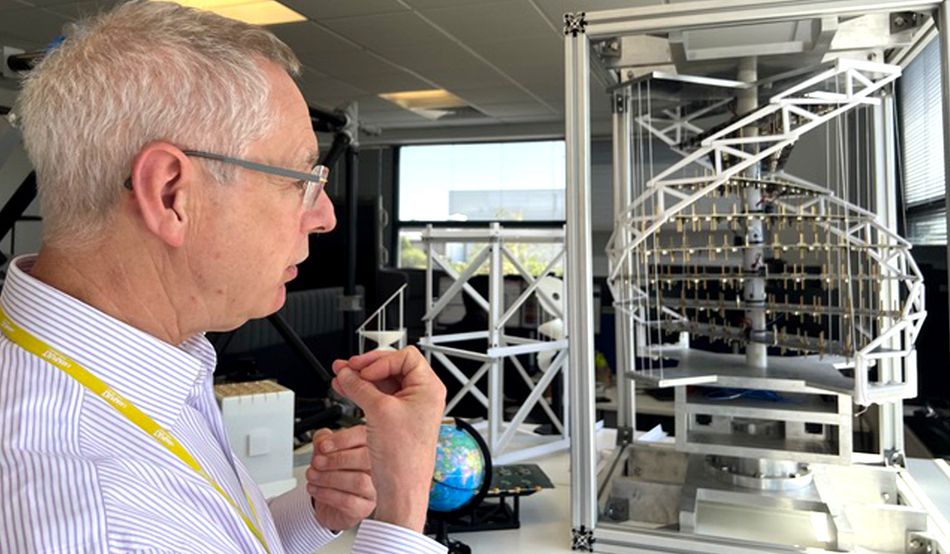
He puts the funding gap down to a failure of institutional imagination as much as of ambition. His frustration, shared with other supporters of space-based solar, is that the government also continues to spend billions on chasing the dream of endless power from nuclear fusion which, as Glaser observed in the 1960s, is unlikely to deliver. The UK government is backing the construction of a prototype fusion power plant in Nottinghamshire with £1.3bn. It is also investing £45m to fund the world’s most powerful fusion‑dedicated AI supercomputer to accelerate fusion design, modelling and operations. And yet Soltau maintains that the promise of fusion, which “has been held up for decades as this holy grail of energy—cheap and infinite, no waste, no fuel, just perfect energy too cheap to meter”, will not be fulfilled. “There are still incredible challenges to overcome,” he says, adding that it is impossible to know how cost-effective power generated by nuclear fusion would be, even if the technology could be made to work, without a costed design for a commercial fusion reactor. “We have an engineered design. They do not,” he says.
David Homfray, now Soltau’s colleague at Space Solar but formerly the engineer in charge of the Joint European Torus, the world’s largest fusion experiment, shares his view. Homfray was part of the team that developed a £220m programme to commercialise fusion power. He concluded that it was unlikely to work.
The business case for space-based solar is only getting stronger. The entry of private space entrepreneurs like Elon Musk into the market transformed the cost of launching rockets, and the design breakthroughs of a modular system, as used by Cassiopeia and SPS-Alpha, reduces the cost of manufacture and makes feasible the launch of what, once assembled in space, will be very large structures. At the same time, the potential customer base has expanded.
It has long been thought that energy could be beamed from space to remote or disaster-hit regions on Earth that lack conventional grid infrastructure, Soltau notes. “We’re working very closely with the British Antarctic Survey who’ve got a real challenge,” he says. “Their whole remit is climate science, but they can’t decarbonise their own operations.” Space Solar is working on a pilot project that will eventually beam power from low-Earth orbit to British scientists working on the continent.
According to Mark Garnier, a Conservative MP and a non-executive director of Space Solar—who no longer lobbies government on behalf of the project because he recently acquired share options in the company—there are also big commercial prospects in the satellite’s capacity to beam energy wherever there is a receiving station. “If you fly your satellite over Nairobi,” he explains, “it can see the UK, its prime market. It can also see India, so we can be selling electricity there when we have no demand, or to Tashkent, or the Middle East, or across Africa. If you’ve got another satellite placed slightly to the west, you can see as far as Brazil or the east coast of America. You can sell electricity across a third of the planet, to whoever is the highest bidder at any given moment, 100 per cent of the time. It’s an incredible investment opportunity.”
There’s a keen military interest from countries including China and the US. Bases that allow troops to operate far from home generally depend on diesel generators supplied by fuel convoys. These are a huge vulnerability: delivery costs in war zones can run into hundreds of dollars per gallon, without counting the cost in lives lost defending convoys from enemy action. A satellite that could direct its beam to a lightweight, portable receiver anywhere on Earth offers a compelling alternative: near-instant power, with no exposed supply lines.
The dramatic development of AI, and the data centres it requires, have sent energy demand rocketing—and prompted perhaps the most striking shift in attitudes to space-based solar. The world’s first trillionaire, Musk once called space-based solar one of the stupidest ideas he had ever heard. Why put renewables in space, he asked, when they can work on Earth? But global electricity demand from data centres is projected to double in five years, reaching 950 terawatt-hours (TWh) by 2030, in large part because of AI. The Big Five hyperscalers (Amazon, Alphabet, Meta, Microsoft and Oracle) will spend more than $725bn on AI infrastructure in 2026 alone, a 77 per cent increase on 2025 and close to the entire GDP of Belgium. Despite the huge outlays, the US market now has a 9.3GW shortfall in capacity, which could widen to 45GW by 2028, according to Goldman Sachs. Musk is now a fervent advocate.
As AI competition heats up, the ambitions of the hyperscalers are crashing into the hard limits of terrestrial power generation: shortages of critical minerals, long waiting lists for grid connections and gas turbines add up to delays so severe that some companies are contemplating a return to coal and Musk’s firm resorted to using dozens of unregulated natural gas turbines to power supercomputer clusters in Memphis, Tennessee. For Musk today, not only might data centres need to go into orbit, but the energy solution also lies in space.
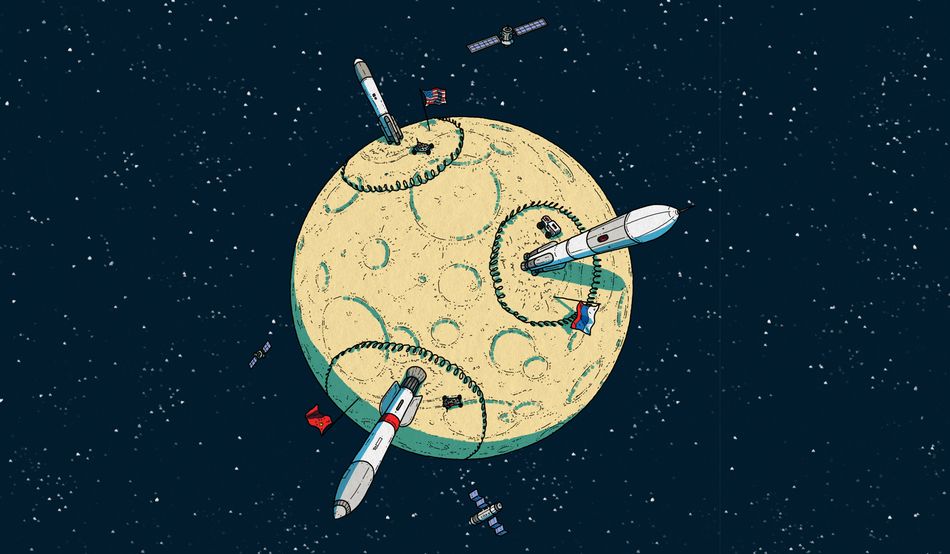
Meanwhile, China’s ambitions for a permanent lunar base, plans to mine water ice at the lunar south pole and eventually to mine asteroids, will all require far more power than conventional solar arrays can supply. Power beamed from orbiting satellites could, in principle, direct energy to lunar mining operations, or to space-based manufacturing, as well as to Earth.
Soltau believes that the compounding of all these trends—falling launch costs, maturing modular manufacturing, an explosion in orbital and lunar demand for power, and the urgent energy crunch driven by AI—have made it possible that space-based solar will be the key to delivering the cheapest form of clean power, outperforming earthbound renewables.
Today, wind power in the UK costs more than £100 a megawatt hour for intermittent supply, and must be supplemented by other costs to make it reliable. Meanwhile, Soltau estimates that “if the prices remain broadly the same as today, our levelised cost is £30 a megawatt hour”—and could fall to as little as £10 a megawatt hour if Elon Musk and others reduce the costs of launches further. The only snag? “If SpaceX have a monopoly, the prices may stay high.”
There remain good reasons to be sceptical about this technology’s potential. A Nasa lifecycle assessment published in January 2024, shortly after Caltech’s demonstration, concluded that current designs remained between 12 and 80 times more expensive than terrestrial renewables—though Space Solar advocates argue that these numbers are now out of date.
Some astronomers fear that vast reflective structures in geostationary orbit would mean the loss of dark and quiet skies. And because satellites in geostationary orbit do not naturally burn up on re-entry, as low-orbit satellites do, the deployment of space-based solar would add seriously to the long-term space debris risk unless careful recovery plans are created.
Humanity has never built or maintained a struture in orbit on the scale of the satellites projected
Safety and regulatory questions may also delay deployment. Securing the radio spectrum allocations demanded by such an ambitious project is a slow, multilateral process conducted through the UN’s International Telecommunication Union and national bodies such as Ofcom. All this could add up to decades of delay.
In addition, the robotics required have yet to be proven adequate and there are still many unknowns, such as the effects on such enormous structures of the stresses they would experience in geostationary orbit.
Henri Barde, a retired engineer who was head of space power systems at the European Space Agency, has questioned whether such large and complex systems could be deployed on a scale and in a timeframe that would be meaningful, pointing out that investors and governments have baulked at the “huge investments that must be risked to build a system that cannot be guaranteed to work”. He noted that technical challenges, from beaming microwaves at the scale of gigawatts to the robotic construction of huge structures in low Earth orbit, are unprecedented. Space-based solar power, in his view, is a beautiful idea that may never happen.
But Soltau and his backers believe that concerns about safety, regulation, debris and cost may be excuses for lack of ambition and imagination. In his view, space-based solar could be commercialised within five to six years if the project moved at the pace of the private sector rather than government. “If we don’t have the will, anything is decades away,” he says.
Humanity has never built or maintained a structure in orbit on the scale of the satellites projected. The debate that this most seductive proposition has provoked is now more than a century old and has been the object of repeated waves of enthusiasm and disappointment. And yet—today, the possibilities of space have been transformed by repeated waves of investment and technological progress. Never has interest in space-based solar power been so widely distributed or so well underpinned by engineering advances. That does not guarantee success, but for the first time, it brings the possibility tantalisingly close.
This article originally stated that the GDP of Switzerland was less than $725bn—but in 2025 it was $1trillion. It has been replaced as a comparison in this article with Belgium, which in 2025 had a GDP of $725.5bn.