Every so often, a novel analogy reshapes my whole perception of the world. In late September, a paper by Columbia University economist Stijn Van Nieuwerburgh estimated that from 2025 to 2032 spending on data centres to support the AI boom will reach $10.3 trillion in the United States.
That number by itself is staggering, but the only way to understand the scale is to compare it to the largest infrastructure investment in history, which is where the analogy comes in.
Between 1870 and 1890, the US spent 2.24 per cent of GDP per annum building the transcontinental railroad network—more in GDP terms than similar periods of intense infrastructure spending on canals, electrification, interstate highways and the internet.
But, by his own reckoning, Van Nieuwerburgh’s number for AI is equivalent to 3.63 per cent of US annual GDP. If his estimate is correct, or anything like correct, it would make the success of artificial intelligence—where AI does indeed become the backbone of a new economy—the largest investor bet in history.
In 1873, while the railroad was being built, Mark Twain wrote The Gilded Age: A Tale of Today, with his friend Charles Dudley Warner. A satirical novel about land speculation and government influence, its themes of greed and corruption were so apposite that historians would subsequently use its title to describe the entire era.
It was a period of profound transformation. A trip to California from the east coast—previously a three-month affair via dangerous wagon train or 40 days at sea around Cape Horn—became possible in under four days via the new transcontinental rail. This opened the west to a massive flow of migrants, who began farming newly accessible land.
Now, farmers could sell their corn and cattle to the city dwellers back east, shipping the produce via rail to feed labourers in the steel foundries and factories of a rapidly industrialising economy.
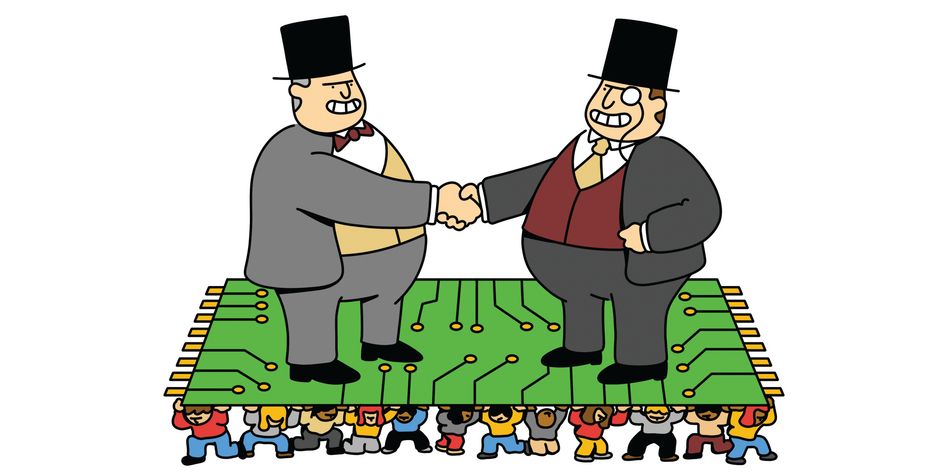
These changes created an incredible concentration of wealth in the hands of a select few “industrialists” or “robber barons”. The economic innovation of the day was the “trust”, an alliance of businessmen that allowed for monopoly pricing, often kept up through bribing politicians to look the other way. Concentration of economic power led to a concentration of political power.
Unsurprisingly, this period also became a low point for American democracy—a time of unprecedented corruption, inequality and racial violence. It wouldn’t be until decades later that the progressive-era reforms increased democratic participation through the secret ballot, ballot initiatives and muckraking journalism.
There are, of course, fears that AI might re-enact the economic panics of 1873, 1893 and 1896, where overinvestment in rail created a speculative bubble as well as widespread fraud. But it might also revive the tainted democracy of the Gilded Age.
For a start, Twain would have had a field day with Donald Trump’s transactional presidency and the willingness of tech barons to play along. But there are also technical details of the AI revolution that make concentration of economic and political power likely, if not inevitable.
As with the railroads, AI so far has required enormous capital investment to yield benefits. During the internet boom, a company such as Facebook could be created in a college dorm. In contrast, training a “frontier” AI model requires hundreds of millions of dollars, if not billions, in computer hardware and power, meaning that only the best-financed companies need apply.
As AI becomes the dominant way we find information, AI companies will have hidden influence over our choices
Training also requires massive data sets, which the largest players have scraped from authors, in what Microsoft researcher Brent Hecht reportedly described in an internal company document (and contrary to Microsoft’s own public view) as “the largest theft of labour in human history”. Defending that theft necessitates armies of well-compensated lawyers and lobbyists, all trying to persuade governments to “protect” AI innovation at the expense of thousands of creators.
Railroad barons could influence what land would be valuable and what would be worthless based on the routing of tracks and stations. The railroad companies and the US government both gave away and sold the land opened up to farmers, displacing and decimating the country’s indigenous population.
Similarly, as AI becomes the dominant way we find information, AI companies will have subtle, hidden influence over our consumer and political choices. Without oversight and careful auditing, the temptation for the AI “hyperscalers”—the giant companies Alphabet (owner of Google), Amazon, Microsoft and Meta—to sway answers towards political and economic partners in a new form of “trust” will be enormous.
Some observers have asked whether Van Nieuwerburgh’s estimate is inflated: $10.3 trillion is higher than numbers offered by the hyperscalers commissioning these data centres. Van Nieuwerburgh is a scholar of real estate and his numbers extrapolate from projects that have been planned and from those already underway, but assumes that only a fraction (around 55 per cent) of them will ever be completed.
If his projections are correct, or even if they are off by a factor of two, humanity will need to spend an enormous amount on AI services for these investments to succeed. Van Nieuwerburgh argues that AI revenue in 2032 would need to be $3.5 trillion, or 8.8 per cent of US annual GDP, for the investments to be good deals. As Greg Ip of the Wall Street Journal points out, that’s roughly the percentage of GDP Americans spend on food, and about seven times what they spend on phone, streaming and internet services combined.
The only way this scenario works is if AI eats into the largest component of industrial spending: labour. If companies begin modelling their economics with three categories of spending—capital investment, labour and AI—rather than just the former two, perhaps societies as a whole will spend as much on AI services as they do on food. But a lot of other factors would need to fall into place.
Take the infrastructure. Many, many companies are investing in AI infrastructure. Generally, as technological capacity increases, prices fall due to competition. But investors are also betting that we’ll see an instance of Jevons’ paradox, named for the 19th-century economist William Stanley Jevons, who noted that as steam engines became more efficient British industry used more coal, keeping prices relatively constant. In other words, as AI becomes cheaper, companies and their backers are hoping that we’ll all use lots more of it.
History shows what happens if demand does not increase sufficiently. During the internet and broadband boom at the start of this century, investment in fibre-optic networks—which cost a comparatively paltry 1.1 per cent of GDP—led to overcapacity. Multiple telecoms companies went bankrupt following a 96 per cent fall in telecom prices on routes from New York to London.
Van Nieuwerburgh doesn’t opine on whether AI is a bubble, but does query how the buildout is being financed. Companies including Amazon, Alphabet, Meta and Microsoft have issued more than $200bn in bonds this year, which suggests that none are financing expansion from their sales of AI services. Indeed, Anthropic has reported losses of $80bn for the first half of 2026.
The borrowing is so large that some economists believe it’s contributing to the rise in US interest rates. And many of the hyperscalers’ transactions reside in partnerships and joint ventures that add opacity to corporate finances, making it hard to estimate exactly how much risk they are taking on.
The railroad era powered American industrialisation and the nation’s subsequent dominance of the 20th century. AI may prove a similarly transformative economic force—all that its investors hope for. But if it does, it’s easy to imagine a similar, deeply undemocratic alignment of industrial and political power that takes decades to unpick. And there are signs that it is already happening.