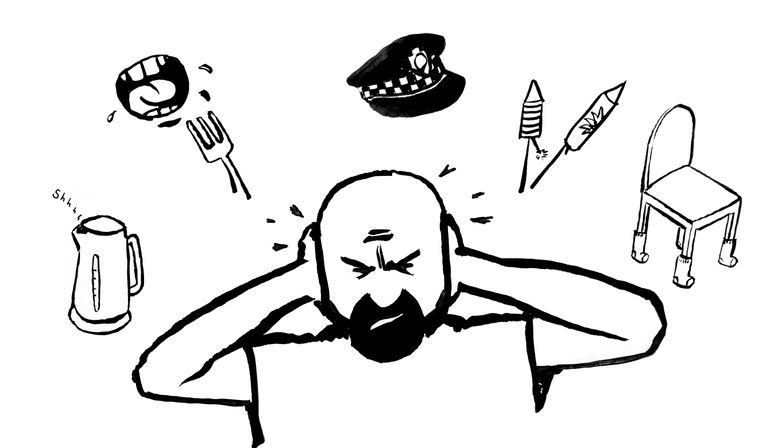
I leave my flat and I’m made to suffer the siren of e-bikes, the compensatory boom of souped-up cars, the midlife-crisis roar of a motorbike. I’m forced to overhear FaceTime on the train: digital chinwags to the detriment of everyone in the carriage and maybe the world. I have to attend meetings in open-plan offices, heightening visibility at the expense of my sanity. Even once-quiet sanctuaries are in freefall. Public libraries close early or have closed entirely. Coffee shops have developed a penchant for techno. Parks blast music all summer, our few remaining green spaces sold to the richest noisemaker.
Our homes are not much better. According to the most recent English Housing Survey (EHS), 46 per cent of households report noise problems, with 42 per cent of those households claiming noise affects their sleep. Traffic was the issue most commonly referenced in the survey, followed closely by street noise, caused by many of my nemeses: speakerphone-shouters, vlogging influencers, the bloke outside my flat the other day who hoisted a boombox like he was John bloody Cusack.
Excess noise is largely consigned to cities. But more people than ever live in cities—most of us, in fact—and they are loud. Decibel Shield, an app that measures sound in cities across the world, found four of the noisiest 10 are in India, many with average daytime noise above 80 decibels, akin to a hairdryer, and nighttime noise above 70, like a 24/7 hoover. London sits comfortably at number 40—a bit quieter than Chicago and Paris—but it is hardly quiet, with average daytime noise akin to a loud washing machine. I grew up in London and I still live there. I love my city, even with its excesses. But I wish I could turn it down.
I am not alone. Four-fifths of Brits value quiet time, according to a 2023 national noise report by Quiet Mark, a noise certification company. Nearly two-thirds crave a quieter home. But it seems to be getting harder to live in one. The Chartered Institute of Environmental Health (CIEH) recently found that nearly a third of Brits believe their area has grown louder in the past two years alone. And noise is not simply a matter of annoyance. According to the magazine Harvard Medicine, excessive noise exposure may cause memory impairment, learning delays, mental health problems and cardiovascular disease. Noise exposure disproportionately affects people from lower-income groups, the CIEH report found: people earning under £20,000 were 10 per cent more likely to report noise disturbance in the UK, for example, than people earning more than £55,000. Deprived postcodes in London simply experience more noise than affluent postcodes, according to a study in the scientific journal Atmosphere, and people renting council houses are more likely to have noise disrupt their sleep compared with homeowners, the EHS found. Noise has long been a health issue and it has increasingly become a class issue, too.
I grew up in a mad house. I spent much of my childhood in a shared bedroom with my two loud and annoying brothers. My mum made matters worse, selfishly becoming a childminder to support the family finances and adding a few more kids into the mix. My childhood was a compendium of chaos which I’d often try to escape, finding quiet corners of the house and stealing moments of peace, usually spending time alone with a book. I learnt from a young age that sound impacts people differently. One person’s racket is another’s lullaby and sound subjectivity, I have learnt, seems partly responsible for a noisy world.
It is not just a matter of sound levels, but the reaction to different types of sound. I can read with brown noise—low-pitched sounds to mask background noise—in my headphones, usually drowning out a more offensive sound, but music only serves to distract. Death metal hurts my ears but forces other people to thrash heads. Low-level noise can cause horror: nails on chalkboards, knives on glass. I still remember the beep of my brother’s Game Boy from the top bunk.
Four-fifths of Brits value quiet time. Nearly two-thirds crave a quieter home
Some people have neurological and physiological conditions that reside on the extremes of sound subjectivity. Everyday noises such as chewing, breathing or pen-clicking can trigger intense reactions from people who experience misophonia, for example. Individuals with hyperacusis find common environmental sounds—such as car engines—painfully loud, and people with phonophobia fear sudden sounds, such as fireworks or people shouting. The vast spectrum of sound subjectivity can make urban living profoundly challenging.
Different cultures have different responses to sound. In his book Urban Sound Environment, Jian Kang, professor of acoustics and soundscape at UCL, highlights how cultural heritage can affect which noises we find annoying. A 2021 study demonstrated that Brits found railway noise less annoying than road noise—trains have a romanticism for us, bringing to mind postwar rekindling and the poet John Betjeman—but people in Japan held no such preference. Another study in the Science of the Total Environment journal found that Taipei residents had a more positive reaction to insect sounds than Sheffielders, who preferred the sound of church bells. We attribute cultural meaning to certain sounds, elevating or demoting our appreciation.
The complexities of sound subjectivity are partly why our cities have grown so loud. Interpretation of sound is not universal. I have sometimes assumed we are all equally annoyed by the same noises, but no one makes a fuss because we’re all too British. But friends inform me that, when a person plays (always terrible) music out loud on the Tube, they “just ignore it” like “an adult”. The laissez-faire approach to noise, adopted by friends and others who are complicit, renders noise abatement difficult. It’s hard to collectively police noise if we cannot agree on the levels and types of noise that we find annoying.
Despite this, the UK government has a history of passing noise-reducing legislation. The Noise Abatement Act 1960 brought noise into the existing “nuisance regime”—the body of laws, principles and procedures that deal with things in society that we find annoying. Subsequent legislation, such as the Environmental Protection Act 1990 and the Noise Act 1996, expanded the power of local authorities to police noise. We saw small successes. The Noise Act established the “night hours” that we all know and love, encouraging everyone to quieten down between 11pm and 7am. The night hours are folkloric, referenced in beds across the land to condemn anyone partying too late or drilling too early.

The problem, I learnt, in trying to investigate why our world is so loud, is that practical application of noise regulation has been limited by sound subjectivity and absent political will. Consider that I, the great pursuant of quiet, have never complained to the authorities about noise. Partly it’s because, growing up with brothers, I was taught not to grass. But it’s also because I have little faith in the process. Call the police and they’ll work from their biases, from their sound subjectivity. With my luck, I’d get a Motörhead-loving copper. At best, even if they agree that the noise is unacceptable, they’ll simply ask the noisemaker to turn it down—and the person will likely turn it down, until next time.
The more formal route demands making an official complaint. That might entail a council environment officer visiting the site of the offence, witnessing and measuring noise, then making a report. Seems slightly absurd. I picture trying to get the council to come to my old flat at 2am on a Saturday, in 2022, to measure my downstairs neighbour’s tenacious commitment to landfill indie. That was the closest I ever came to lodging a formal complaint and it came because of a particular type of noise: the Kooks.
Yet noise caused by neighbours is the most policeable form of noise. Far more uneven and scattered legislation regulates the noise of everyday tech: FaceTime on the Lizzie Line, rogue boomboxes, the drone of data centres. The laws are imprecise at best, unenforceable at worst. Businesses create noise and face inadequate or absent regulation. The public suffers the consequences. Will Dunn, writing in the New Statesman, claims it is part of public nuisance capitalism: “The less companies are regulated, the more they create the means for one person’s liberty as a consumer to impinge on someone else’s as a citizen.”
At the risk of hyperbole, I believe the search for quiet is a matter of freedom. In his seminal 1859 essay On Liberty, John Stuart Mill shows that individual liberty should only be restricted to prevent harm to others. The philosopher Isaiah Berlin built on Mill and distinguished between two different forms of liberty: “freedom to” (the positive form of liberty) and “freedom from” (the negative form). We should have the freedom to act however we like, Berlin and Mill suggest, if it does not harm or interfere with other people. That’s not how it works with noise. The government seems hellbent on ensuring businesses and their consumers have the freedom to create everyday noise, but seems unconcerned by the public’s freedom from influencers, FaceTime and the Kooks.
The government has always been reluctant to tackle externalities—light pollution, odour pollution, literal pollution—partly for the same reason I’m frustrated: the harm caused is often subjective and difficult to measure. It does not help that the companies causing the harm like to find ways to disguise the harm. Nor does it help that businesspeople and politicians of all stripes have long-waxed lyrical about the scourge of red tape, often successfully, undermining the political will to introduce new regulations. And it really does not help that tech lobbyists now dwarf pretty much every other group.
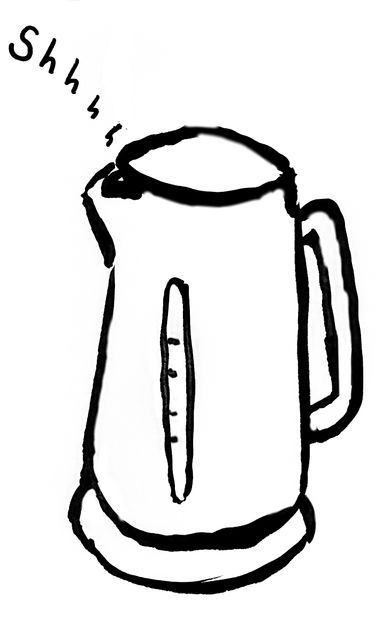
My first purchase was a £200 silent kettle. That’s the sort of joy that money can buy
I rented a flat in Brixton during the pandemic. I would later learn that Brixton, during normal times, might be the loudest place on Earth. But everything seemed so quiet, like it was perpetually the night before Christmas. The quiet seemed a small silver lining on the darkest possible cloud. But, amid the quiet, I found that I missed certain sounds that I’d always loved: singalongs in late-night pubs, the hum of the street market, fireworks.
I am against sound at the wrong time, in the wrong place; not sound in general. But it is interesting that the government seems well equipped to regulate sound in very specific spaces. The humming data centre, the booming cars, the tech creating the drone of modern life—all are permissible, all require little government intervention. But God forbid you make noise at a DIY rave or shout too loudly at a protest. Then the government is happy to use noise as a pretext to regulate other “undesirable” elements of British life.
Perhaps the most absurd example, familiar to ravers and anyone who listened to the Prodigy’s Music for the Jilted Generation, is the Criminal Justice and Public Order Act 1994. Section 63 leans into the contradictions of sound subjectivity, targeting very specific types of sound: “Sounds wholly or predominantly characterised by the emission of a succession of repetitive beats.” They regulated against sounds few people heard, clamping down on ideals the government found undesirable. The act “wasn’t just about trying to shut down illegal parties”, the journalist Ed Gillett explains in his book Party Lines. “It was a concerted attempt to defeat a coalition of subcultural groups and radical ideas.”
But the act shows that noise regulation can work. Police effectively shut down raves, arrested hundreds of ravers and essentially dismantled the “free party” scene. The irony is that all summer, outside my window, I now hear the boom of festivals in Crystal Palace Park, half a mile away. The events often have repetitive beats, excessive sound and annoy a hell of a lot more people than any daytime rave ever could. But that noise is permissible because the politics are mainstream, councils receive a wad of cash and the events are run by big business.
The Police, Crime, Sentencing and Courts Act 2022 similarly uses noise as a pretext to limit dissent. The act permits authorities to intervene if protesters generate noise that “significantly impacts” others. If I attend a protest, much like a rave, I expect noise. It’s kind of the point. The act even extends regulation to a single protester, meaning low-level noise from one person could in theory result in legal intervention. It’s telling. Noise justifies government intervention against the freedom to protest, but does not justify intervention to secure our freedom from the far uglier everyday noises we face.
When my partner and I finally bought our own flat, small enough for estate agents to use the word cosy, in the suburbs of south London, I started creating my own quiet sanctuary. My first purchase was a £200 silent kettle. That’s the sort of joy that money can buy.
After the kettle, I looked at other ways to make our new flat quieter and found an entire industry dedicated to silence, promoted specifically as an escape from a noisy world. The market has essentially stepped in to compensate for government failure, promising freedom from noise to consumers seeking silence. It is the privatisation of peace and quiet, the commodification of calm. And I was sold hook, line and sinker.
Tech companies create anti-noise tech to deal with noise that tech companies make
The quiet industry is big and getting bigger. Earplugs and noise-cancelling headphones sell in higher numbers and at higher prices than ever. Soundproofing and residential noise reduction have become big business and the appetite among consumers for quiet appliances has boomed, with the Quiet Mark survey indicating that four-fifths of consumers consider the noise of a product in their purchase. “We’ve seen a marked rise in ‘quiet buying’ across whole-home technology,” Samuel Pye, director of the residential developer Echlin, told me, with products “now chosen as much for their acoustic discretion as their performance”.
You can find sound-reducing rugs, artworks with acoustic panels and noise-absorbing poufs. All appliances come at a whisper: silent kettles, discreet toasters, even quiet alarm clocks. Because you wouldn’t want to be alarmed by your clock, would you? The very noisiest items have received the silent treatment: blenders, hoovers, hand-dryers. I recently spent money I do not have on a quiet washing machine from Hisense. You’d have to not hear it to believe it. I can put on a wash and make a cuppa, with barely a peep.
My washing machine features on Quiet Mark, the noise certification company and bastion of the quiet industry. “Digital overload and macro instability have caused a sustained increase of personal stressors,” Poppy Szkiler, CEO and founder of Quiet Mark, told me. “We crave peace more than ever to balance out any noise, chaos or disharmony.” The business is dedicated to quiet. They test products across various categories to judge noise levels and the type of noise emitted. If a product commits to a certain level of peace, it receives a Quiet Mark. If you’re looking for a quiet forklift, you’re in luck. Or perhaps you really want to trim your hedges in silence. Products are seldom cheap—quiet has become a coveted commodity—but you can find quiet robot lawnmowers, if that’s your bag.
The quiet industry extends outside the home, protecting us from noise the government fails to regulate. Tech companies create anti-noise tech to deal with the noise made by tech companies. For close to £800, Bose QuietComfort promise to defend us against everyday noises with a system that counters spikes in noise. New headphones produce noise-countering noise, otherwise known as adaptive noise-cancelling technology. I had to settle for second-hand AirPods—still £80—and I seldom take them off, always ready with brown noise at hand, in case any sound attacks me.
But the best example of the quiet industry at work belongs to the “calm cabin”, now a selling point of cars. Take the Lexus LC, boasting a “powerful sound produced by the engine and exhaust” but also a quiet cabin for the driver. The motorist is granted the freedom to create roaring noise for us all to suffer, as well as freedom from that noise with their soundproofed cabins. It’s a microcosm of the wider quiet industry, an industry that helps people who can afford it to claim quiet.
As a kid, I loved the day the Littlewoods catalogue arrived. I’d find a quiet corner and circle the items I would buy if my family had all the money in the world. Nowadays, the Quiet Mark website has become my Littlewoods catalogue. I still want everything but can hardly afford anything. Silence demands a premium. The privatisation of peace and quiet largely serves the wealthy. Most of us have no access to calm cabins or gated communities, no soundproofed houses full of quiet tech.
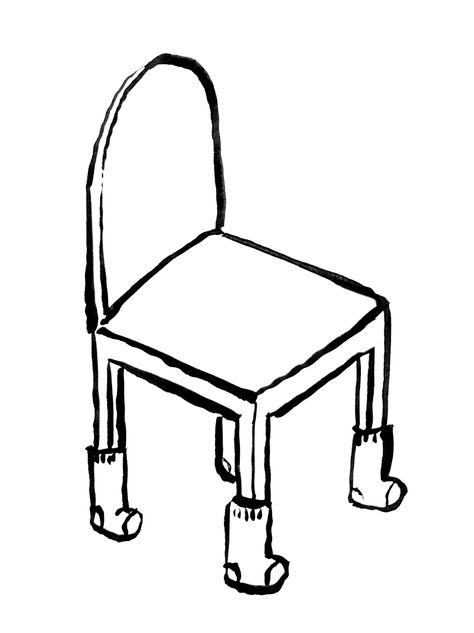
I’m luckier than most. I can afford degrees of quiet. I have my own small space, in a mostly peaceful part of south London, with an understanding partner and quiet neighbours, and I work from home. I also have some DIY solutions. I’ve trialled every colour of noise: brown and green, pink and white. I buy second-hand quiet tech. I own door sausages, which partially block out unwanted noises from outside, and put little socks on my furniture. I avoid the garden during festival season because the Wombats played Crystal Palace in the summer.
But many suffer the inequalities of noise. The privatisation of peace and quiet is felt most keenly by the poor, who face more noise and cannot afford to protect themselves from it. They disproportionately suffer the harms to their physical health, their mental health, their quality of life. It is a quiet injustice.