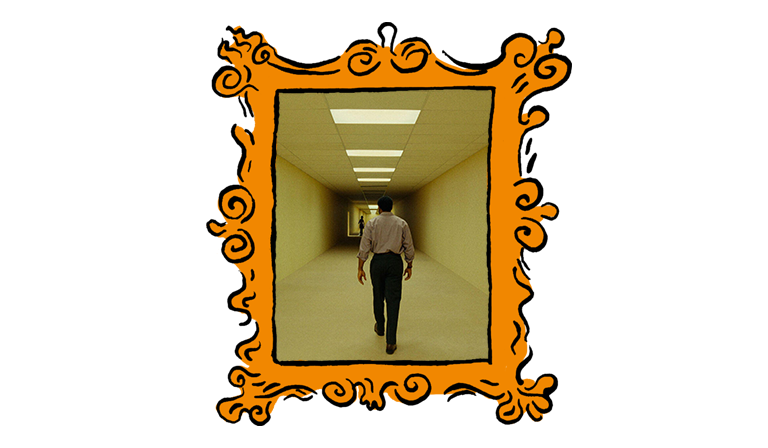
To my mind, the single best thing about the internet is that, between all the vast archives of humdrum information, there are so many niches where the really weird stuff gets in. “Creepypasta”, a mutation of copypasta, itself a mutation of “copy and paste”, is one of those dear online traditions that, when described, sounds almost primordial: simply put, it is the sharing of short horror stories. Usually of a paranormal nature, posted anonymously and accompanied by strange images, most creepypasta plays heavily on the pretences of a found-footage film: a mystery has been discovered, and it’s up to us to figure it out. In this way, the original story gets gradually unearthed and extended by others, until eventually it belongs to its own authorless folklore without end or explanation.
In the internet’s hoary canon of creepypasta, the Backrooms are a relatively new addition, stemming from a mysterious photograph of an empty office with a sickly-coloured wallpaper posted to the messaging board 4chan back in 2019. The room didn’t appear to serve any function, nor did it seem to lead anywhere. “If you’re not careful and you noclip out of reality in the wrong areas, you’ll end up in the Backrooms,” commented one anonymous user. It would take five years before it was confirmed to be a real place, an emptied furniture store in a small town in Wisconsin, photographed in 2002. In the meantime, the post would spawn a whole cycle of artworks, stories, video games and short films, including a YouTube series by Kane Parsons that has now amassed nearly 200m total views.
When a film “adaptation” of the Backrooms phenomenon was announced back in 2023, to be directed by Parsons, there was excitement but also understandable concern. So much of what makes creepypasta alluring lies in the encounter: you’re browsing the internet late one night and stumble across an old forum post, or maybe an odd video thumbnail catches your eye on YouTube. Before you know it, you’re down the rabbit hole. You don’t know where it came from, only that it has a weird name like “Petscop” or “Marble Hornets”. You don’t really know what it means or is trying to say. You don’t even know for certain what’s real about it and what’s not… it’s a dispersed, ambiguous, plotless ambience that can be easily lost to the self-contained, act-by-act structure of a film. Pretty much all previous attempts to bring creepypasta to the big screen, particularly about the Slender Man, have been decisive flops.
But fans of the Backrooms can rest easy. Taken purely as the directorial debut of a 20-year-old whose influences lie more in video games than, say, David Lynch, Backrooms is a hugely impressive film. But it’s also much more than that. It marks the first time a film rooted in the tastes and worldbuilding techniques peculiar to the internet has breached the mainstream, and to widespread critical and financial success: on its opening weekend in the US, which was last weekend, it became the highest-grossing film ever released by the film studio du jour, A24.
Clark, played by Chiwetel Ejiofor, is a failed architect and current furniture salesman who finds a hidden opening into what at first looks like some abandoned office rooms in the basement of his shop. The rooms seem to go on forever: littered about are familiar but distorted objects, such as a stop sign with the lettering mirrored, or chairs and shoes embedded in the floor. As Clark investigates the rooms further—taking some unwitting employees and a VHS camera with him to prove to his therapist Mary, played by Renate Reinsve, that they really do exist—he comes to learn that they are something like a self-propagating interdimensional plane, created out of the fragments of memories and experiences of those who live near its openings (or “null zones”, in the parlance of the YouTube series). What Clark is seeing is not just random detritus. The rooms are feeding directly from human memories, but they gradually distort those memories into something disturbing and, on occasion, literally monstrous. The film’s own analogy for this is trying to describe a dog to a person who has never seen one before, then asking them to draw it: the drawing would be recognisable but, chances are, it would never be quite right. The rooms, in other words, are trying to remember things they have never experienced.
There are many ways of dissecting how Backrooms has succeeded where previous creepypasta adaptations have failed. There is enough exposition and resolution to allow the story’s arc not to be mired in ambiguity for its own sake, while still leaving plenty more to be pored over and unpicked; it also stays loyal to Parsons’s own lore without alienating the majority of cinemagoers who will, quite frankly, have never heard of the Backrooms phenomenon. There are all the signs of craft that mark out any good film, like excellent performances from Ejiofor and Reinsve. But most important of all is how Parsons has managed to preserve that fundamental quality that made the original Backrooms photograph so beguiling, an aesthetic experience Mark Fisher would famously theorise as the eerie: “a sense of alterity, a feeling that the enigma might involve forms of knowledge, subjectivity and sensation that lie beyond common experience.”
Yet while we should hail it for the genuine achievement that it is, Backrooms also underscores the most typical dilemma faced by contemporary storytellers of all genres. For a film born of a thoroughly 21st-century way of communicating, its plot nonetheless hinges on the tropes, aesthetics and material culture of a bygone era. Set in 1990—15 years before Parsons himself was born, and over a decade before the original Backrooms photograph was taken—the world of Backrooms has, by default, no mobile phones and no internet; here, the technology is much more tangible and relational: VHS, floppy discs, cathode ray tube televisions, all connected by big electric cables that lead… we don’t know where, but somewhere. Parsons’s own conception of the Backrooms itself offers up a neat comparison to magnetic tape: a place where memories are relived and recreated time and again, but only at the expense of their gradual corruption and disintegration, until the flaws and artefacts acquire their own significance.
When VHS footage was used by the makers of The Blair Witch Project in 1999, it was directly responding to a contemporary culture in which VHS was still widely used. When the same thing appears in Backrooms, it’s making a very different kind of statement: that the internet has so fundamentally changed our way of life that we still find it hard to parse in the stories we tell about ourselves in the here and now. It’s striking that even in a film like Backrooms, where the influence of the internet has never been more present, the internet itself remains an eerie absence.