“‘To me the window is still a symbolically loaded motif,’ drawled Cody”. Speaking out the side of his mouth while smoking a cigarette, Cody is a cowboy addressing his partner on horseback. This pen and ink cartoon from 1978, captioned in hand-lettered capitals, was the first print Glen Baxter made. For many years after leaving art school in the mid-1960s, where his interest in the “silly” wasn’t encouraged, he had experimented with the individual ingredients of this breakthrough piece: pastiche comic strips and pulp novel covers (Strange Tales from the Files of the Milk Man) as well as surreal prose poems characterised by their precisely impossible sentences (“Their speech bubbles rise and touch in the air above their heads, then suddenly burst”). But it was the one-shot formula of a single mid-story picture paired with a single, surprisingly worded statement that brought Baxter—who died this week at the age of 82—many decades of popularity across the world.
Although his deadpan absurdism is often considered quintessentially British—and was often inspired by imperial adventure stories, such as the Biggles books—there is an internationalism to Baxter’s work that tapped into a transatlantic sensibility, which saw him published in the New Yorker and exhibited in Parisian galleries. Anyone talking about the “symbolically loaded motif” of a window in the 1970s had been reading Roland Barthes just as much as Boy’s Own magazine. Juxtaposing high and low was a trick Baxter learned from friends such as John Ashbery in the New York poetry scene, where pop art and European avant-gardism were striking sparks off each other.
Born in Leeds in 1944 to working-class parents, Baxter’s childhood imagination was nourished by a postwar mulch of cultures that stayed with him for life. The plain, no-nonsense cuisine of ration-book Britain, for instance, shadows his recurrent and (dare I say) comically loaded motif of fancy foreign food. Reviewing his 1986 collection Jodhpurs in the Quantocks, the novelist Beryl Bainbridge singled out the sentence “Crundley approached the profiteroles with some degree of trepidation”, remarking: “I like this because it’s such a daft word for cake.”
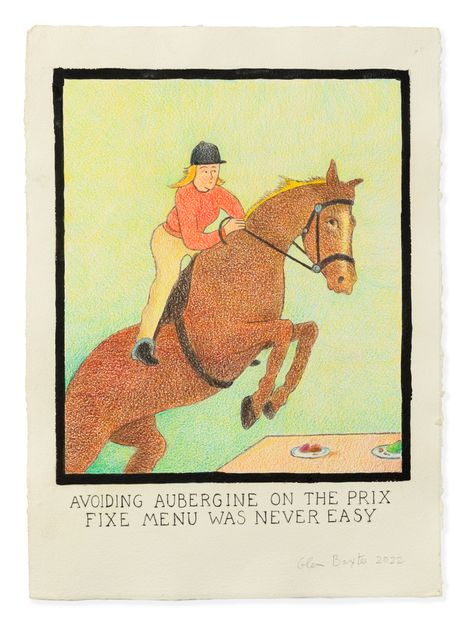
It would be wrong, though, to see Baxter as a self-invented eccentric, when in fact pieces such as “It was Henderson’s sixth attempt at lasagne” (accompanied by a picture of an exploding oven dish) continue an English Nonsense tradition of kitchen nightmares going back to Lewis Carroll’s Mock Turtle, Edward Lear’s recipes (“To Make an Amblongus Pie” ends “throw the whole out of window as fast as possible”) and Humphrey Jennings’s surrealist painting Swiss Roll (1939).
One of Baxter’s favourite books was a masterpiece of Edwardian weirdness called What a Life! (1911): a pseudo-autobiography created by two Punch contributors who cut up a department store catalogue and wove a ridiculous memoir around its elaborate illustrations of costumes and contraptions. Baxter’s own pseudo-autobiography, His Life: The Years of Struggle (1983), pays homage to this Pythonesque bildungsroman, although here the pictures are absurd too, so that the boy sawing slices of bread on a workbench is said to be preparing a picnic using “mother’s home-baked wholemeal” (itself perhaps a nod to Raider’s Bread (1979), a sculpture by his fellow Leeds surrealist, Anthony Earnshaw, which places a loaf-like lump of flint on a breadboard with a knife).
Theodor Adorno described surrealism as “the attempt to uncover childhood experiences by means of explosions”—in particular, the anarchic freedom and desire we first felt when encountering things and images, before we made them safe through rational understanding. Or, as Baxter wrote in The Wonder Book of Sex (1995), next to a picture of a man looking at a single black olive on a side table: “Sometimes even unlikely objects and household items appear to emit potent erotic signals.”
It seems fair to say that Baxter’s surrealism became safer over the years with its repetition of themes, reproduction on greeting cards and amiable fondness for jokes about the more abstract kinds of modernist art. (Alternative uses for Gerrit Rietveld’s design classic Red and Blue Chair as a cowboy’s saddle or a guillotine went down particularly well with his Dutch fanbase.) In the last decade he was also a popular poster on Instagram, which may have influenced the one notable departure of his work into a more mundane topicality: jokes about lockdown and social distancing illustrated by classically awkward Baxterian loners.
Look around his shop-dummy figures, though, and a deeper artistic character reveals itself in his improvisatory feeling for visually ambiguous detritus: sketchy dots, lines and shapes that suggest textures and objects (jodhpurs, profiteroles) only named by the curiously specific caption.
This quietly unsettling quality of Baxter’s vision is memorably caught in Speech with Humans (2008), a collaboration with his friend, the American poet Clark Coolidge, which returns repeatedly to the idea of things we can say but not quite see (and vice versa). “Despite himself, a mental picture formed in his mind: spud blossoms which borrowed importance from the paucity of larger events.” I can’t really describe the picture that goes with this sentence, although it does include a rectangle that suggests the motif of a window.