As a young girl growing up in Estoril, Paula Rego would draw while on her hands and knees on the cool tiles of the playroom at her grandmother’s house, craning over the page like an animal picking at its prey. She would groan, unconsciously, in a trance-like state as she worked with her pencils for hours on end. Somewhat agoraphobic, she sought sanctuary indoors, in an imagination bursting with Portuguese folklore, fairy tales and history. Her mind whirred with a carousel of characters that she projected onto the page—from sketches of slaves fleeing as Rome burned to Greek soldiers crawling out of the Trojan horse.
It comes as little surprise that the young Rego had her feet so deep in the fantastical. She had grown up under the shadow of the Estado Novo, António de Oliveira Salazar’s dictatorship that ruled from 1933 to 1974. With its rigid doctrine of “Deus, Pátria, Família”, women were pushed to the margins and seen as second-class, if not third-class, citizens. Rego’s own mother, Maria, once a keen painter, put away her brushes and turned instead to the servile rituals of domestic life, from housework to hosting tea parties. Rego, by contrast, kept drawing to make sense of the unnerving world around her.
The earliest work in Paula Rego: Story Line at Victoria Miro—the most comprehensive exhibition of her drawings to date—is a portrait of her grandmother, made when she was just nine. The most recent is of her own granddaughter, made when Rego was 80, seven years before her death in 2022. It is a neat cyclicity that sets the tone for an exhibition in which women are revealed as the epicentre of Rego’s universe, as caretakers, storytellers, muses and models. “I make women the protagonists because I am one,” she once said. What better testament to this than The Artist in Her Studio (1993), a preparatory drawing where she is in profile, chewing a pipe, her legs splayed as she exposes her clunky boots, unashamedly claiming the space.
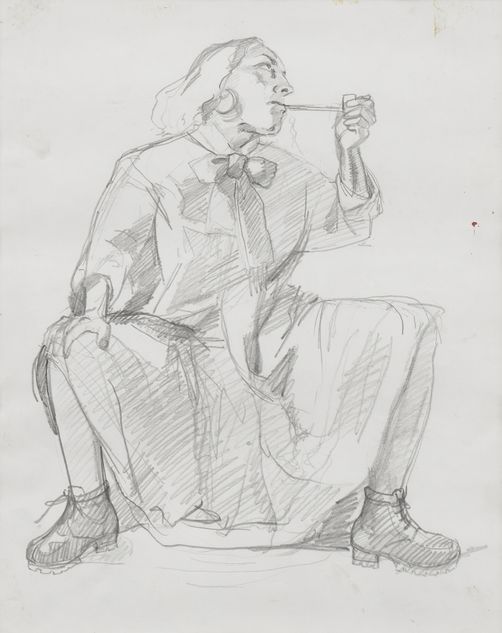
Curated by her son, Nick Willing, the exhibition spans work from the 1950s to the end of her life, foregrounding drawing not as preparation but as Rego’s central language—she was, first and foremost, as she coined it, a “drawrer”. Seen through Willing’s eyes, Story Line leans towards the biographical, with vitrines of letters, polaroids and sketchbooks, including early Dog Women drawings made when she was just 18. Even then, she was resisting passive femininity, giving her figures a feral, canine physicality.
Rego, now widely regarded as one of the most important British artists of the 20th century, was born to a well-heeled, liberal family in Lisbon in 1935. Her father had helped her escape Salazar’s authoritarian regime and move to England to study at the Slade School of Fine Art. On arrival, her surreal, imaginative drawings were shunned, while the mechanical Euston Road method was de rigueur. During her time there, she maintained a “secret sketchbook” to keep the coals of her imagination burning. One cartoonish scribble on display already gestures towards the politics of sex, a street scene with a well-to-do couple walking past as a man fondles himself while speaking to a sex worker.
In her final year at art school, Rego became involved with the then-married painter Victor Willing and soon fell pregnant, returning to Portugal and thereafter moving between there and the UK. It took time for her to start drawing again—she would struggle with bouts of depression throughout her life—but, with Willing’s encouragement, she rediscovered how to play, learning to “pour all my troubles into my pictures instead”.
In Story Line, those troubles swell to fill many frames. Women appear in a gamut of emotional states—solitary, sexually charged, aged, pain-stricken, exhausted and slumbering. They are never passive. They take up space, their bodies given weight and muscularity through her use of line and etching. There is humour to be found, too. In Unknown Title (1973), a woman wears a necklace of kitchen utensils, pans for breasts, and a washing line cinched around her waist. “Do you like what you see?” the figure seems to suggest, staging what feels like a kitchen peepshow.
For Rego, drawing was a physical act, a means of purging her vexations onto the page
Rego was always using drawing to confront abuses and imbalances of power. For her drawing was a physical act, purging her vexations onto the page. As a teenager, she challenged the Salazar regime through surrealist, dreamlike imagery to smuggle her anger without resorting to overt propaganda. That sense of injustice would carry through her work for decades, but it was always rooted in the personal. Stories of backstreet abortions and sexual violence ran through her family: her maternal grandmother died after a botched procedure, her mother nearly died in childbirth and a cousin was forced into an abortion and was drowned by her boyfriend. Sex, for Rego, was a dance between desire and destruction, as seen in works such as Maenads (1958–59), in which a violent spread of Indian ink erupts as if it were a bodice. For Rego, “Fear and pleasure became unhealthy bedfellows,” her son Nick Willing states in his book accompanying the exhibition.
The ground floor of the exhibit shows her adventures in myth and folklore, shaped by an interest in Surrealism and Jungian analysis. Upstairs, the mood shifts. The works grow in scale and intensity, and, frankly, some are uncomfortable to look at for too long—but Rego demands your attention. In She Doesn’t Want It (2007), a response to the casual brutality of coerced sex work, a sinister, doll-faced figure with a blackened hive for hair looms over a seated woman, forcing compliance. She turns her face away, dissociating while her body remains pinned in place, her hands clenched in her lap. As so often in Rego’s work, the use of graphite and conté lends the scene the deceptive charm of a fairy-tale illustration.
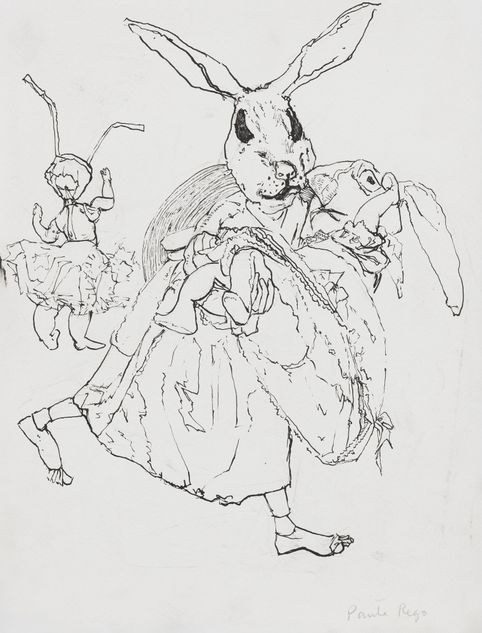
As also seen in Cringe II (2000) and Study for Convulsion II (2000), Rego would use hatching and etched lines to heighten the starkness of the setting and convey the woman’s isolation. Often, these women are found in overstuffed chairs, amplifying their sense of confinement as they try to inch their way to the foreground. There are many chairs in Story Line; they serve as props to convey a woman’s weight, defiance and vulnerability.
Rego’s engagement with the politics of the female body is, of course, most evident in her Abortion Series. While the works themselves are not on display, Study for Untitled (Abortion Series) (1998) is—a preparatory drawing of a woman in isolation, her back turned to the viewer. We are not granted permission to see the pain she is in. The series, made in response to the failed 1998 referendum on decriminalising abortion in Portugal, was, as Rego put it, “born from my indignation”. Across paintings, pastels and etchings, she depicted women undergoing illegal abortions, a subject almost entirely absent from art history. There is no blood, no gore. Women are confined to domestic interiors, their bodies curved inward, cramped and heavy with exhaustion. “I try to get justice for women… at least in the pictures,” she said. “Revenge too.”
Almost a decade later, she did just that. In 2007, Portugal held a second referendum—and Rego’s images are often credited with helping shift public opinion and galvanise higher turnout, ultimately leading to legalisation. In 2010, she was made a dame and would later describe the series simply as “one of the things I’m most proud of having done”. At a moment when women’s bodily autonomy is under renewed pressure—from the rollback of abortion rights in the United States to FGM and the ongoing realities of sexual violence across the globe—Rego’s work may feel confrontational, even uncomfortable, but it does not erase these experiences. It fixes them in place, bringing what is often intensely private into public view and securing women’s experiences within the canon.
After decades working in relative obscurity, Rego came to wider recognition in Britain in the 1980s, with a major solo show at the Serpentine in 1988. Her 1990–91 National Gallery residency produced Crivelli’s Garden, a nine-metre mural conceived as a homage to women, reimagining Crivelli’s predella panel as a Portuguese garden populated by figures from biblical history and folklore, as well as by her own friends, family and gallery staff.
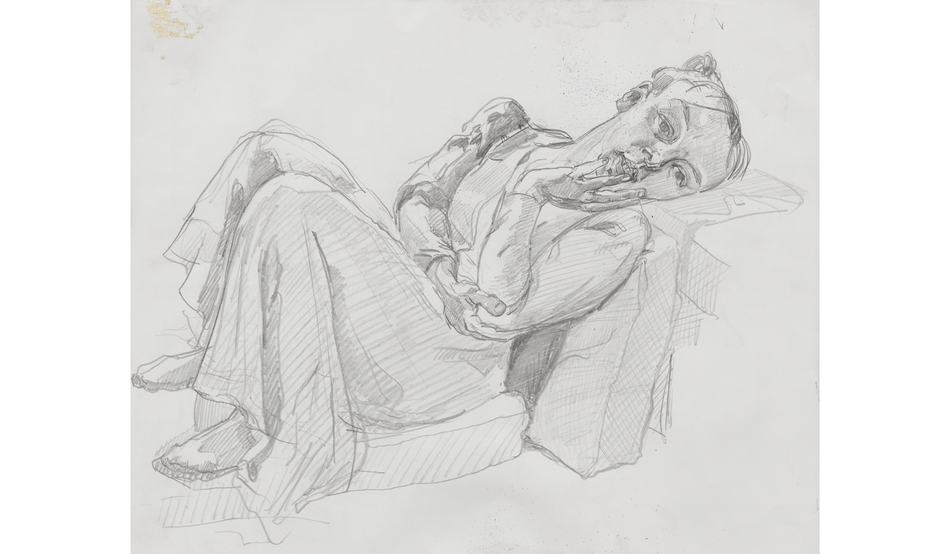
A preparatory drawing for Crivelli’s Garden appears in Story Line, a pencil study of a woman on all fours. It is hard not to think of the young Rego in a similar posture, craning over the floor of her grandmother’s playroom, drawing her way into a world she was trying to make sense of—one where words failed, but lines formed.
Paula Rego: Story Line is on at the Victoria Miro until 23rd May 2026