I am an openly queer man, a co-parent of two children and the author of two picture books for kids: in the current landscape this makes me something of an anomaly—although, since it is no longer considered comme il faut in 2026 to demand that people out themselves, one must suppose that Julia Donaldson and a handful of other writers in the children’s section could be bisexual or questioning or what have you. What is a little more surprising is that queer rights, including the right to become and be recognised as a parent, should still be such a vexed question in the present day.
Earlier this year, the writer Julie Bindel posted on X: “I don’t think men should ever raise children alone. For a number of reasons. And surrogacy is NEVER OK.” The self-styled radical feminist then appended this hasty clarification: “PS I do not mean men whose female partner has died.” One must assume that one of the reasons Bindel believes men should not raise children alone is her opposition to surrogacy in all circumstances (although many people hold it a fairly central tenet of feminism that women should be free to do as they wish with their bodies). Casting about for further reasons, it seems likely that for Bindel men simply cannot be trusted with children—or possibly are insufficiently caring to look after them.
In this, she echoes the thoughts of fellow “gender-critical” writer Sonia Sodha, who put out an article against surrogacy for single men in the Observer not long ago, in which she stated: “It is reasonable to think a man saying he wants to be a single father because he doesn’t want a relationship should prompt some investigation by someone expert in child welfare about his emotional capability to parent alone.” Sodha blithely ringfences gay couples in her article—but her restrictions on surrogacy would nevertheless affect those gay couples. And what of women who elect to become a single mother, simply by getting pregnant rather than going through the rigmarole of thinking about it for a long time, exploring options and undertaking a huge administrative process—should they “prompt some investigation” by child welfare? Back to Sonia: “gestation is a natural if not fail-safe form of safeguarding”. Well, there you have it. I would be more prepared to listen to these tendentious arguments in a world where no mothers ever abused their children.
Do they believe that men are not able to change? Only a fool would argue that men, as a category, don’t commit the vast majority of violent crimes; and, god knows, we can all think of a dozen terrible fathers off the top of our heads—but it seems clear to me that a great many men are capable of great love and tenderness; can and do exercise responsibility for others; show understanding of and respect for the boundaries of children; and take joy and fulfilment from looking after them. And—this feels self-evident to me, but hey ho—it can only benefit women to have men shoulder more of the burden of caring: this starts with dispelling the patriarchy-serving myth that women are by their very nature more given to nurture.
Gay people have been persecuted throughout history: calling queer men weird and suspect and hinting that we’re paedophiles is what homophobes have done for millennia. Gay men change the tenor of the question of a man’s relationship to children, not least because we usually don’t correspond to popular definitions of what a man is. In other words, it’s far harder to argue that all men have a predisposition towards violence or abuse if a certain number of us seem disposed rather differently in other, quite significant, particulars. Or to put it another way still: that man who used to play with dolls as a boy, with all his friends who happened to be girls… I wonder if… could he… could he ever be maternal to a child? Gay men represent a first step in the breaking down of masculinity that is required if more men are to be recruited to caring roles.
Gay or homosexual men, of course, have been around forever, and it’s a logical certainty that we have contributed to child-rearing over the years, in ways most likely undocumented. And I suspect the connection goes deeper. On a recent reading I was struck by Jenny Uglow’s depiction of the nonsense poet Edward Lear, in her beautiful, compassionate biography: “With children, Lear did not have to put on airs. He could be one with them, without effort: ‘Never was there a man who could so live into the feelings of a child,’ remembered Mary Crawford, who knew him when she was a girl.”
The sheer difference in Lear’s work made him, his poetry and his illustrations immensely appealing to young people
Uglow’s book sensitively broaches Lear’s sexuality—it seems clear that he was homosexual, although like many of his time he did not seem to act on it a great deal—and is astute in picking out the sheer difference in Lear’s work, a difference that made him, his poetry and his illustrations immensely appealing to young people. “The rhyming words were the kind that children loved to invent, and the weird happenings were very different to their usual fare of moral tales…. Lear’s limericks challenged the teaching designed, as Sinclair said, ‘to stuff the memory, like a cricket ball, with well-known facts and ready-made opinions.’”
Lear’s work, Uglow shows, connected deeply with children because it spoke to their own profound unreason. “Nonsense persons disdained facts. They were eccentric, mindless, violent, vague, sometimes peaceable, often cross…. They longed to escape but often failed: they set off, gave up and came back. They said what they thought and were rude. Their demands were infantile, their ambitions wild. There was ghoulish stuff here too, another childish taste of which adults disapproved: blood, amputation, screaming, dismemberment.” Many of these aspects of Lear’s work—and here Uglow is only talking of his limericks, with the more fantastical visions and transmogrifications of “The Jumblies” and “The Owl and the Pussycat” still to come—strike me as deeply queer, not least the very concept of nonsense or illogic. Whereas polite and/or straight society often seeks to subordinate life to clear patterns and rules, the queer person and/or outsider sees those constraints as artificial and subverts them by their very being and their art. Children, of course, are naturally lawless, and a large part of their education consists of steering them while somehow not stifling their essence.
It’s startling now to look into Lear’s work and see just how queer it is—in the sense of strange, but not only; and, more than this, to find how discontented and seething he appears. The characterisations of his people, which always come in the second line of the limerick, fairly bristle with weltschmerz: there was a man or a woman, he tells us, “who was wholly devoid of good feeling”; “whose deportment was vicious and crude”; “whose face was adorned with a frown”; “whose mind was perverse and provoking’; “whose manners were tinctured with fury”; “who suddenly threaten’d to scream”. You can see how these rebels and misfits might have appealed to a hemmed-in Victorian child—but, I would suggest, some of Lear’s visions are perhaps too dark for our modern, more prudish sensibilities, which tend to patronise or cosset children. Take this poem, which fairly took my breath away:
There was an Old Person of Tartary
Who divided his jugular artery;
But he screeched to his wife, and she said, ‘Oh, my life!
Your death will be felt by all Tartary!”
Lear’s pen-and-ink illustration shows the man dropping a kitchen knife; he has a large, unmistakable incision at his neck.
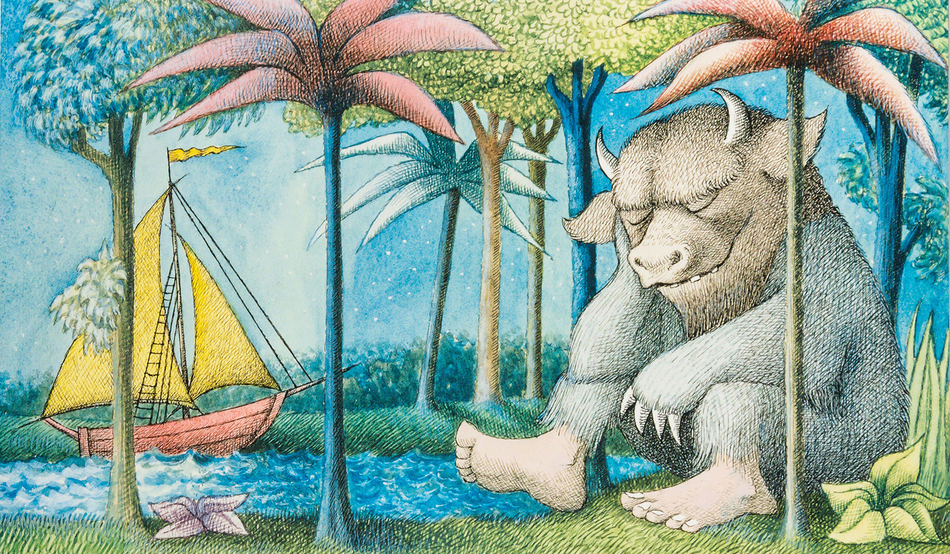
Cut to a hundred years later or thereabouts, and Maurice Sendak—another gay writer of picture books—was finding equal success with a child readership, with a similarly distorted and insolent vision of childhood, one where illogic governs the characters’ lives and where hot, passionate urges rub up against the strictures of civilisation. Where The Wild Things Are is now so well-known as to no longer surprise us, but looking at it with fresh eyes there is a great deal of violence: Max hangs his teddy bear, chases the dog with a fork, and shouts “I’LL EAT YOU UP!” at his mother when she rebukes him. (In Sendak’s book, the character of the mother is never seen.) The monsters are described to us as “terrible”, and their relationship to Max is violent until he subjugates them—in other words, he is able to quash his own subliminal aggression. It isn’t hard to see in Max a roiling discontent akin to that of Lear’s creations. And remember Uglow’s phrase: “they longed to escape but often failed.” Max is dying to flee his life, and something inside him is raging; but he knows that he cannot fully escape it, being a child.
The book is also suffused with a certain kind of melancholy that some children may relate to: no other kids are depicted, and Max clearly feels a deep loneliness, a longing for some kind of connection. You would have to be extraordinarily blinkered not to see an autobiographical element here from Sendak, a man who grew up homosexual in mid-century America. Towards the end of his life, he was asked about his relationship of 50 years with his partner, Eugene Glynn, and said: “I wish I had been more demonstrative, but it’s not a thing I do very well. Being gay in the old days was hard, being gay later was weird. I very much wished not to be. I came from a regular depressing family. I was brainwashed.” On being asked if he was happy, he added, hilariously: “Who’s happy? What does that mean? Of course I’m not, I’ve nothing to be happy about. I can’t complain about my life, I’m just a little bit nervous about how it’s going to end.”
Sendak’s visions are at least as violent and unsettling as Lear’s—famously, In The Night Kitchen features a passage playing on Sendak’s childhood fears of death (he was Jewish, and many of his extended family were killed in the Holocaust), in which the protagonist, a child called Mickey, is told by three bakers who look distinctly like Hitler that they will bake him in an oven. Again, the protagonist is a lone child, the parents barely seen; the boy adventures out into a world full of imagined threats and fears.
Sendak’s lexicon, the fluidity of his dream logic and the violence that is almost casually woven into the fabric of the story appear deeply queer to me, and seem directly descended from Lear’s creations. The monsters of Where The Wild Things Are also appear of a piece with Lear’s oddly nosed, nonsense creatures, the Jumblies. As for the famous owl and pussycat, I think that in their un-fixed relationship to one another, the malleability of their identity, they too are matched by the shifting boundaries in Sendak’s work.
There is an inner rebel in children; they either don’t want to do as they’re told or will take pleasure in not-learning
Both writers made quite pointed attacks on their time, by taking aim at the ambient politesse of society, and they did it by captivating children with stories of transgression. In talking about my own work, I should say immediately that I’m of course not putting myself on the level of these writers. But when I started writing for children, I did find myself reaching, almost unconsciously and without hesitation, for a language of illogic with which to talk to kids. This seemed to me the best idiom in which to address children—one that is a touch combative, even. My first picturebook, How To Count To One, was essentially conceived as a subversion of counting books—and of other tedious, well-meaning stories I have had to read my children. I based the narrator’s chaotic ways, I suppose, on my own inner pandemonium, and sought to establish a joshing relationship with the reader quite like the one I have with my kids, who respond well to irony and deprecation. By barking perfectly insane orders at children (who are only allowed to count up to one on each page), I looked to appeal to the inner rebel in children, who either don’t want to do as they’re told, or—hopefully—will take pleasure in not-learning. (To my horror, I’ve since been told that the book is actually a handy instrument for teaching numeracy and is available to buy at the Science Museum.)
The second book, Now You Know Your ABC, is perhaps less perverse, but again, almost without thinking, I seemed to reach for a story driven by fear and alienation, in which a wolf chases children through the alphabet, all the way to France, which in its difference is scarcely more reassuring to a child. As in Where The Wild Things Are, my character has no visible parents and goes out alone in the world; unlike Sendak, I’ve written a character with no gender, addressing readers directly. These things—my humour, abruptness, light insubordination and irony—come from my identity, and in no small part from my queerness. I know from readings I’ve given that children respond to them. These are traits that help make me a good parent.
It is right that we concern ourselves with the security of children—but, right now, early children’s literature is a little timid and, in my view, sugarcoated. I can say that my children, at least, are categorically not interested in stories about kindness or being the best version of yourself. My books present some elements of subversion, but they are also subject to market demands and their tone and barbs must be tempered concomitantly. (I’ve written a book about an angry young girl with hair made of fire whose dearest wish is to destroy buildings with a hammer, but can’t get it published anywhere.) I suspect this is a sign of our times: it speaks of an era that understands queer liberation in theory but doesn’t want it in practice, and where certain rights have been rowed back in the last few years at the behest of a resurgent right-wing and their handmaidens.
The result is a tentatively liberal, superficially polite society that seeks to protect children from evils both real and imagined. Talking down or lying to them while they’re still growing, and attempting to usher back the good old days, won’t do it.