There is no British cultural event that bears reasonable comparison to the annual Super Bowl halftime performance. No Glastonbury headline slot, Last Night of the Proms or Jools Holland Hootenanny can reach the magnitude of this occasion. The segment usually lasts just 13 minutes, but production costs can hit $10 million, with artists (mindful of its grand exposure and lucrative returns) often spending additional millions to augment the spectacle.
Previous incumbents have included Michael Jackson (1993), Prince (2007) and Kendrick Lamar (2025). There have been marching bands, Mouseketeers, Elvis impersonators and beauty queens playing fiddle. But the shows have not been without controversy: in 2004, Justin Timberlake sparked outrage by exposing Janet Jackson’s nipple; in 2016, the choreography for Beyonce’s song “Formation” seemed to nod to the Black Panthers; last year, midway through Lamar’s set, a cast member unfurled a combined Palestinian-Sudanese flag before being bundled off by security.
To all intents and purposes, these 13 minutes offer a little light entertainment sandwiched between some football—but, in recent years, the halftime show has often come to serve as a kind of cultural bellwether, an indication of how America might be feeling about itself.
This year, amid the continuing horrors of ICE raids, military operations in Venezuela and the release of the heavily redacted Epstein files (to name but three recent events), the chosen headliner was Puerto Rican rapper Bad Bunny. At 31 years old, Benito Antonio Martínez Ocasio is already regarded as perhaps the greatest Latino rapper of all time and has been credited with sparking a global enthusiasm for Spanish-language rap. On Sunday, just a week after winning Album of the Year at the Grammys, he was the event’s first Latino solo headliner; 130 million people tuned in.
This was not Bad Bunny’s first appearance on a Super Bowl stage. In 2020, he joined Jennifer Lopez and Shakira for what was billed as “a celebration of Latin pride”. Lopez, whose parents were born in Ponce, wore a coat incorporating the Puerto Rican flag, and during a performance of her 1999 hit “Let’s Get Loud”, a choir of children appeared in a series of cage-like structures, which some took as a protest against the Trump administration’s immigration practices.
This year, many anticipated Martínez Ocasio would go further in his political statement. The rapper has long been open about his beliefs, supporting LGBT+ causes, starting a non-profit foundation (named Good Bunny) for underserved youngsters, and berating President Trump for his woeful response when Hurricane Maria devastated Puerto Rico in 2017. During his last tour, fearful that his shows might be targeted by immigration officials, he instead performed a 21-date residency in San Juan (ensuring an estimated $200 million boost for the overseas territory’s economy). Last week, accepting his Grammy, he began his acceptance speech with the words, “ICE out.”
But Sunday’s performance proved surprising—memorable not for furious political invective or any confrontational stance, but for its portrayal of a kind of indisputable gladness. During his short time on air, the rapper gave a rich and layered portrait of immigrant culture, showing an understanding of the symbiotic relationship between attention to detail and joy rarely seen outside of the work of Mary Oliver.
There were choreographed sugarcane fields, a reference to the island’s colonial history, when Taínos, Puerto Rico’s indigenous people, were forced into manual labour by Spanish colonisers (and exploited into near-extinction; the colonising powers simply drafted in African slaves to take their place). There were barber shops and domino tables, nail bars, piraguas vendors, a coco frio and a taco stand. There was a cameo by Toñita, the owner of New York’s last remaining Caribbean social club. There was a real-life wedding (a couple invited Bad Bunny to their nuptials; the rapper asked them to get married mid-show). There were nods to the island’s post-Maria power grid struggles, a casita, a bodega, a coquí frog (native to Puerto Rico), a cuatro (Puerto Rico’s national instrument), an abundance of plena rhythm, and Lady Gaga wearing a dress by American-Dominican designer Luar.
In a week when we saw videos circulating online showing ICE officers telling detainees that they were targeted precisely because they were heard speaking Spanish, Bad Bunny performed his set almost entirely in the Spanish language. Ricky Martin, another Puerto Rican artist who was instrumental in the Latin-US pop crossover, but who had to adapt to English to make it big, took to the stage to join him for “Lo Que Le Pasó a Hawáii” (“What happened to Hawaii?”), a track from Bad Bunny’s 2025 album that addressed the implications of US statehood, using the example of Hawaii, where the native culture and language were roundly trampled by colonisation.
“God bless America!” the rapper announced towards the end of his set, before namechecking every nation of Central, South and North America. He held up an American football inscribed with the words: “Together we are America”, before concluding, in Spanish: “We’re still here.” It was a night that raised questions, certainly, but that, beyond all, celebrated hope, community, hard work, innovation, difference, music, multiculturalism and connection.
Cast your eyes to the right, however, and the picture looked quite different. Even before Sunday’s performance, the Maga crowd had expressed its concern. President Trump described the hiring of Bad Bunny as a “terrible choice”, adding that “all it does is sow hatred”. On the day itself, the president remarked that “Nobody understands a word this guy is saying, and the dancing is disgusting, especially for young children who are watching throughout the USA and all over the world”.
Turning Point USA, the organisation founded by the late Charlie Kirk, even staged an alternative “All-American” halftime performance via Youtube, headlined by Trump favourite Kid Rock (sample Kid Rock lyric: “Young ladies, young ladies, I like ’em underage/ See, some say that’s statutory, but I say it’s mandatory”). Viewing figures reached just over six million.
At the crescendo of Bad Bunny’s performance, a screen appeared behind him emblazoned with a message: “The Only Thing More Powerful Than Hate Is Love.” It resonated, of course, with the night—and with the times, when the world feels more fractured and more fragile than it has for many years. But it echoed, too, the words of a more unlikely figure.
In the aftermath of her husband’s killing, Charlie Kirk’s widow, Erika, took to the stage at his memorial service. “The answer to hate is not hate,” she told the assembled crowd. “The answer we know from the gospel is love and always love.”
On Sunday night, 13 minutes of big budgets, big names, many costume changes, cast members and choreography boiled down to something really quite simple: an olive branch, a hand across the water, a suggestion that, really, for all our variations in language, rhythm, custom, culture, aren’t we all in this together?
The universal language of Bad Bunny
This Puerto Rican rapper’s Super Bowl show was more celebratory than confrontational—but he made his message clear, all the same
February 12, 2026
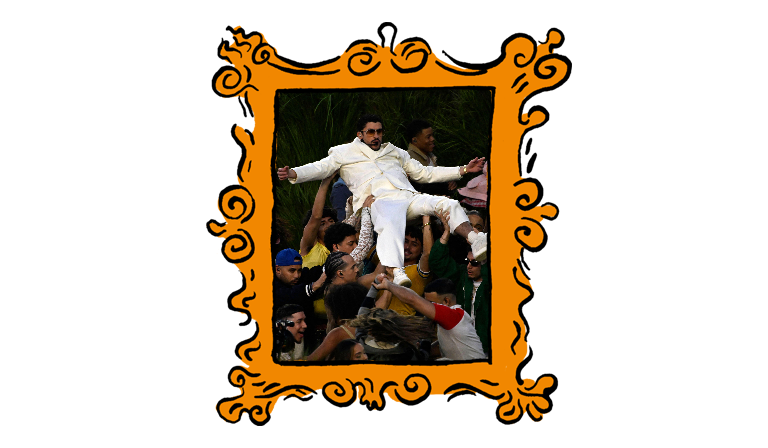
Image: Cal Sport Media