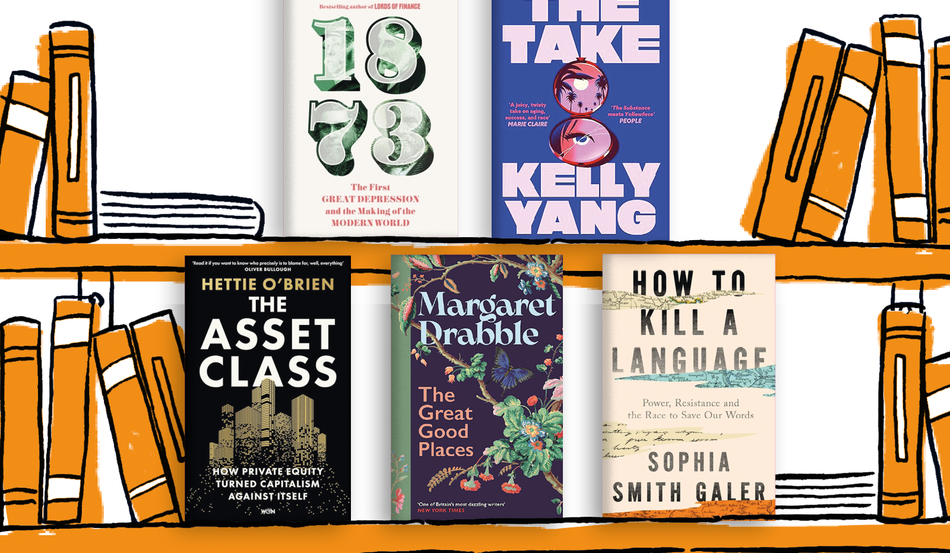
1873: The First Great Depression and the Making of the Modern World
by Liaquat Ahamed (Hutchinson Heinemann, £25)
Inflation of the right type, John Maynard Keynes flamboyantly ventured, was needed for Shakespeare’s genius to flourish. In his new book, Liaquat Ahamed opens our eyes to all sorts of things that flourish when prices are instead falling. They include: antisemitism, international skirmishes over debt defaults, and obscure but explosive arguments about the ideal monetary base. Ahamed’s cast list includes Karl Marx, Mark Twain and all manner of Rothschilds, but it is to Oscar Wilde that he turns to illustrate the last point: the playwright served up cranks with dogged views on “bimetallism”.
After the last few years, falling prices are hard to imagine and sound like a nice problem to have. But they were often the norm historically. In the 130 years between Waterloo and VE Day, prices fell more often than they rose in Britain. The dynamics of “deflation” are actually nastier than those of inflation. Some viable businesses and farms get ruined by debts whose real value rises remorselessly; others keep going by resorting to wage cuts and class war.
1873 saw the start of a particularly sharp, sustained and global “depression” of prices, which ushered in stagnation in the real economy, if not quite the dramatic contraction of the 1930s. Two mutually reinforcing developments were to blame. First, the bursting of a big financial bubble. Second, the almost-accidental convergence of the western economies on the gold standard. Previously, silver was often just as important for backing currency. Now that marks, dollars and francs were all defined in gold terms, the metal became very scarce—and so did the money it backed. With the “price” of money rising, the prices of everything else fell.
They stopped falling only after two prospectors in Witwatersrand, South Africa, chanced upon the world’s largest goldfield in 1886. Bewildering as Bitcoin may be, there is no more rationality in being in hock to gold. Keynes wasn’t wrong to damn it as a “barbarous relic”.
Tom Clark
The Asset Class: How Private Equity Turned Capitalism Against Itself
by Hettie O’Brien (Weidenfeld & Nicolson, £25)
When most people think of owning assets, they might have housing in mind. But if you’re excellent at playing Monopoly, you’ll realise that owning all the utilities and train stations on the board is often the most efficient way to maximise profit. This is much like how private equity firms operate.
The Guardian journalist Hettie O’Brien’s debut book outlines how our lives in the 21st century have been shaped by something murkier and more obscure than politicians and policy decisions. It explores how, starting almost a 100 years ago, a handful of wealthy men set on getting even wealthier came up with a new way to do so: using investors’ money and borrowed debt to buy companies or assets, with the promise of returns. The problem? Their methods often increased social inequality and spoiled public services, as actualised today in unaffordable care homes and sewage-filled rivers.
On this account, private equity is omnipotent—yet many of us are unacquainted with it. This mystique—cultivated by the industry itself with its obfuscating, off-putting lingo—prevents us from asking too many questions. O’Brien manages to demystify this secretive world and, in doing so, gives us new ways to understand contemporary “broken Britain”.
Many of the issues the UK faces today are understood by the left in the context of Margaret Thatcher’s time in office. But O’Brien explains how private equity lobbyists did actually engineer tax breaks in backroom meetings with Thatcher’s ministers, convincing the government that “what was good for them would be good for the nation”. The result was instead a “billionaire factory”, and existing companies were lumped with heaps of debt. Now, whenever the idea of fairer tax rates is raised, the asset class threatens to take its money elsewhere. As O’Brien says, we’re all living with “a husband who might decide to leave at any moment”.
This is a book for those who can sense that something is wrong—but haven’t quite put their finger on it yet.
Kathryn Schoon
How to Kill a Language: Power, Resistance and the Race to Save Our Words
by Sophia Smith Galer (William Collins, £22)
Linguicide is a term belonging to the 1.5bn English speakers worldwide, and yet, ironically, not part of the vernacular. As journalist Sophia Smith Galer opens her book with the moving loss of her nonna, an Italian minority speaker of “dialët”, she not only provides an intimate vignette of linguistic endangerment, but raises the question: what do we lose when a language disappears?
The answer itself involves survival. Only as a speaker of Samoan was an American ethnobotanist able to locate an enzyme to pioneer HIV treatment. While in spoken Bathari, seasonal names coincide with the “rising and setting of certain stars” to guide fishermen along the Omani coast. It is no coincidence, you feel, that “the world’s biodiversity hotspots…host more than 70 per cent of the world’s languages.”
But language is not a quid pro quo; it is a threatened cultural inheritance. The last century of punishing schoolchildren for speaking their native language—from France’s young Breton-speakers to the Welsh and Irish—leaves behind a trail of trauma that is not entirely in the shadows. In the spirit of mothers who, through their very voices, act as “custodians of cultural wisdom”, Galer calls on us, too, to nurture the linguistics of generations.
The book’s strength lies in its global research, which reveals the intricacies that people bring to life and language. Dozens of Kurdish expressions exist for the varying sounds of water pattering; while, like water rolling off stones, Galer’s grasp of Arabic phonetics encompasses even the precise direction of air moving across the tongue. There is hope in How to Kill a Language that what we are losing, and what is already lost, is not beyond recovery.
Sophie Farmer
The Great Good Places
by Margaret Drabble (Canongate, £16.99)
The Great Good Places is not a memoir—Drabble is working on one, though if it’s published at all, she’s decreed that it won’t be until after her death—but it does contain a rich handful of life writing, alongside essays about the writing life.
Her fraught relationship with her mother—which she previously explored in her “memoir-novel, mingling fact and fiction” The Peppered Moth (2000)—takes centre stage. She also writes movingly about the loss of her beloved daughter Rebecca Swift—who was only 53 when she died in 2017—and with whose death Drabble realised that her “life as a novelist was over”.
For those of us who’ve long admired Drabble’s fiction—she published her first novel, A Summer Bird-Cage in 1963, and her 19th, The Dark Flood Rises, in 2016—this is its own cruel loss. But, as she argues here, writing fiction is synonymous with “a life of crime”: and now she’s going straight, she can ponder her past felonies, plead guilty of “aggression and betrayal and appropriation”.
Nevertheless, there is some fiction here: previously unpublished short stories and an excerpt from her unfinished novel, the one she was working on when Rebecca died. That Drabble has often drawn on her own life as inspiration means that, regardless of the genre, the same skill and perception is on display across her writing.
If this collection is united by anything, it’s the fact of growing older, or—as the 87-year-old Drabble would probably put it herself—growing old. People want her to spout life affirming platitudes, she explained at a recent book event, but that’s rubbish. Life is grim, she said, and facing it takes courage. This she does here, with impressive grace, eloquence and sensitivity.
Lucy Scholes
The Take
by Kelly Yang (Constable, £10.99)
The central question of Kelly Yang’s quick, smart novel: is there a price you can put on youth or experience? And is it $3m? For Maggie Wang and Ingrid Parker, the answer is yes.
Maggie is 23, penniless and desperate to become a writer. She’s tired of watching doors close to her, only to watch them open for everyone else. Ingrid is in her fifties, a film producer who is finding out first-hand that Hollywood never changed its ways; there’s still no place for older women.
Enter: The Machine. A technology that allows the women to exchange blood and, with it, certain characteristics they crave. For Maggie, it’s wisdom and a foot in the door. For Ingrid, it’s youth, new stories to tell and fresh perspectives.
Appropriately, The Take reads like a Hollywood screenplay: glossy scenes, drama and characters who are unapologetic about their choices. It interrogates an industry that wants women to be more like, or more liked by, men.
That said, it’s a light-touch novel; it does little to handhold the reader towards firm prescriptions. And while there is much to admire in this approach, there is also, sometimes, something lacking. The book’s exposé of the dark side of the creative industries never truly delves into the contradictions of “girl-boss” feminism, nor do its characters act outside of the status quo.
Still, when it comes to that central question, as well as those that spring from it, The Take is clear and cutting. What does it, well, take to get to the top? And what would you do if faced with the moral quandary of risking your career and life for doing what you know to be right?
The answers here—for Maggie, Ingrid and the rest of us—are devastatingly realistic.
Ellie Jay