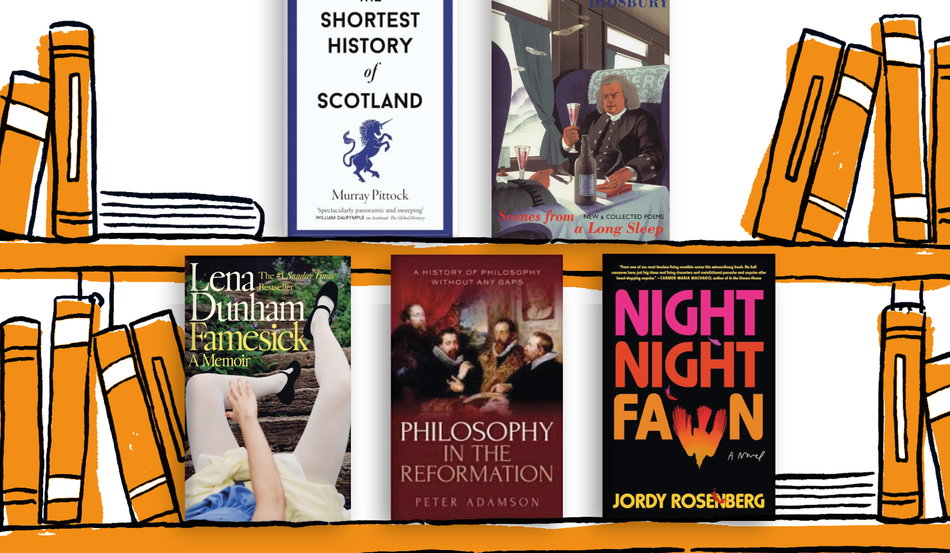
Famesick: A Memoir
by Lena Dunham (Fourth Estate, £18.99)
Lena Dunham’s new memoir, Famesick, documents the period of her life with which many of us will already feel familiar: her breakthrough in 2012 with her HBO show Girls; her 2010s notoriety; her relationship with the music producer Jack Antonoff; her diagnosis with endometriosis and Ehlers-Danlos syndrome; her hysterectomy; her stint in rehab. Yet knowing about Dunham the Celebrity is very different from knowing about Dunham the Person.
“Getting sick is not that different than getting famous,” she writes, since she was hung out to dry by the media and in online discourse—scapegoated, criticised and abused—just as her body was falling apart. The book reminds us that she is not her most famous character, Hannah Horvath, nor a pariah of white feminism, nor an overrated nepo baby, but a fellow human being whose only ambition has been to make art.
That’s not to say that there isn’t plenty of juicy new material. Tales of friendships with the Safdie brothers and Greta Gerwig; of her friend and co-star Jemima Kirke’s bolshiness; of Adam Driver’s mysterious and sometimes volatile behaviour onset, including an already-infamous anecdote about him throwing a chair at a wall. The details of her fallout with her Girls co-producer and mentor Jenni Konner, as well as of her breakup with Antonoff, are deeply sad. She writes candidly about cheating on him with her “sixth-grade boyfriend”, and delicately about the teen pop star who cried into Antonoff’s lap in their apartment. She is, as she has always been, startlingly honest, but never cruel.
But it is not the gossip that defines Famesick—it’s Dunham’s singular voice. She paints her world as vividly as she did that of Girls, her characters and settings singing with life (she describes the apartment she moved into when she got her first Girls paycheck with exquisite tenderness; that apartment would go on to become the set for the final scene of Gerwig’s early masterpiece, Frances Ha).
The culture is resetting after social media’s turbulent 2010s adolescence. Girls is having a rightful renaissance, and Dunham is back. Famesick is her much-deserved reckoning.
Emily Bootle
The Shortest History of Scotland
by Murray Pittock (Old Street, £15)
Scotland—this land of “mountain and flood,” as the historian Murray Pittock calls it—is home to one of the world’s oldest land borders, dating back to the treaty of York in 1237. Its national flag can be traced to the 9th century. Yet despite these ancient claims—or perhaps precisely because of them—the nation of Scotland has persisted without a state for the past three centuries. As Pittock shows in this eloquent potted history, the ways in which it has achieved this are fascinating—and prove that just because Scotland’s part in world history is small, that is not the same as saying it is marginal.
Even prior to the Union of 1707, there has never been a point in Scotland’s history where it has not needed to reaffirm its right to exist, regardless of whether that right has hinged on differences of a cultural, ecclesial, economic or geopolitical sort. In that sense, the modern independence movement is not (at least not wholly) the product of post-imperial decline, but rather the latest manifestation of a centuries-long struggle for definition.
In laying this all out so well, Pittock positions himself as an equally astute commentator on the current political standoff: it should come as little surprise that attempts by successive British governments of the 20th century to homogenise Scottish institutions with their southern peers have only advanced, rather than dampened, the “cause”.
Yet Pittock’s diagnosis of the SNP’s predicament rings just as true. Lacking a clear vision to get behind, he argues, most independent-minded Scots are more likely motivated by the restoration of a communitarian Britain of the past: a noble ideal, but no template for imagining a state outside those very same governmental strictures. As Scottish history shows, charting a different path is riven with risks and challenges, but also rewards. We are yet to see whether Scotland’s incumbent leadership will take its place in its annals.
David McAllister
Philosophy in the Reformation
by Peter Adamson (Oxford UP, £25)
Peter Adamson’s compendious history of philosophy covers what is often omitted in such series—Islamic and African philosophy, and the way philosophy is influenced by art and literature. The eighth volume tackles 15th- and 16th-century European philosophy in light of the Reformation. It starts with the defining feature of Protestantism’s split from Catholicism: Luther’s claim that, rather than earning redemption through our own moral efforts, we receive it thanks to God’s gratuitous grace. Adamson outlines how Melanchthon, Zwingli and Calvin took “salvation by faith” to its “relentlessly consistent” conclusion: only the predestined “elect” win eternal reward. But reward for what? For possessing an innate, God-implanted good character? Far from being recherché and obsolete, such questions, as Adamson shows, essentially underlie the whole, still-raging free will-versus-determinism debate.
If Erasmus anticipated Luther in elevating internal spirituality over external action and observance, says Adamson, Dürer conveyed in a single painting—of himself as Christ—what Erasmus’s thousands of words sought to express. The printing press and the “discovery” of America helped foster philosophical ideas that are usually attributed to the later era of Enlightenment. Montaigne antedated Rousseau in comparing European customs unfavourably to those of (newly contacted) cannibals. Adamson discusses Shakespeare’s ambiguity in depicting the ignoble savage, Caliban, and in using suspected infidelity to explore scepticism, and acting itself to portray the inability to act.
The Inquisition and the Jesuits could not halt the rise of individualism. The gloriously muscular nudity on the Sistine chapel ceiling was partially concealed by Counter-Reformation clerics, but they had commissioned Michelangelo in the first place. Adamson shows us Cervantes and Teresa of Ávila celebrating the uncertainty of human knowledge, and the necromancer John Dee flourishing alongside Kepler, Copernicus and Hooker. Lightheartedly scholarly, if occasionally facetious, Philosophy in the Reformation ends with Galileo and leaves readers looking forward to the next volume.
Jane O’Grady
Night Night Fawn
by Jordy Rosenberg (Random House, £24)
Jordy Rosenberg’s Scheherazadean novel unfolds as a long, feverish narration by a terminally ill Jewish mother. As acknowledged in an epigraph, the book draws inspiration from Gillian Rose’s Mourning Becomes the Law, which imagines a “dialectical lyric” in which “the representation of Fascism would engage with the Fascism of representation”. Rosenberg takes up that challenge obliquely.
The novel mostly takes place in 2011, as Barbara Rosenberg (she shares a name with the author’s mother) lies in her Upper East Side apartment, hopped up on OxyContin. Her estranged trans son, J, has returned to provide grudging care. In Barbara’s opioid-softened perception, however, the child whom she persists in misgendering appears as a bird, adding a fabulist shimmer to the story’s tricksy perspective.
Barbara’s recollections shuttle across decades, transiting from her youth on the Lower East Side to her courtship with her future husband, Stephen, to her work as a cosmetic surgeon’s secretary. Barbara never accepts her child’s gender transition and continues to refer to him as her daughter, her resentment deepened by the absence of a grandchild.
Rosenberg channels a ferocious comic energy throughout. Barbara’s voice—abrasive and perversely hilarious—ranks among the most memorable in recent fiction. Philip Roth is the obvious comparison, but there is also something of Faulkner’s hyperthymesia, recalling the past with a vividness that makes the present seem comparatively dim. She remembers her father as “Someone who tried to turn nickels—the already thankless backbone of transaction—into pennies, transaction’s shit”.
Only in the novel’s final movement does the narrative perspective shift towards J, whose experiences echo aspects of the author’s own. The novel’s most audacious choice is to tell the story largely through Barbara’s consciousness, granting even her most blinkered perceptions the full amplitude of a life remembered. Whatever else it might be, it’s foremost an act of love.
Rhoda Feng
Scenes from a Long Sleep: New & Collected Poems
by Peter Didsbury (Bloodaxe Books, £14.99)
This reissue of a 2003 collected edition, adding a later volume from 2020 and more recent work, is published as one of the most interesting English poets turns 80. Peter Didsbury was a key figure in the Hull poetry scene of the late 1970s and early 1980s: the Hull of Philip Larkin and of Douglas Dunn, as well as of younger poets such as Sean O’Brien. Didsbury’s range and arresting sensibility are all his own, however.
Reading Didsbury’s work provides a reminder of his prescience. Having worked for many years as an archaeologist, his sense of history and place is well evinced by a poem such as “Mappa Mundi”, which imagines the maps of the Middle Ages and their “fertile cartography… in which each emblematic creature rose / above a smoking town, and called aloud / to the beasts at the corners of the world”. Unlike Seamus Heaney in his lauded bog poems, Didsbury is more critical of the atavistic forces he unearths from the past. See the terrifying “The Drainage”, or “In Britain”, for instance: “The stories, reasons for killing each other.”
Didsbury is attracted to many of the great eccentrics of literature; we encounter figures such as Sterne, Coleridge and Christopher Smart. He has his own visionary streak, too, as seen in “That Old-Time Religion” and “The Devil on Holiday”. And, for all the darkness, he is often irrepressibly funny: “That large bird is running away / from a poem by John Keats, and it failed” (“Back of the House”). These are poems worthy of deep and lengthy excavation.
Andrew Neilson