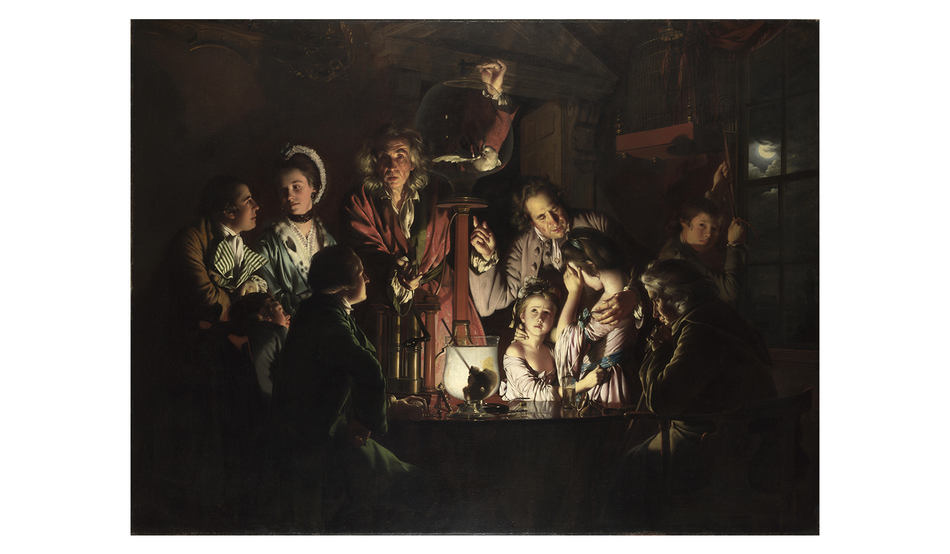
Joseph Wright of Derby’s painting An Experiment on a Bird in the Air Pump (1768) is not really an experiment on a bird—it’s an experiment on the people watching. How, it asks, will spectators react to a cockatiel trapped in a giant, airless jar, thrashing for its life? Some despair; others are grimly fascinated. In the centre, a ragged scientist stares provocatively out of the frame. Look a little closer, he seems to say: this is also an experiment on you.
Having long been part of the National Gallery’s permanent collection, Air Pump has now been whisked to the centre of its new exhibition of Wright’s work, subtitled “From the Shadows”. The show is meant to position Wright as one of the foremost painters of the 18th century, but its greatest success is in gathering all of Wright’s candlelit creations together in one room. Stricken, rosy faces call to each other from different walls. It’s not always clear what illuminates each scene: in Air Pump, the light emanates from a mysterious lantern, a skull concealing it from view.
That skull might make Air Pump a vanitas, about the frailty of life, but the painting is most known as a chiaroscuro emblematic of the Enlightenment era—science ushering us from darkness into light. See the awe and terror on the children’s faces here—now remember that such expressions were normally reserved for God.
That it’s a group depicted here, rather than a sole inventor, is key. You have the lovers more engrossed in each other than the experiment; and my favourite, the man in the foreground, staring into the light like a crystal ball. A few of the people are clearly family—there’s a father encouraging his daughters to look—but otherwise they’re a ragtag bunch. Wright is reminding us that the Enlightenment spread through all of society: aristocratic family portrait this is not.
And plenty would have related to the scene. Air pump experiments, at first rare, had grown into ticketed events in town halls up and down the country, shocking and entertaining in equal measure. But their purpose was originally scientific: to prove the existence of “air” by taking it away, just as here, oxygen is being pumped out of the glass vessel containing the bird. The scientist holds the controlling valve in one hand, meaning he hangs off a kind of moral precipice: will he close the valve, and kill the bird?
But it’s possible that the bird’s life isn’t at stake at all—and we, like the children, are being overly scandalised. Some air pumps came complete with stopcocks, letting the user restore the pump’s air at the last second, revive the bird and impress your audience with a resurrection-esque miracle. That might be why some of the spectators in Wright’s painting look so unconcerned. They’ve seen this party trick before.
Wright would have known such scenes well too. Having trained in London as a 16-year-old, he later moved back to his hometown of Derby where he quickly became housebound with deep depression and severe asthma. It was his doctor who encouraged him to meet the scientific Lunar Society, so called because they would choose to meet on full-moon nights when they could walk back safely from their day-long discussions. (The moon seen poking through a window from one corner of this painting is Wright’s little nod to them, even though a boy is just about to draw the curtain over its distracting beams.)
I first saw Air Pump as a child. Like the girl at the centre, I couldn’t look away. If I remember it correctly, other children there were just as disturbed. Is it the sheer life-like size of it that unsettles? The eyes of the scientist, that might just haunt your dreams?
I was no closer to knowing when I saw it again at the gallery’s recent exhibition, but I did find myself moved. Air Pump has been London’s jewel for 150 years: it has seen millions pass it by. And it has seen us slide into a new age now, too—but unlike these striking figures our faces gaze downwards, and they’re lit by a different kind of light.
Wright of Derby: From the Shadows is on display at the National Gallery until 10th May