Tom Krone keeps a round chambered at all times. He never leaves home without a spare magazine, a flashlight, a knife and a tourniquet. When he enters a room, the first thing he does is identify the nearest exit and check if anyone is wearing a duster coat that might conceal a weapon. He avoids taking showers because being naked puts him at a “major tactical disadvantage”. To the domesticated foreign observer, Tom’s life is a form of camp.
At times, it is hard not to laugh at the modern American male. Whipped into a dystopian fervour by Bruce Willis and Sly Stallone flicks, he skulks around Costco looking for tactical cover lest something should go down—neon-coloured foodcourt slushy in one hand, Daniel Defense DDM4 V7 tactical rifle in the other. You never know when a roving “bad guy” might emerge from behind a pallet of Chocolate-Frosted Sugar Bombs and go berserk. “A stranger asking for the time was an opponent to defeat, or else be defeated by,” writes the sociologist Harel Shapira, who spent four years shadowing men like Tom for his book Basic Pistol.
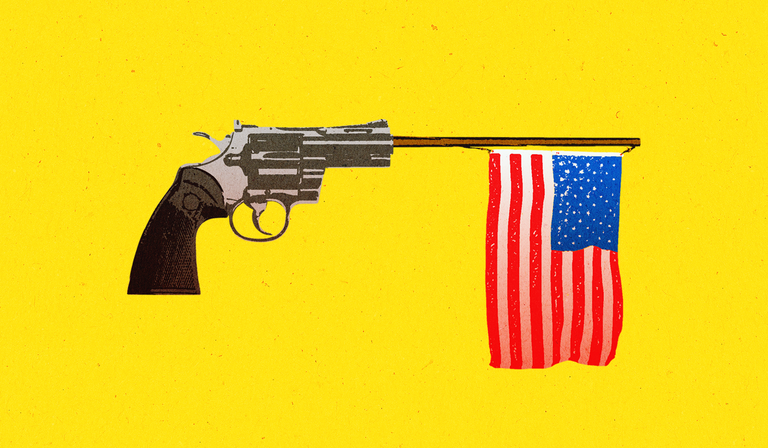
Until the 1980s, gun ownership in the United States was mainly tied to hunting. Since then, the American middle class has become increasingly preoccupied with “self-defence” and seven in 10 Americans who today own a gun say they do so for protection. Hunters are now in the minority.
The law has gradually come to reflect this fixation on personal safety. Before Florida liberalised its firearms laws in 1987, only five states required authorities to grant concealed-carry permits to applicants who met certain conditions. Today, concealed carry is legal in some form in every state, and 29 allow it without a permit. A 2022 Supreme Court ruling further restricted the ability of states to deny permits to people who could not demonstrate a special need to carry a weapon. More assertive laws, such as “stand your ground”, have meanwhile granted certain immunities from criminal prosecution and civil lawsuits, in certain circumstances, to people who use deadly force in self-defence.
In The American Way of Killing, Malcolm Gladwell looks at some of the “dishonest conversations” Americans are inclined to have with themselves about guns. He cites the periodic calls for prohibitions on assault rifles as an example. Democratic politicians, desperate to be seen to be doing something in the aftermath of a mass shooting, dredge up talk of banning semi-automatic versions of these weapons. This may assuage the immediate anger of the bereaved, but it has about as much practical bearing as all the obligatory “thoughts and prayers”. “The inventory of rifles not covered by the assault rifle ban is almost four times longer than the formal language of the ban itself,” writes Gladwell.
The next “dishonest conversation” concerns the Second Amendment to the US Constitution— “A well regulated Militia, being necessary to the security of a free State, the right of the people to keep and bear Arms, shall not be infringed”—which, according to Gladwell, pro-gun Americans are apt to cite “without regard to the motivations of the men who conceived of it back in the eighteenth century”. Those men, he argues, were mainly concerned with appeasing slavers in the American South, who relied on armed militias to keep their chattel out in the fields.
Gladwell’s slight book is the fruit of a podcast series—and it shows. Basic Pistol is a nuanced, ethnographic journey into the heart of American gun culture that overflows with hard-earned insights, whereas The American Way of Killing is a whistlestop tour of the legal, political and statistical evasions that have brought America to where it is. But constitutional archaeology can only take us so far in explaining the growing American penchant for firearms.
If Gladwell deals with how liberal gun laws came into being, Basic Pistol investigates the culture that sustains them. The most important thing to understand is that lives are built around guns as well as destroyed by them. As Shapira observes, Americans do not stock up on firearms simply because the Constitution says they can; they are steadily turned into people for whom killing another person becomes imaginable as a rational, responsible and even moral act.
During his time embedded at the Tactical Training firearms school in Texas—one of several pseudonymous names in his book and therefore in this review—Shapira alights on something I noticed during my own undercover excursions into the manosphere. Not only is Tom’s masculinity, as Shapira puts it, “premised on his rejection of femininity”, but male intimacy is deemed acceptable only under the cover of hypermasculinity. Pickup artists will talk openly with each other about sexual failure; gun fanatics will readily admit to being scared while learning how to destroy another human being. Vulnerability is permitted in the pursuit of invulnerability.
The men who inhabit such spaces talk a lot about “mindset”; yet the mindset in question has only two gears—vigilance and paranoia. Shapira encounters one gun instructor who avoids gas stations whenever possible because, as he puts it, they are places where “predators and prey are forced to interact”.
Seven in 10 Americans who today own a gun say they do so for protection. Hunters are now in the minority
These men, ready to drop the hammer wherever and whenever—in line at Walmart, as they pick up the kids from school, when a beggar is weaving through traffic to mooch a dime—believe they are responding rationally to the experience of crime. “Train like your life depends on it,” Tom tells the author, “because it does.”
Many of his fellow citizens apparently share this belief: there are now more guns in circulation than there are Americans.
Yet, as Gladwell points out, rather than making Americans safer, the sheer ubiquity of guns increases the likelihood that ordinary disagreements will spill over into deadly violence. Most shootings do not occur as a result of planned acts of criminality; instead, they are forms of “expressive violence”. In a world that is overflowing with guns, red mist is a greater threat to human life than any criminal mastermind.
Like so much else in America, fear and profit are locked in a fatal embrace. At gun schools across the country, safety advice is interspersed with sales patter. Exhortations to remain “vigilant” are, as Shapira observes, “tied to a product being sold or a service rendered”. Meanwhile, every firearms instructor has a bootstrapping origin story down pat. Once upon a time I was weak, now I am strong. Taking this course made me who I am today. Train hard enough and you can be like me. They jack up your cortisol levels and then hit you with a hyperenergetic sales pitch. Killing and making a killing go hand in hand.
The “history wars” may not be as important as Gladwell seems to think; The American Way of Killing features an at times pedantic retelling of the Supreme Court squabble over the true meaning of the Second Amendment. Yet Gladwell does supply several illuminating facts. Black people in the United States are around seven times more likely to be victims of homicide than white people. In certain quarters, this is blamed on rap music and a “culture of violence” among black Americans, yet Gladwell draws attention to another, less frequently discussed factor: disparities in emergency medical care. Black victims of gun violence can face longer journeys to specialist trauma centres, reducing their chances of survival. His pithy formulation: “The homicide rate is gunshot wounds minus doctors.”
And minus police. The US incarcerates people at roughly five times the rate of western European countries, yet employs fewer police officers per head of population. One New York police chief tells Gladwell that, once you grasp that most murder is expressive, you understand the value of having lots of police officers. They can intervene before things escalate; they also have the time “to know their communities and spot problems before they spiral out of control”.
In this light, Gladwell argues that some of the calls to “defund the police” following the killing of George Floyd in 2020 rested on a misdiagnosis. As he puts it, “Many Americans decided that their country’s problem was that it had too many police officers, when in fact its problem was it had too few.”
There are around 3,500 instructors like Tom teaching men and women (though mostly men, who are mostly white) the essential business of taking down bad guys. As Wayne LaPierre, then executive vice president of the National Rifle Association, declared after the Sandy Hook school shooting in 2012, in which 20-year-old Adam Lanza shot and killed 26 people, mostly children, “The only thing that stops a bad guy with a gun is a good guy with a gun.” Tactical Training exists to turn them out with assembly-line regularity.
The catch in the chamber, of course, is that good guys also kill lots of innocent people. We learn that Michael, another instructor at Tactical Training, shot and killed an unarmed man who had broken down his front door. And nobody, least of all Shapira, is particularly surprised. Isaac, the victim, ticked all the requisite boxes: he was male, black and mentally unwell.
Fortunately for the boys at Tactical Training, a well-developed lexicon is available to bathe any nascent feelings of regret in the emollient balm of euphemism. Michael had “stopped the threat” and “neutralised” the danger.
It was an earlier crisis of manhood—his sense of having failed to protect his wife when she was sexually assaulted by a stranger—that prompted Michael to equip himself with what, in most other countries, would be considered battlefield ordnance. From that day forward, he was primed to see in the next perceived threat an opportunity to recover his lost sense of masculine authority. Michael feels sad about the killing—though mainly for himself. After all, Isaac (in Shapira’s words) “was like so many other mentally disabled people who appeared in Tactical Training’s lectures… They were a danger to society, to themselves. They didn’t feel pain. They needed to be put down.”
If the average American is unaware, as Gladwell posits, of gun culture’s anti-black antecedents, he or she can hardly ignore its contemporary reflection. Reading Shapira’s book, one is left with an unavoidable impression that a section of America’s white, male population is still waging an undisclosed war against the country’s black population. As Shapira writes: “The vast majority of Tom’s archive of news clippings depicted Black and brown men assaulting people on the street, at gas stations, or in their homes.”
The myth of the good guy with a gun requires a corresponding bad guy. Shapira’s book also features a candid interview with a woman from Firearms Legal Defense, a service for gun owners. “A lot of them are racist, old white men,” she says of her company’s clients. “And they’re mostly scared of Black and brown people.” In a further startling admission, she worries that the work she does is “aiding people in their murder fantasies”.
In Tom’s taxonomy of the world, borrowed from former Army Ranger Dave Grossman’s On Combat, there are three kinds of people: sheep, sheepdogs and wolves. “Sheepdog is what you want to be,” he tells his charges.
And so the gun schools turn out the sheepdogs, while the culture supplies the wolves. Or is it the other way around? Perhaps I simply don’t possess the appropriate “warrior mindset”. Maybe I haven’t found the right course or mentorship package. Or it could be that I am just another sheep.