Across Europe this autumn, we’ve been treated to the spectacle of riots and the theatre of the street. One viral image from Milan showed masked looters passing the door of a baroque Roman Catholic church, only to be met by a raging cleric barring his doors and flipping a middle finger.
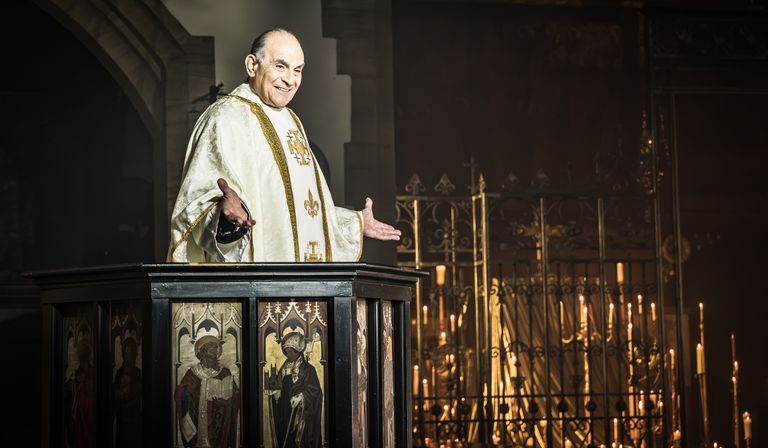
This is not the approach taken by Thomas Becket in TS Eliot’s 1935 play Murder in the Cathedral, where the archbishop’s painstaking piety ensures that no one is denied entrance to Canterbury Cathedral—even when they are assassins hurling threats and waving swords. Just as I left the Orange Tree Theatre’s superb production, which David Suchet leads as a shrewdly obstinate Becket, the gods of the algorithm ensured that the image of Father Giannicola Maria Simone defending his own house of God flashed across my phone. There wouldn’t be much of a play if Eliot’s celebration of voluntary martyrdom had instead featured a fiery priest who fought back against his killers. But it would have made Suchet’s job considerably easier, and our hero considerably more human.
Instead, Tom Littler’s production of Murder in the Cathedral engages with the inviolate and the unearthly: what is sainthood and why does it look so infuriating? In a theatre landscape populated elsewhere by featherlight box-office boosters or by earnest excuses for tick-box diversity exercises, it feels radical to be staging a text so connected with our need for social ceremony and for liturgical scripts, as well as so rooted in a conservative intellectual tradition.
Murder in the Cathedral is a modernist play in the format of a Greek tragedy. We meet a tragic protagonist, a chatty messenger (a likeable Jad Sayegh) and a chorus of women from Canterbury who could match The Trojan Women with their laments for the state of the city and the conflicts of human nature. Becket, of course, was the chancellor-turned-archbishop who resisted Henry II’s attempt to impose secular law on the church and paid for it with his life. As Suchet’s Becket deconstructs the worldly temptations offered him, wryly mocking both the fears of his supporters and the threats of his enemies, he remains simultaneously inspirational and insufferable.
Rather than waste much time on the political ins and outs of 1170, Eliot’s text is interested in the drama of religious sacrifice and the temptations of the martyr’s ego. (Were this Becket confronted by 21st-century looters, he would spend three hours agonising over the vanity trap of going viral on social media before deciding whether to flip that middle finger.) Littler stages this beautifully in the Anglo-Catholic church of St John the Divine in Richmond—although it moves to Bath’s Theatre Royal in November—and the diction across the cast shows that he has broken down Eliot’s difficult and variable verse rhythms impeccably.
The well-networked Littler always brings in established talent at every level: lighting is by Peter Mumford, who constructs the illusion of a much larger space in a cathedral of light, while composer Orlando Gough has scored the choral sections. The chorus itself consists of community newcomers supervised by associate director Francesca Ellis. Despite the mud daubed across their faces to remind us that we’re dealing with medieval peasantry—50 years on from Monty Python, this remains a tired cliché—the overall aesthetic is elegantly Grecian.
The mud daubed across their faces reminds us that we’re dealing with medieval peasantry
The women of Canterbury are not the only pre-modern community on British stages this season. At the Old Vic, Matthew Warchus has revived Martin Guerre 30 years after the first production, which failed to replicate creators Claude-Michel Schönberg and Alain Boublil’s success with Les Misérables.
For a production based on a terrific true story—the Frenchman who seemingly returned to his Pyrenees village in 1556 after eight years away, and was then denounced as an imposter—this is disappointingly flat. But while it’s not worth much of Prospect readers’ time—you’re better off digging up Natalie Zemon Davis’s 1983 book on the story—it feels telling that the Old Vic is turning to the 16th century.
Like Murder in the Cathedral, Martin Guerre is a story of a lynch mob, but it is more concerned than Eliot with public shaming and monsters wielding pitchforks. Here, the individual who clings to her conscience against the pressures of the world is Martin’s dignified wife Bertrande, played affectingly by Liv Andrusier.
Unlike Becket, however, her character is stripped of religious motivation: Warchus has pared back the theological conflict of Schönberg and Boublil’s original. Perhaps he shares the modern assumption that the faiths for which men and women once willingly died are no longer moving to a contemporary theatre audience. Down the river at Richmond, however, Murder in the Cathedral proves him wrong.