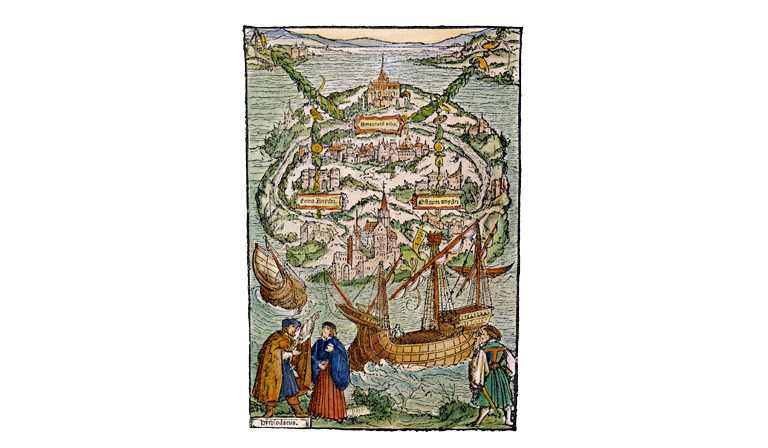
It does not fall to many authors to invent a new genre of writing, but Thomas More was one such. His Utopia first appeared in 1516 and brilliantly fused satire, dialogue, political and philosophical speculation, the fantastic voyages of the Greek-Roman author Lucian (which More had recently translated into Latin), accounts of the new world discovered in the Americas and much else besides. Although an English work, it was written in Latin, published in the Low Countries and belonged to the international culture of humanism whose leading proponent—and representative—was More’s close friend, Erasmus.
Like Erasmus’s most famous work, The Praise of Folly, More’s Utopia is animated by a spirit of relentlessly playful paradox—by contradictions that cannot be resolved without the reader supplying some learned good sense of his or her own, perhaps to conclude that resolution is not always available to human minds. It was written for people who could not only notice that a word like Utopia is a joke (in Greek, it can mean, or sound like it means, both “no-place” and “good place”), but who could be trusted to draw the right conclusions as to why More had bothered with it.
The central disagreement of Utopia is outlined between the two main speakers of Book 1: Morus (the Latinised version of More’s name that, in Latin, also means “fool”) and Hythloday (in Greek, a “speaker of nonsense”). Morus champions a version of the good life that is broadly Roman, and in keeping with the ways in which most early 16th-century Europeans liked to theorise themselves—honour, decorum, status and glory are what make the human condition valuable. Hythloday, though, has travelled to the island of Utopia, the politics and culture of which are modelled on the Greek-Platonic principles of truth, rationality, simplicity, equity and the common good. From this perspective, what Morus defends looks backward, corrupt and inimical to virtuous living.
And yet, when Hythloday provides a detailed description of Utopia in Book 2, the reader is given plenty of pause for thought: about the Utopians’ enthusiasm for euthanasia, for one thing. Utopia is cast as the province of moral vanity as much as of enlightened rationality, its citizens in denial about who and what they are: they like eating meat but delegate responsibility for butchery to their slave class (who are ostensibly treated well but “put to death like wild beasts” if they rebel) on the grounds that doing their own butchery would be an affront to their compassionate self-image. In short, More trusted his readers to recognise that, although there was much to be learned from what one might call utopianism, it was essential to maintain a sense of the way human beings actually are (in all their God-given weakness and complexity) when arriving at a view of how best to govern them.
Unfortunately for More and Erasmus, the weather was about to change. The early- to mid-1510s were, in the literate portions of northern Europe at least, a time of optimism and confidence in the future. But in the two decades after Martin Luther nailed his 95 theses to the door of the Castle Church in Wittenberg, everything changed. Communality of outlook could no longer be assumed; discussion could no longer be free; readers could no longer be trusted. Compare the open-endedness of More’s Utopia with the dogmatism of his Dialogue of Comfort Against Tribulation, written in 1534–35 as he was imprisoned in the Tower of London and awaiting execution for his refusal to disavow the doctrine of papal supremacy in line with Henry VIII’s demands. There feels like far more than 18 years between them.
A new study of More’s life and writing brings all of this superbly into focus. Andrew Hadfield and Joanne Paul’s Thomas More: Humanism and Heresy is accessible, authoritative and attractively produced, with lots of high-quality colour illustrations. It is particularly strong on the challenges of Utopia as a work that resists easy interpretation—and that, in a spirit of self-consciously serious play, was designed to do so for the very good reason that there were no easy answers.
By contrast, most of those who have engaged with Utopia over the past 500 years have fled from its complexity. One still occasionally reads that Utopia puts the case for communism, and at various points it has been made to offer support for everything from colonialism and civic planning to population control and penal reform. As for the many others who wrote utopian works in More’s wake, not all of them shared his goal of trying to make the reader think about the fundamentals of human flourishing—and to think about just how hard such thought is. They instead preferred to outline their own visions of a society as ideal as that championed by Hythloday. In the nicely mischievous words of the art historian TJ Clark, it can therefore seem that utopian writing was “the invention of early modern civil servants” who cared less for the welfare of real people than for the display of their own political (or social/economic/religious/administrative/philosophical) virtuosity. It is not, perhaps, as surprising as it should be that the relationship between utopian writing and eugenics came to be so well established; cases in point include Charlotte Perkins Gilman, Aldous Huxley and works such as Ernest Callenbach’s Ecotopia.
What of Utopia and utopianism in the mid-2020s? Given the stridency of our age and its hunger for simple solutions to complicated problems, one might expect the worst: consider the Silicon Valley billionaire Peter Thiel and his well-paid votaries, who appear to believe that Francis Bacon’s studiously unfinished utopia, New Atlantis, is an exercise in techno-futuristic apocalypticism that can be paired with the manga series One Piece to demonstrate that the hour of the Antichrist is at hand. But our expectations are not always reliable guides. Two recent books on the history of utopianism, though very different from each other, are never less than attentive to the distinctions between utopias as literary texts and utopian thinking more generally.
Joad Raymond Wren’s The Uses of Utopia is on one level a survey of utopian writing from Plato (who didn’t write one but did offer a version of an idealised state in his Republic) to the present day. Most of the usual suspects are here, briskly and intelligently summarised, but there is a lot that’s further off the beaten track, too. I did not know about the Spanish lawyer and bishop Vasco de Quiroga, who in the 1530s used More’s Utopia to argue that the indigenous population of what is now the Mexican state of Michoacán should not be treated as slaves. Hamja Ahsan’s Shy Radicals (2020) outlines Aspergistan, a utopian state for introverted people, governed by “Shyria Law”—and was similarly new to me. It was also good to learn more about Robert Owen’s idealised community New Lanark and the base layers of socialism, romanticism and geometrical fervour on which it rested; likewise, to see William Morris’s News from Nowhere, his 1890 indictment of capitalism and wage labour, given its due. If some readers are likely to take the view that the juxtaposition of Bacon’s New Atlantis with the Afrofuturist state of Wakanda, as imagined in Marvel Studios’ Black Panther franchise, is a Thiel too far, others will no doubt be more appreciative.
Wren, a professor of literature until he quit to become a full-time writer, is always mindful of the dangers in reading utopias for what he calls “blueprints”. Doing so involves neglecting the defining literariness of utopian writing—and, as such, missing the point. As he puts it, “Utopia is, with some exceptions, a literary and philosophical undertaking, an exercise in moral thinking. It’s not a blueprint for revising society, though utopias may contain blueprints or more limited ideas for reform; they can effect change not by providing a blueprint so much as by presenting a challenge.” Any careful reader of More and his inheritors is bound to agree.
It’s just that, for Wren, the challenges are all of a particular sort: political, practical, concerned (albeit through the refracting lens of literariness) to make the world an immediately and materially better place. This works well when reading a Robert Owen, but not so much for a Thomas More.
Utopias are sealed off from the real world by their elaborately sophisticated patterns of recursion and self-referentiality
In Wren’s estimation, although the society described by Hythloday may be imperfect, it is a “communitarian” entity whose citizens are “free from poverty, want and political oppression” and who are therefore “free to experience good health and embrace pleasure”. These are goods whose value is obvious, but for which More was unable to contend “in a political treatise… because he couldn’t have conceived a more literal-minded argument in their favour” than the fictional one he made in Utopia.
A bold claim to make of a writerly intelligence as fertile as More’s, but all I want to emphasise here is that, in permitting himself to make it, Wren gets himself into a muddle. The truth of the matter is that More’s Utopians have pleasurably elevated levels of work-life balance because they can depend on the labours of their slave class. Wren knows this and works hard to demonstrate that Utopian slaves are not really slaves but something more akin to serfs or domestic servants, or what he calls “bondmen”: “Citizens can be made bondmen (and implicitly bondwomen), or servi in the Latin, a word that can be translated as ‘servants’ or ‘slaves’, only for ‘heinous offences’.” Unfortunately, servi not only can be translated as “slaves”, but in this context must be. Something like “bondmen” does appear once in Utopia, but the relevant Latin term is famuli, not servi. And, as Hythloday’s usage is ambiguous, these famuli may be a subgroup of the servi anyway—among whom, Utopians stripped of their citizenship for crimes such as adultery are but one relatively small constituency. More wants us to notice that the Utopian glorification of the state as the guarantor of virtuous living is attained at serious cost to the dignity of human life; we are prompted to challenge Utopian notions of virtue accordingly.
I both enjoyed and admired Wren’s attempt to treat utopian texts as complex works of art rather than grab-bags of political ideas, but his book ultimately disappoints. Reading it is a little like watching a non-striker running into a fine position in front of goal, only to find that they can’t get the ball out from under their feet when the time comes to shoot. Bad luck? Or the fact that they aren’t a striker? We shrug, salute the energy and commitment to the cause that put them in such a good spot, and hope for better next time.
Although Jenny Mann’s The Forms of Utopia addresses many of the questions that preoccupy Wren, it could hardly be more different from The Uses of Utopia. Mann says of her short book, which focuses on early modern examples, that it argues for utopias as “a literary form that, by design, cannot be aligned to stable political content”. Utopias are, for her, deliberately sealed off from the world of political activity by their elaborately sophisticated patterns of recursion and self-referentiality. As such, they are like mathematical or logical formulas that do not stand in imitative relation to life as we have experienced—or might imagine—it.
Mann begins with More’s Utopia, and with one of the letters (written by More himself) with which it is prefaced. By translating both the Latin mendacium dicere and mentior as “to lie” (in fact, mendacium dicere here means “to speak falsehood or untruth”, perhaps unwittingly), she sets up Utopia as a version of the so-called Liar’s Paradox: what are the criteria through which we can assess the truthfulness of one who says “believe me, I’m a liar”? Mann sees this paradox as irresolvable and unable to escape its own contradictions. Its “self-referentiality coupled with the negation of its own truth value” lead to a kind of “infinite regress”. More and the utopian tradition he inaugurates, she maintains, pick this regress up and exploit it to the full, constructing something similar to the “artificial mathematical systems” through which Bertrand Russell and Kurt Gödel sought to tame the Liar’s Paradox: “The uniquely abstract formalization of my argument suggests that Utopia generates its most profound ‘meaning’ precisely because the design of the system makes it impossible to escape its closed and hermetic world.” With enclosure comes wisdom, or at least an acceptance of the provisionality of much that we might like to think of as settled.
In addition to the Liar’s Paradox, Mann is attracted to the labyrinth, the Möbius strip, and the principle of geometric recursion; they provide her with something between models and analogues through which to explain how utopian texts function. The best of her three chapters treats Shakespeare’s The Tempest. This isn’t a utopia and I’m not sure why Mann thinks it is, but she is very good on the play’s structure, and on the ways in which it scrambles our expectations (as playgoers and as readers) of what its structure ought to be doing. She is even better on how these structural games work to collapse the apparent distinctions between the new world and the old, barbarism and civilisation, colony and metropole, around which so much of The Tempest revolves. Finally, a chapter on Margaret Cavendish’s wonderfully uninhibited The Blazing World (1666) opens with 17th-century attempts to square the circle (a series of failures in which Cavendish took an informed interest) and connects these to what Mann calls the “looping” structure of Cavendish’s utopian narrative.
The Forms of Utopia is a demanding read, partly because of its abstraction but mainly because of its self-enclosure: in making its case, it addresses itself with obsessive regularity. The reader only seems to feature as the audience for some missionary zeal about what mathematical and/or logical formalism can reveal about utopian texts. This is a shame because Mann’s idea is a good one. It does a fine job of illuminating the artfulness with which early modern utopias were written, and of warning us off any impulse to read them either straight or as calls to political action. But in allowing her interest in mathematics to shade from a heuristic to an analytical imperative, Mann goes too far.
Thomas More straight-facedly subtitled his Utopia “a truly golden handbook, no less beneficial than entertaining” and maintained that it had been written to explore “the best state of the commonwealth”. If we lose sight of this teasing levity and the lightness of touch for which it calls, our readings and our commonwealths will suffer alike.