In the spring of 1953, a new exhibition opened at the Sidney Janis Gallery in midtown Manhattan. Janis, a rich clothing manufacturer-turned-art collector, was already making a name for himself showing Fernand Léger and Piet Mondrian, as well as the American abstract expressionists. The previous year, Janis had begun showing Jackson Pollock, for many the premier American painter of his age. Still, it is that 1953 show, Willem de Kooning: Paintings on the Theme of the Woman, for which Janis is chiefly remembered.
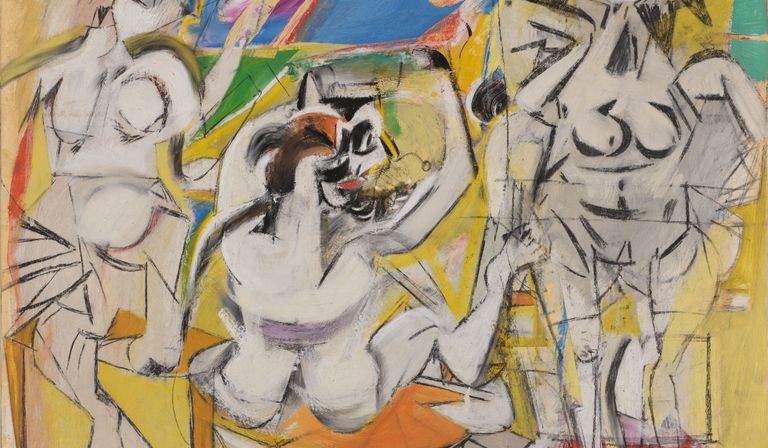
It wasn’t a big show: just six paintings on canvas and 16 works on paper. There was no catalogue, and just a few black-and-white photographs of it survive. At the centre was Woman I, a work of oil, enamel, metallic paint and charcoal that De Kooning had struggled with for two years. In it, he seemed to be retreating from the abstract art represented by his 1950 painting Excavation, which had been selected for the Venice biennale, and returning to figurative art. Yet it was a kind of figurative painting that had never been seen before.
The woman is gawping and her teeth are like “smiling American choppers”, as De Kooning’s biographers Mark Stevens and Annalyn Swan would write half a century later. Her breasts aren’t breasts so much as boobs, her pointed feet as big as rowboats. Clearly influenced by Picasso’s Les Demoiselles d’Avignon, Woman I has always felt monumental, even though it is no more than lifesize. As a portrait of a woman, it is an assault on taste, full of sexual tension and almost embarrassing to look at. “The gallery was crowded every day,” one critic wrote. “And the paintings aroused a great deal of puzzled and sometimes angry discussion.”
Born in poverty in Rotterdam in 1904, De Kooning was brought up by a violent mother who terrified him all his life. A friend smuggled him onto a British freighter bound for the United States and, at 22, the stowaway ended up in New Jersey with nothing but his wits. “I knew one word of English,” he later joked. “Yes.”
Fellow Dutch immigrants helped him get work as a house painter, a trade he had learned as an apprentice at a Rotterdam decorating firm in order to support himself while taking night classes at the city’s academy. For nearly a decade, he painted houses, shops and signboards during the week and worked on his art on Sundays. Gradually, he became known among artists in New York and, with Arshile Gorky, spent hours looking closely at Picasso and other modern painters in the Museum of Modern Art, then later at the newly opened Guggenheim.
De Kooning’s aim was not to draw beauty or real life, but to create works that were both fresh and ancient, surprising yet resolved
The evolution of De Kooning’s life as an immigrant—it would be 42 years before he returned to the Netherlands—mirrored the postwar shift of modern art’s centre of gravity from Europe to the US. A new exhibition at the Rijksmuseum to mark the centenary of De Kooning’s departure from his homeland also shows how a master draughtsman unlearned everything he’d been trained in, to become one of the most original and accomplished artists of the 20th century.
The Rijksmuseum show, a joint venture with the Art Institute of Chicago, has brought together more than 120 works, many of them iconic museum pieces but also a large number from private collections in Europe and the US that have not been seen together for over 40 years.
The show begins with a piece De Kooning did in his last year at the academy, a charcoal still life of a jug and a dish which he worked on for a year . He reckoned it took 600 hours of applied drawing to complete—no erasing was allowed. The result, as meticulous as a black-and-white photograph, shows just how well De Kooning was trained and what an accomplished draughtsman he was, even at a young age.
The artist may not have had his first exhibition until he was in his mid-forties, but he worked every day. The aim was not to draw beauty or real life, but to create, through drawing with pencils, charcoal, wax crayons, pastels, gouache, brushes, tracing paper and cutouts from magazines, works that were both fresh and ancient, surprising yet resolved.
After each successful project, De Kooning did not simply make more of what had been well received; instead, he began something completely new. The scraped-away richness of Excavation—its thick impasto turned over with a palette knife, recalling the flooded polders of the Dutch countryside where farmers folded the wet earth with their spades—gave way to his spiky portraits of women, so influenced by cartoons, advertising and colour magazines.
He could have gone on drawing women, but moved instead to radical abstractions in pastel, in which colours and forms seem to dissolve and blend into each other. Then, in the mid-1960s, he began a series of paintings on wooden doors that had been propped up in his studio, rescued from one of many building projects. In the 1980s, the work shifted again to a gradual yet remarkable simplification of forms in which all his ideas were stripped down to their bare bones and drawing and painting became more and more integrated.
To the end of his life, De Kooning continued to push the boundaries of drawing. He drew when he was drunk (which, in his later years, was often) and while watching television—pad and paper by his knee. He even drew with his eyes shut, just to see what that might produce. As the late New Yorker critic Peter Schjeldahl, who knew De Kooning, once wrote: he wasn’t so much an artist as “a hand with a man attached”.
Willem de Kooning at Work is on display at the Rijksmuseum, Amsterdam, until 17th January