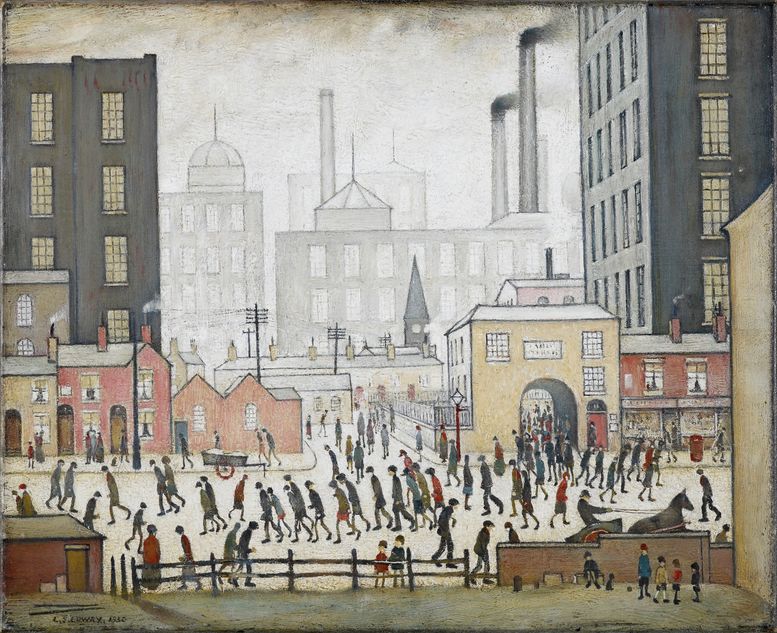
LS Lowry is not who you think he is. He was no outsider, nor was he self-taught. He was not working class, hero or otherwise, nor were his idiosyncratic scenes of Britain’s industrial landscape free of “continental” influence. Fifty years on from his death, what we think we know about Lowry has proven hard to separate from what he has come to represent: an artist of the people, beloved by the general public and prime ministers alike, from Margaret Thatcher to Andy Burnham (who claims him as his favourite painter); a chronicler of an ordinary, peculiarly northern, particularly English way of life that has always been more nostalgic than real. As representations go, these aren’t the worst. But as a new exhibition at the MK Gallery in Milton Keynes makes clear, Lowry is much more interesting—and much weirder—when we consider him beyond mere representations; and even, to some extent, more radical.
Like so many artists of a so-called naïve style, Lowry was, in fact, an able draughtsman: many of his earliest portraits and still lives on show here, mostly done during his decade of evening classes, show a hand that is very capable of rendering people and objects in that much-prized if anonymous style of workshop realism. As he slowly turned towards landscape and street scenes from the late 1910s onwards, some of his tutors and champions—including Adolphe Valette and Bernard Taylor, art critic for the Manchester Guardian—encouraged him to look to the impressionists, particularly for their technique of plein-air painting. Lowry would owe a lifelong debt to impressionism, but the habit of working out of doors never stuck: he virtually never painted from life, his preference being to go about his day making preparatory sketches as he carried out his duties as a rent collector, returning to the safety of home to paint through the night. (But not before reading his mother a bedtime story.)
With this in mind, we can start to understand why Lowry’s pictures have a dreamlike quality that never quite descends into full-throated surrealism: none of his scenes are real, strictly speaking, yet their oddness is tightly and formally controlled.
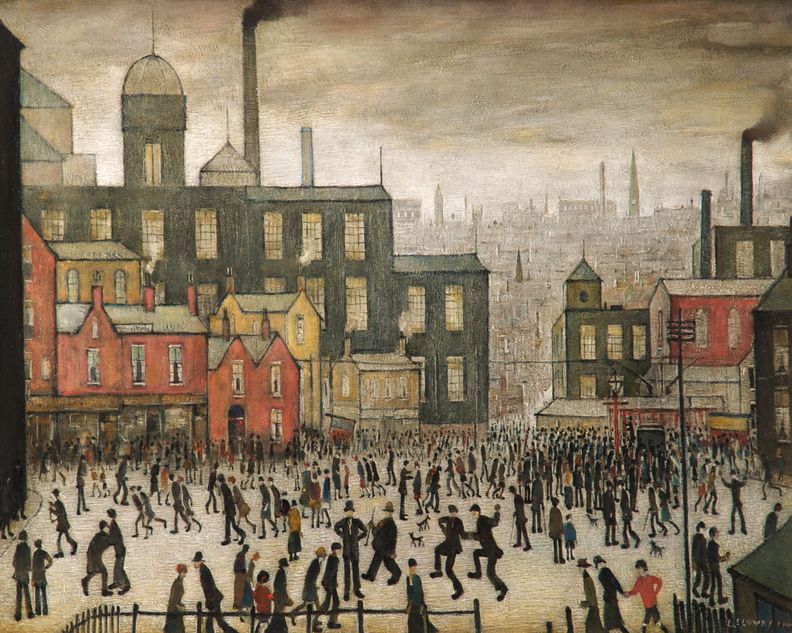
Most of Lowry’s best-known landscapes follow a template. Typically, he divides them into three horizontal bands, with the horizon sitting about two-thirds from either the top or bottom. Sometimes, as in The Mission Room (1937) and Our Town (1941), the perspective is so shallow that there are barely any receding lines; it is this framing that gives his buildings the flimsy, unreal quality of props on a stage. With the vanishing point obscured, it falls to the swathes of smudgy people who populate the scene to imply depth of field.
In the first band of Our Town, the foreground, we see an open area filled with people going about their days; in the second is a line of scraggly black and orange buildings that seem to cascade down to a single opening two-thirds from the left, giving us a glimpse of the third and final band of fainter buildings against a milky sky. It is towards this opening that the people dissolve from distinct, bandy-legged men and women into nothing more than a morass of congealed dots and scratches.
It is impossible to imagine how we would make sense of Lowry’s pictures without the presence of these crowds. And it is perhaps because we depend on them so much in this unusual way that we find them so appealing.
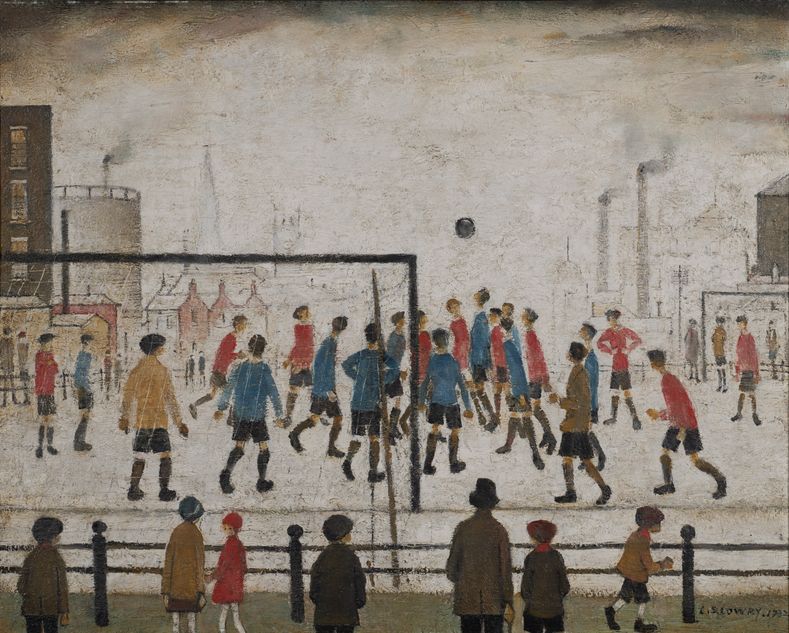
But if this tells us a lot about how we should look at the Lowry we know, the more crucial job of this exhibition is to uncover the one we do not. Beyond his reputation for industrial dreariness is ample evidence of good humour and an eye for camp melodrama, as in A Football Match (1932). Here, signs of the industrial pastoral are limited to just the occasional building or whisp of a chimney held once again in relief against that same, all-pervasive milky sky. Less typically, the plane of open ground is in the second of the three bands rather than the first, where two teams in red and blue jerseys bunch together under a ball—more a tiny black marble—suspended in the air. Looking closely, you can see that, rather than paint the netting between the goalposts, Lowry has scratched a delicate grid of lines. Whereas many of his most famous paintings feel like one interchangeable scene among many in the course of a day, there is nothing humdrum and quotidian here: this is the moment of action. And just look at how much significance is wrapped up in something so small!
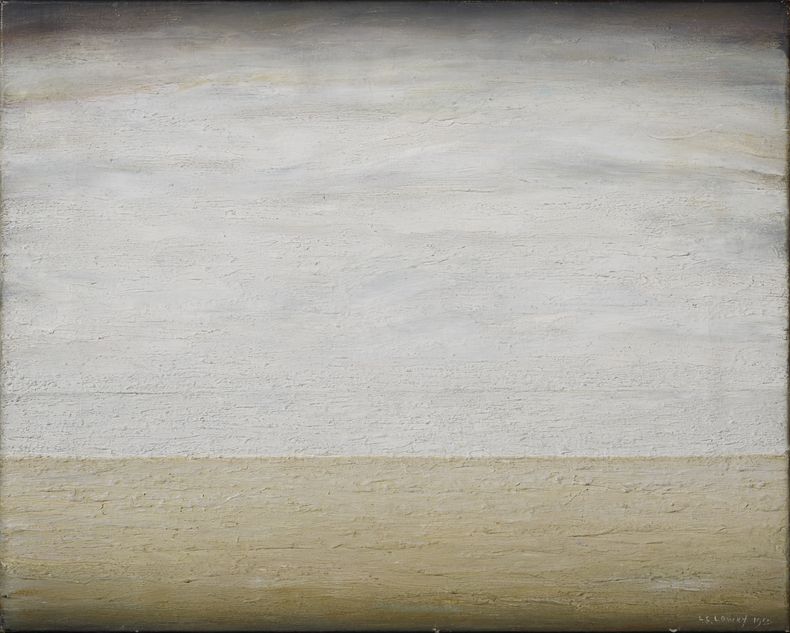
As time went on, and Lowry began to gain modest recognition in Paris and across the British Isles, his landscapes would grow larger and more monumental—such as Industrial Landscape, River Scene (1950), commissioned for the Festival of Britain in 1951—even if the fundamentals remained largely the same: the off-white sky, the three bands, the chimney smoke, the multitudinous crowds. However, his frequent asides into unpeopled seascapes and a more grotesque kind of portraiture—except for the carefully, lovingly rendered Ann, the fictitious muse of this lifelong bachelor—suggest he was never content to simply give the people what they wanted.
Reputations are seldom controlled; John Berger once said it is death that makes everything certain about a person. Yet in Lowry’s case our certainty may have outrun the facts of the man himself. Fortunately, this exhibition offers the opportunity to reappraise who Lowry was and is—and to restore the true eccentric hiding behind the popular image.
Lowry: The Theatre of Life is on display at MK Gallery, Milton Keynes, until 28th February