At the ICA on The Mall in central London—with Buckingham Palace just down the drag—a 1976 exhibition called Prostitution prompted the Tory MP Nicholas Fairbairn to call four young musicians “wreckers of civilisation”.
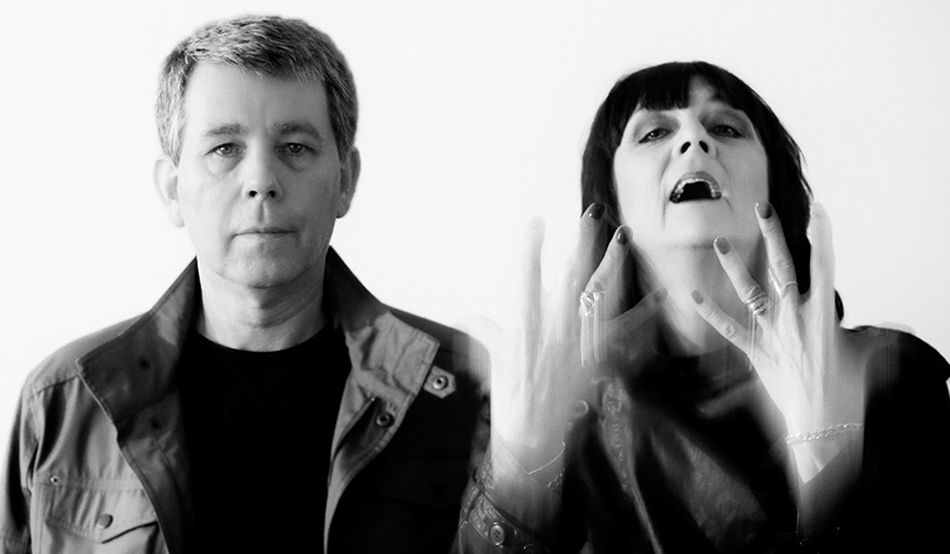
A couple of weekends ago, 50 years to the day since that exhibition, around which the band Throbbing Gristle played their first gig in London, two of those musicians sat in a fancy room at the top of the ICA and, chaired by Luke Turner of The Quietus, reminisced in front of an audience of fans. Cosey Fanni Tutti and Chris Carter, now in their seventies and the sort of softly spoken couple who finish each other’s sentences, felt at first like an unlikely source of so much fury and insurrectionist zeal. Turner asked them about our current retrospective musical culture—which feasts off reissued music and loves nothing better than a good old anniversary—to which Tutti replied that she felt uncomfortable about “being part of history while still being alive”.
Cosey Fanni Tutti—the clue’s very much in her nom de plume—was, in October 1976, the point of connection between an exhibition themed around sex and new ideas of a music that deployed electronic gizmos to smudge, distort and bruise the sounds of guitars and voices. A working-class girl from Hull, she’d come to London, where she worked as a stripper, a model for sex magazines and a porn film actress. It was a way of making money, but also of generating imagery which she diced and spliced, William Burroughs-style, into collages—some of which, 50 years ago, adorned the ICA walls.
Tutti had been a member of a collective called COUM Transmissions, introducing performance art to what had been predominantly a musical concern. It was in COUM that she’d meet two future members of Throbbing Gristle, Genesis P-Orridge and Peter “Sleazy” Christopherson—along with Carter, who, although not a member of COUM himself, knew enough of the people who were. On that Sunday evening, Carter said he’d found COUM performances “hippyish” and already he was hearing in his inner ear things other than “music”—sounds and noises—that he wanted to act upon. When, in the Q&A following the talk, a music geek in the audience—me—asked whether Carter had been inspired by the pioneering electronic music of Edgard Varèse, Karlheinz Stockhausen and John Cage, or by groups like the Velvet Underground or Suicide, he said he’d encountered them only in retrospect. He’d worked for television companies as a sound engineer. His awareness of sound outside music had been instilled through the BBC Radiophonic Workshop and—Spike Milligan over Lou Reed—The Goon Show.
Turner asked Carter and Tutti about the mythologies that have sprung up around Throbbing Gristle’s 1976 ICA gig—could they all possibly be true? Tutti explained that, following complaints about the content of her exhibition, it was presented in an area curtained off from the performance space. The Throbbing Gristle performance was only ever meant to be a backdrop to the exhibition, but that night ended up being COUM’s last outing—as TG made such an impact that it was obvious there was more to be achieved. Tutti remembered violence breaking out when punks turned up and clashed with members of the press. P-Orridge was set upon and sustained a finger injury. At hospital, medics initially assumed the damage to be far worse because of the theatrical blood he’d poured over himself during the performance.
Throbbing Gristle made such an impact that it was obvious there was more to be achieved
If Carter disdained hippies, Tutti, it became clear during the talk, considered TG to be an entity separate from punk. TG is often nevertheless categorised as punk, sometimes as anarcho-punk—there’s punk that isn’t “anarcho”?!—and also as “industrial music”. Writing about jazz, I’ve been prone to wondering whether that form is really a noun or a verb. Jelly Roll Morton believed jazz was a way of doing rather than a body of compositions, “to jazz” being something musicians did to whatever musical material they were handling. Certainly, Throbbing Gristle’s approach was to act directly upon musical material the moment it emerged.
Much laughter from the audience as Carter recalled suggesting to P-Orridge that he didn’t need to sing all the time; TG music could be woven from purely electronic and instrumental sounds. Combining improvisation, electronically sustained drones, mechanical drum machine rhythms and sonic objets trouvés with synthesisers and tape loops, TG rejected conventional notions of song form by chasing sounds wherever they led. Multi-tracking and machines designed to alter pitch and add waves of echo further transformed sound into something intentionally abrasive and volatile.
This first incarnation of Throbbing Gristle crashed out in 1981. But their early albums, such as The Second Annual Report, D.o.A: The Third and Final Report of Throbbing Gristle and (especially) the live Heathen Earth, demonstrate what fine ears they had as individuals, and that their collective hearing was a thing of wonder. Someone asked Carter and Tutti whether they agreed that latter-day TG, after they reunited for six years from 2004, was less confrontational and sonically more beautiful. Carter agreed. Live at the Volksbühne, Berlin, New Year’s Eve, 2005 sounds to me, in between all the sonic ruptures and belching, like a Pythagorean thesis about proportion and pure-toned harmonics. Christopherson died in 2010, P-Orridge in 2020, and Throbbing Gristle died with them.
During a particularly affecting moment, an audience member asked about the group invoking Nazi imagery onstage. Carter remembered that being P-Orridge’s preoccupation, confronting audiences with what was considered suppressed and swerving art away from becoming overly polite (although detractors claimed this showed TG feeding off easy shock value). Tutti remembered growing up in the two decades after the war and the unease her family felt about its horrors, the Holocaust in particular.
Throbbing Gristle’s music retains its power because concept and sound ran in perfect alignment, as the group explored sounds that are usually hidden away, while everyone else pursued rigid definitions of what “music” must be. Wreckers of civilisation? Depends on which definition of civilisation you’re minded to defend, I suppose. Let’s not forget that, after his death, Nicholas Fairbairn was the subject of multiple allegations of sexual abuse.